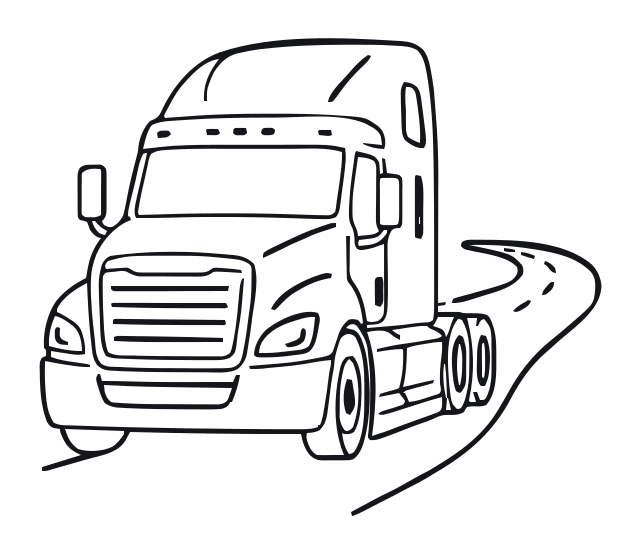
Truck driver
Moves freight between places — and handles everything that goes wrong between the loading dock and the delivery.
This is not a probability of losing your job. It combines how much of the role's task load is exposed to automation with how far adoption has actually gone — useful for comparing occupations on one consistent basis, and for nothing else.
Written for long-haul and regional freight. Urban last-mile delivery, specialised haulage (hazmat, oversize, livestock) and owner-operators face very different economics. Confidence is deliberately low: this is the occupation where public expectation and deployment reality have diverged the most.
What is actually changing#
The unit of analysis is the task, not the job title. A role is not replaced — its task mix shifts.
Highway driving
Automating✓ Evidence-backedThe long, structurally simple middle of a trip — controlled access, predictable lanes, no pedestrians.
This is the most tractable driving environment and the one every autonomous freight programme targets first. Hub-to-hub models exist specifically because the highway segment is separable from the hard parts.
Automating the highway middle does not automate the trip. Hub-to-hub models still require a human for the first and last segments — which changes where drivers work far more than whether they work.
Yard manoeuvring and docking
Still human-led≈ Platform inferenceBacking a trailer into a tight bay, in a yard with people walking around and no lane markings.
Unstructured space, live pedestrians, improvised signalling from dock staff, and a very high cost of a small error. Structured highway autonomy does not transfer here.
Being responsible for the load
Still human-led≈ Platform inferenceSecuring, checking, signing for, and answering for cargo that is damaged, short or refused.
A large fraction of the job is not driving. Someone has to physically verify and legally accept the freight, and that person is currently the driver.
Handling the trip going wrong
Still human-led≈ Platform inferenceBreakdowns, closures, weather, a receiver who will not accept, a gate that is locked.
The exception rate in freight is high and the exceptions are unbounded in kind. Remote-operator models handle some of this, but each remote operator can only cover so many vehicles once things go wrong at the same time.
Remote supervision of autonomous fleets
New task✓ Evidence-backedMonitoring several autonomous trucks from a desk and intervening when one gets stuck.
Where hub-to-hub autonomy is deployed, this role appears alongside it. It is a genuinely new job that reuses driving judgement without the road time.
The ratio matters and is not yet settled publicly. One supervisor per many trucks is the commercial premise; one per two trucks would not change the industry's labour picture much.
Which technologies matter here#
Four separate signals. They are deliberately not added together — a job exposed to two technologies is not twice as exposed.

How it got here#
The index is not a static number. This is where it would have sat at each capability checkpoint since ChatGPT — reconstructed, and labelled as such.
● 2 verified events for this occupation, plotted at the date it happened — the parts of the line near a marker are anchored to something checkable.
Nearly flat for three years, then a visible bend in 2025: that is the point at which driver-out commercial freight actually started running on a fixed lane, rather than being demonstrated. The bend is what a real deployment looks like on a curve — and it is confined to structured highway routes, which is why the level is still below halfway.
A flat line is not a forecast of safety. It says which tasks automation has reached so far — the occupations that moved least here are the ones where the constraint is physical or regulatory, and both of those can change.
Recent changes#
Fixed middle-mile routes on highways and surface streets in Texas, Arizona and Arkansas, serving retail distribution; one remote supervisor oversees several trucks. Says nothing about long-haul, unmapped routes, or the yard and dock work that stays with people.
An employer has put it into production. Can move the baseline — weighted by scale and how similar the setting is.
FreightWaves ↗US, Texas, one interstate corridor, heavy-duty trucks; hub-to-hub with human-handled first and last segments. Expansion to El Paso and Phoenix announced for end-2025.
An employer has put it into production. Can move the baseline — weighted by scale and how similar the setting is.
Aurora Innovation — press release ↗What this means for you#
Long-haul driving remains a genuine route into a stable income without a degree, and the timelines being discussed publicly are longer than the headlines suggest. The sensible caution is geographic and segment-specific rather than general: hub-to-hub corridors in permissive jurisdictions will change first. If you are entering, prefer segments with high exception rates and physical handling — those are the slowest to change.
Your practical exposure over a five-year horizon depends mostly on which corridor and which segment you run, not on the technology in general. The transferable asset is not the driving — it is that you know how freight actually behaves when it goes wrong, which is what dispatch, yard management and remote supervision all need.
Your options#
Four directions, each with its real constraints and one thing you can test this week. Continuing as you are is a legitimate choice — it just has to be a chosen one.
Move to a segment automation reaches last
Specialised haulage, multi-stop regional work and anything with heavy physical handling have the highest exception rates and the weakest automation case.
Some specialisms need endorsements or certifications that take months and cost money.
List the endorsements available in your market with cost and time, and ask two drivers who hold them whether the pay difference is real.
Dispatch and freight operations
Dispatchers need to know what actually happens on the road. Former drivers are better at it than people who have never done the trip.
Desk-based, usually a pay cut in the first year, and requires being comfortable with software all day.
Ask your dispatcher to let you sit with them for two hours. You will learn more about whether you want this than from any article.
Yard, terminal or warehouse operations
Hub-to-hub models increase, not decrease, the amount of work that happens at the hub. That is where the physical exceptions concentrate.
Shift work, and pay varies a lot by employer.
Next time you are at a hub, ask who runs the yard and what they look for when hiring.

Get in early on remote supervision
Where autonomous freight is being deployed, the operators need people with real road judgement. Being early matters because the ratio of supervisors to trucks is still being worked out.
Only exists where these programmes are actually running. Check before planning around it.
Find out whether any autonomous freight programme operates on a corridor you drive. If none does, that itself is your answer for now.
Common questions#
The honest answer is that nobody credible knows, and we will not invent a number. What is more useful: the highway middle of a trip is the tractable part and is being worked on hard; the yard, the load and the exceptions are not. That means the realistic near-term change is where drivers work and what a trip looks like, not whether drivers exist. Watch corridor-level deployments in your own region rather than national headlines — that is the signal that actually applies to you.
Method and sources#
- Assessment date
- 2026-09-09
- Basis of the task judgements
- 2 evidence-backed · 3 platform inference · 0 not enough evidence
- Verified events
- 2