Majors
A major is not one job. Each of these breaks down into the competencies it actually trains and the several directions those competencies can go.
10 majors in the first batch. No rankings and no obsolescence scores — automation acts on tasks, so assessments live on the occupation pages.

English / Foreign languages
4 directionsTrains you to work precisely in a second language — and, less obviously, to research an unfamiliar subject fast and explain it to someone who does not share your context.
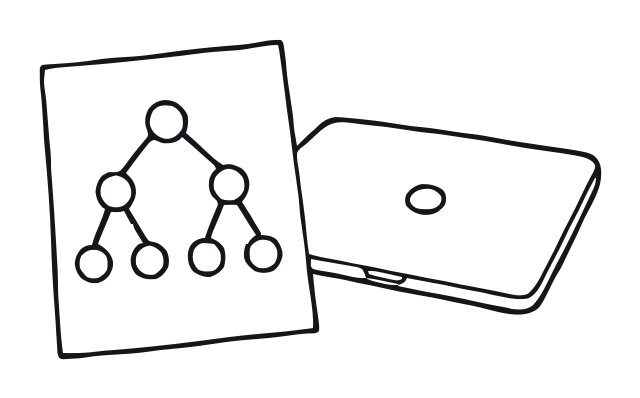
Computer science
4 directionsTrains you to model a problem precisely enough that a machine can execute it — and to reason about what happens when it does that at scale, under failure, and with someone attacking it.

Accounting
4 directionsTrains you to see how money actually moves through an organisation — and to be the person who can say whether a number is defensible.
Psychology
4 directionsTrains you to study human behaviour without fooling yourself — designing a question that could come back with an answer you did not want.

Journalism / Communication
4 directionsTrains you to find out what is actually happening, verify it, and explain it to people who were not there — on a deadline.

Finance / Economics
4 directionsTrains you to price time and risk — what a future cash flow is worth today, why two assets with the same expected return are not the same bet — and to read how institutions actually move money.

Law
4 directionsTrains you to take a messy situation, find the rule that governs it, and argue to a standard where someone who disagrees has to answer you rather than dismiss you.
Visual communication design
4 directionsTrains you to make a visual decision on someone else's behalf — what a stranger sees first, reads second and feels about it — and to defend that decision in a review.

Marketing
4 directionsTrains you to work out who buys, why, and what would make them — then to spend someone else's money on that guess and be measured on whether it was right.
Nursing
4 directionsTrains you to keep a person safe through the hours when no doctor is in the room — to notice deterioration before the monitor does, and to act inside a protocol while still exercising judgement.
Already working rather than studying? Occupation pages break the same analysis down by task. Explore occupations →