 LO
LO
Get told when a verified record lands on this occupation → · Mark which of these tasks are yours (VOLO Pro, free) → · For a team or a graduating class →
First-line manager / team supervisor
The first person above the work: deciding who does what today, noticing trouble before it reaches a report, and answering for a team's output without doing the work yourself.
For one week, write down every time you changed what a system proposed — the roster, a flag, a rating — and what happened afterwards. Five entries tell you whether your overrides are judgement or habit, and that page is the case for being given more of them.
This is not a probability of losing your job. It combines how much of the role's task load is exposed to automation with how far adoption has actually gone — useful for comparing occupations on one consistent basis, and for nothing else.
The first management layer that still touches the work — shift supervisors, team leads and department heads, typically running 5 to 30 people. Senior executives (strategy, capital, headcount plans) and project managers without direct reports are different jobs with different automation paths and are not assessed here. Confidence is low on purpose: this occupation was added because it appears on every org chart, not because the published evidence about it is thick.
What is actually changing#
The unit of analysis is the task, not the job title. A role is not replaced — its task mix shifts.
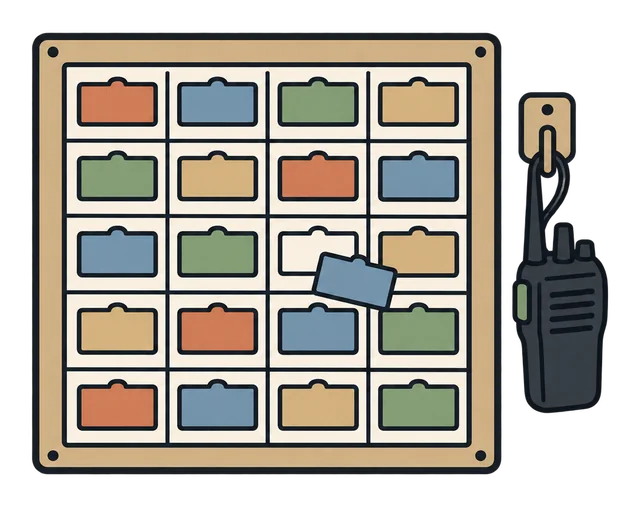
Each tile is one task. Its size is how much of the job it is; its colour is where the task is heading. Click a tile to see what the judgement does not establish.
A roster the machine produced still has to be defended to the person who got the bad shift, and that conversation stays with the supervisor. What automates is the hour of arranging, not the accountability for the arrangement — so this role can lose its most visible daily task and keep the one that makes it a job.
More alerts is not more attention. Where detection got cheap, the usual result is a supervisor triaging a longer list of flagged items in the same hours — the work moved from finding to filtering, which reads as no change at all on a job description.
A drafted review is not a delivered one, and what costs a manager something is saying it out loud to someone who disagrees. It also creates a new failure mode rather than removing one: an assessment assembled from whatever was easy to log quietly promotes whoever is most legible to the system.
Being the least automatable task does not protect the headcount around it. A company can halve its supervisors with this task fully intact — each remaining one simply does it with twice as many people. That is how an irreplaceable part gets thinner without ever being replaced.
The countersigning rule covers one hazardous sector. What automates is the summary, not the selection: deciding that a near-miss is worth the boss's attention this week is a judgement with career consequences attached, and a system that reports everything has effectively reported nothing.
New duties are not new authority. A supervisor asked to explain a system they are not allowed to change carries the blame for it without the power to fix it — a different job from the one they were promoted into, heavier, and invisible on the org chart.
Is this your job? Say so and this page narrows to your share of it.
A job title is a bundle of tasks bought together, and no two people hold the same bundle. Nothing is sent anywhere — it stays in this browser.
Read all 6 tasks in full — direction, reasoning and limits →
Recent changes#
Colorado only. The statutory definition of a consequential decision names employment, so an adverse decision an employer makes with an automated system falls inside this law. One thing this record does not establish needs saying plainly: the law puts the explanation and the review on the deployer, and says nothing about who inside an employer discharges it — it never mentions supervisors. Attaching it to this occupation's tasks is our inference about where the duty lands in practice: on the layer standing closest to the affected person. The law also does not require the review to change the outcome, only that it be meaningful. Duties phase in, with the developer documentation requirement starting 1 January 2027 and the attorney general's rules on post-adverse-outcome disclosure due by the same date.
Failure, rollback, regulation or cost is suppressing adoption. Can lower an assessment or widen its uncertainty.
California. The bill would have required three things: notice to a worker before deploying an automated decision system that makes employment decisions; a prohibition on relying solely on such a system for a disciplinary, termination or deactivation decision; and a right for the worker to request the data the system used. The Governor's veto message gives his reasons: the notification duty was unfocused and would fall on any business using even innocuous tools; the restrictions were overly broad (his example is that barring customer ratings as the primary input removes a tool for rewarding high performers); and the disciplinary and termination scenarios are, in his words, partially covered by forthcoming California Privacy Protection Agency regulations. That last point matters: this record establishes that the specific guardrail SB 7 proposed does not exist, not that California has no protection — separate privacy and anti-discrimination rules are outside its scope.
A rule that would have constrained or required automation was formally proposed and did not come into force — vetoed, voted down, struck down, or allowed to lapse. It establishes something real and checkable about the legal environment: a guardrail many people assume exists does not. It never moves a task's assessment, because it says nothing about what employers can do or are doing.
An OECD policy brief on a survey of more than 6,000 mid-level managers in six countries. It reports that 90% of managers in the United States say their firms have adopted at least one tool to instruct, monitor or evaluate workers, against an average of 79% in the European countries and 40% in Japan; that monitoring tools have an adoption rate of 67% in Europe; that 60% of managers report an increased need for analytical skills and 32% for social skills such as conflict resolution and empathy; and that 60% cite improved decision quality. The brief notes the tools are not necessarily AI-powered, and the respondents are mid-level managers rather than frontline supervisors only.
An employer has put it into production. Can move the baseline — weighted by scale and how similar the setting is.
The Commission's guidelines on the AI Act's banned practices, including Article 5(1)(f), which since 2 February 2025 prohibits AI systems that infer the emotions of a person in the workplace except for medical or safety reasons. The guidelines say the workplace spans offices, factories, warehouses and shops; that a call centre using webcams and voice recognition to track its employees' emotions, such as anger, is prohibited; that systems monitoring the emotional tone of hybrid work teams for conflict prevention are prohibited; and that a call centre tracking its customers' emotions, such as anger or impatience, is not prohibited by that article. The guidelines state that they are non-binding; the ban itself is law.
Failure, rollback, regulation or cost is suppressing adoption. Can lower an assessment or widen its uncertainty.
The European Union. The clause names exactly two things this job does every day: allocating tasks based on individual behaviour, personal traits or characteristics, and monitoring and evaluating the performance and behaviour of people in work relationships. Regulation (EU) 2026/1744 (the Digital Omnibus on AI, published 24 July 2026) moved the application of these obligations from 2 August 2026 to 2 December 2027 for systems that are high-risk under Annex III, and to 2 August 2028 for those that are high-risk under Article 6(1) and Annex I; so this is a rule on the books that does not yet apply. High-risk is not prohibition: it brings obligations — risk management, data governance, logging, transparency, human oversight — and this record cites the classification itself, not the detail of that obligation set. It does not say any employer has been penalised under it, and says nothing about jurisdictions outside the EU.
Failure, rollback, regulation or cost is suppressing adoption. Can lower an assessment or widen its uncertainty.
United States, underground coal mines. The regulation says a certified person must record the action taken to correct hazardous conditions and violations found during the pre-shift examination; that all pre-shift and corrective-action records must be countersigned by the mine foreman or equivalent official by the end of their next regularly scheduled shift; and that records may be kept in a secure book or electronically. The corrective-action records were added by the 2012 rule, effective 6 August 2012. One sector; electronic records are allowed, but the signatures stay with people.
Failure, rollback, regulation or cost is suppressing adoption. Can lower an assessment or widen its uncertainty.
What this means for you#
The usual first rung into management was being trusted with the roster and the weekly report — the two things that automate first. Expect to be promoted straight into the hard half: the conversations. That is a harder start than your own manager had, and the practice they got from doing the easy half is not on offer to you.
What you know about this team — who covers for whom, which two people cannot work the same shift, what your best operator is actually worried about — is in no system, and it is a larger share of why you are paid than it was. The risk is not being replaced; it is being handed two more teams because the roster stopped taking time.
Your options#
Four directions, each with its real constraints and one thing you can test this week. Continuing as you are is a legitimate choice — it just has to be a chosen one.

Own the override, not the roster
Building the schedule is leaving this job; being allowed to overrule it is not. The supervisors who stay valuable are the ones whose override sticks — and who can say afterwards why it was right.
Override authority is granted by people who have been burned by a bad one, and it usually arrives only after a run of small correct calls. It also makes your mistakes attributable in a way that following the system never is.
For one week, write down every time you changed what a system proposed — the roster, a flag, a rating — and what happened afterwards. Five entries tell you whether your overrides are judgement or habit, and that page is the case for being given more of them.

Decide what the system is allowed to decide
Somebody has to set which calls the scheduler makes alone, which need a human, and what happens when it is wrong. In most companies nobody owns this, and it is being settled by default — usually by whoever configured the tool.
It is a governance job dressed as a settings screen, it competes with your operational number, and it only becomes a real role if someone above agrees it is one. The common failure is doing it for a year unpaid and then asking.
List the last ten decisions your scheduling or rating system made without a human, and mark each: fine, should have been checked, caused a problem. Bring the three counts to your manager. Counts move this conversation; opinions do not.
Move to where the work is physical and variable
Allocation automates fastest where the work is uniform and the constraints are clean. Sites where the job changes with weather, terrain, a customer's building or a safety call keep more of the decision with the person standing there.
It usually means shift work, a site rather than an office, and a first year where you are worse than the person you replaced because you do not know the site. Domain knowledge here is physical and takes time you cannot compress.
Ask one supervisor on a site like that a single question: what did you have to change this week that no schedule could have predicted? If they cannot think of one, that site is closer to yours than it looks.

Cross into workforce planning
Deciding how many people a site needs, at what skill mix, against what demand curve, is becoming a function rather than a spreadsheet someone keeps. Supervisors who have actually run the roster know the constraints that never make it into the model.
It pays in salary rather than in the authority you have now, you stop knowing anyone's name, and you will be measured on other people's numbers. It is also a small function: most companies have one of these people, not five.
Take last quarter's staffing and work out, from the raw records, how many people you actually needed each week versus how many you had. Whatever took you longest is the job — and whether that hour was interesting tells you more than any job description.
Common questions#
Not the part where someone has to be answerable to the people in front of them — a commitment has to come from someone who can be held to it. But rostering, reporting and drafting assessments are a large share of a first-line manager's week, and those are automating. The realistic reading is fewer supervisors each carrying more people, not a floor with nobody in charge.
The signal for this job is your span of control, and you can read it yourself. Write down how many people you were responsible for twelve months ago and how many today. If that number has grown while nobody was promoted into the layer beside you, the change has already happened in your building — it arrives as more reports before it ever arrives as a redundancy.
Rostering first, then the weekly report, then the first draft of performance reviews. All three are assembly work over records the company already keeps. Spotting trouble is being assisted rather than removed. The conversation that keeps someone, and being the one who answers for a decision, are the parts nothing on the market currently does.
For the exceptions and for the answering. A scheduler optimises against what it was told; it does not know that one of your two best people is covering for the other this month, and it cannot be the one who explains the outcome to the person it disadvantaged. That is real work — but notice it is work that scales, which is why the honest concern here is span of control rather than replacement.
Use it for the draft, never for the decision, and read what it assembled before it reaches the person. The failure here is not a wrong number, it is a rating built from whatever happened to be logged — which systematically favours the people whose work leaves traces. If you cannot say, in one sentence and without opening the tool, why someone got the rating they got, it is not yours yet and you should not be delivering it.
Studying towards this?
These majors lead here. Their pages break down which of their competencies transfer and what graduates typically lack.
What these judgements rest on#
5 of 6 task judgements on this page are backed by a verified event and 1 are platform inference, each labelled where it appears. Behind them sit 2 technology dimensions, a reconstructed trajectory since language models reached the public, and 6 verified events.
See which technologies, how it got here, and the method →
Where it sits in the official classification: skills, knowledge, related jobs →
Other roles in the same function#
A company divides its work into functions before it divides it into jobs. These sit in First-line management alongside this one — a fact about org charts, not a judgement that they are similar or that they are changing in the same direction.