 LO
LO
Get told when a verified record lands on this occupation →
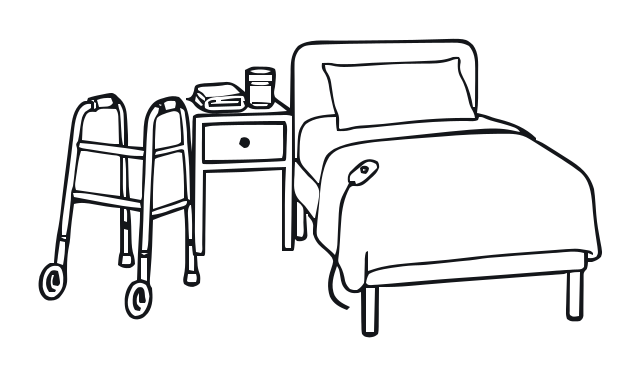
Care worker / nursing assistant
The person who does the physical work of looking after someone who cannot look after themselves — washing, moving, feeding, watching — and who is usually the first to notice something has changed.
This is not a probability of losing your job. It combines how much of the role's task load is exposed to automation with how far adoption has actually gone — useful for comparing occupations on one consistent basis, and for nothing else.
Covers paid personal care in homes, residential facilities and hospital wards. It does not cover registered nurses, who have their own page and a different legal scope, and it does not cover unpaid family care, which is a much larger number of people doing similar work under conditions this page cannot describe. Pay, training requirements and who employs you differ so much between markets that the one thing this page will not generalise is the employment relationship.
The evidence base holds verified records for other occupations, but not one for this one yet. Until it does, the analysis below is reasoning about task structure and known technical capability — for this job in particular it is not backed by traceable sources, and we would rather say so than cite things we have not verified. An empty section here is a gap in our coverage, not a finding about the work.
What is actually changing#
The unit of analysis is the task, not the job title. A role is not replaced — its task mix shifts.
Is this your job? Say so and this page narrows to your share of it.
A job title is a bundle of tasks bought together, and no two people hold the same bundle. Nothing is sent anywhere — it stays in this browser.
The body work
Still human-led≈ Platform inferenceWashing, dressing, toileting, transferring someone from a bed to a chair — physical tasks performed on a person who may resist, be in pain, or weigh more than you.
Transfer assistance is the single most demonstrated robotics task in care and the least deployed, and the gap between those two facts is the finding. A lift demonstration involves a compliant subject and a known geometry; the real task involves a person whose body does not do the same thing twice and who has a right to refuse. Powered hoists have existed for decades and are widely used — they did not remove the worker, they changed what the worker's back does.
Difficult to automate has not translated into pay or staffing anywhere we can verify, and treating that difficulty as security gets the economics backwards: this occupation's problem has never been replacement, it has been turnover, injury and a wage set by what a public budget will bear. A task can be irreplaceable and badly paid at the same time, and this one is the clearest example on the site.
Noticing something changed
New task≈ Platform inferenceRegistering that this person is quieter, or hotter, or eating less, or confused in a way they were not yesterday — and deciding whether it is worth escalating.
This is the task sensors are genuinely aimed at, and the aim is reasonable: continuous measurement catches drift a twice-daily observation misses. What sensors do not have is the baseline — knowing that this particular person is normally like this — which today lives in the head of whoever has washed them for six months and is written down nowhere. Systems that capture the measurement without capturing the baseline generate alarms rather than judgements.
Emerging here does not mean the worker is being replaced on this task; it means the task is being split. The measurement moves to a device and the interpretation stays with a person — but the person doing the interpreting may end up being a remote nurse watching twenty residents rather than the carer in the room, and that is a change in who holds the knowledge, not in whether a machine can care.
The record and the handover
Automating≈ Platform inferenceCharting what was done and what was observed, and telling the next shift what they need to know in the four minutes before they take over.
This is the same automation arriving across every occupation on this page: a conversation or an action becomes structured text, and a person signs it. Care charting is unusually repetitive and unusually disliked, so the adoption pressure is high, and the review step exists because the record is legally consequential.
The handover is not the same thing as the chart, and only the chart is being automated. What one carer tells the next about a resident is mostly the part that never enters a form — who is having a bad week, who will refuse a wash from a stranger. Automating the record without noticing that can make the documentation better while making the handover shorter, and the second is where the safety actually lives.
Being the person who is there
Still human-led≈ Platform inferenceTalking, listening, being known — for many people receiving care this is the majority of their human contact in a day.
Companion devices exist and some people use them, but the value here is not conversation in general — it is being known by a specific person over time, which is a property of continuity rather than of dialogue quality. A device that remembers everything and is never the same presence twice does not substitute; the thing that substitutes for a carer's presence is a different carer.
Saying this is human does not mean anyone is paid for it. In most staffing models this task has no line and no minutes assigned to it — it happens in the gaps of the tasks that are counted. A device that fills those gaps does not have to be as good as a person to be chosen, it only has to be cheaper than adding one, and that comparison is made by a budget rather than by a resident.
Which technologies matter here#
Four separate signals. They are deliberately not added together — a job exposed to two technologies is not twice as exposed.
How it got here#
The index is not a static number. This is where it would have sat at each capability checkpoint since ChatGPT — reconstructed, and labelled as such.
The lowest curve on this site, and the shape is almost a straight line because almost nothing in this job has a mechanism to move. What little rise there is comes from two places, neither of them the hands-on work: charting following the same ambient-documentation route as every other clinical role, and monitoring sensors arriving in facilities. Lifting and moving a person is the most demonstrated and least deployed robotics task we track, and powered hoists — which have been in wards for decades — are the precedent: they changed what a carer's back does without removing the carer. A flat curve here should not be read as security. This occupation's risks are injury, turnover and a wage set by a public budget, and a reconstruction of automation exposure cannot see any of them.
A flat line is not a forecast of safety. It says which tasks automation has reached so far — the occupations that moved least here are the ones where the constraint is physical or regulatory, and both of those can change.
Recent changes#
No verified events recorded yet.
This section will fill from the monitoring pipeline as events are collected, de-duplicated, graded and linked to the tasks above. An empty list here means we have not verified anything — it does not mean nothing is happening.
"We found no news" is not the same as "you are safe."
What this means for you#
This is one of the few occupations on this site where the entry ladder is not being pulled up — the shortage is real and hiring is not the constraint. What you should look at instead is what the job costs you: injury rates, whether hoists and second pairs of hands are actually available on your shift, and whether the employer counts the minutes the work actually takes. Those decide whether you are still doing this in five years, far more than any technology will.
The knowledge you hold that nobody has written down — the baseline for each person — is about to become valuable to somebody building monitoring systems, and it will be extracted from you without being paid for unless someone notices. If your organisation is installing sensors, the question to ask early is who decides what counts as normal for a resident, because today that is you and tomorrow it may be a default setting.
Your options#
Four directions, each with its real constraints and one thing you can test this week. Continuing as you are is a legitimate choice — it just has to be a chosen one.
Be the one who sets the baseline
Monitoring systems fail on false alarms, and the fix is always somebody who knows the individual. That person has leverage in a facility that has just spent money on sensors.
It requires the employer to admit the system needs tuning, which usually happens only after the alarms have already annoyed everyone.
Pick three residents and write one sentence each on what normal looks like for them. If no such sentence exists in their file, you have just found the gap.
Take the clinical step up
Several systems have widened what trained care staff may do — medication administration, wound checks, some assessments — because they cannot recruit enough nurses. The widening is where the pay is.
It is real training on your own time in most places, and the responsibility rises faster than the pay does.
Find out exactly which tasks your grade is permitted to do where you work, and which the grade above adds. The gap between those two lists is the ladder.
Common questions#
Care is the most demonstrated and least deployed robotics application we track, and the distance between those two facts is the answer. Lifting and moving a person is hard for reasons that do not get easier with better software: the body does not behave the same way twice and the person can refuse. Powered hoists have been in wards for decades and they changed what a carer's back does without removing the carer. Expect monitoring to arrive long before manipulation does.
The wrong question for this job, and we will not answer it with a date. The signal that actually predicts your working life here is not technology at all: it is whether your employer staffs to the minutes the work takes or to the minutes the budget allows. Watch whether sensors arrive as an addition to staffing or as a justification for reducing it — that decision is made in a meeting, it gets made within months of installation, and it is the one that matters.
That is the business case most vendors make, and it is worth reading closely, because the saving is usually claimed on the observation rounds rather than on the hands-on work. A sensor can tell you someone got out of bed; it cannot help them back into it. Where this has gone wrong it has gone wrong the same way each time: the rounds were cut, the alarms went to fewer people, and the response time got longer while the chart looked better.
Safe from automation and safe as a career are different claims, and only the first one is supported here. This occupation's real risks are injury, turnover and a wage set by what a public budget will bear — none of which a robot has anything to do with. Treating the difficulty of the work as job security gets the economics backwards: the work being hard to replace is exactly why it has stayed cheap, because the people doing it have had nowhere else in the sector to go.
Method and sources#
- Assessment date
- 2026-09-14
- Basis of the task judgements
- 0 evidence-backed · 4 platform inference · 0 not enough evidence
- Verified events
- 0