 LO
LO
Get told when a verified record lands on this occupation →
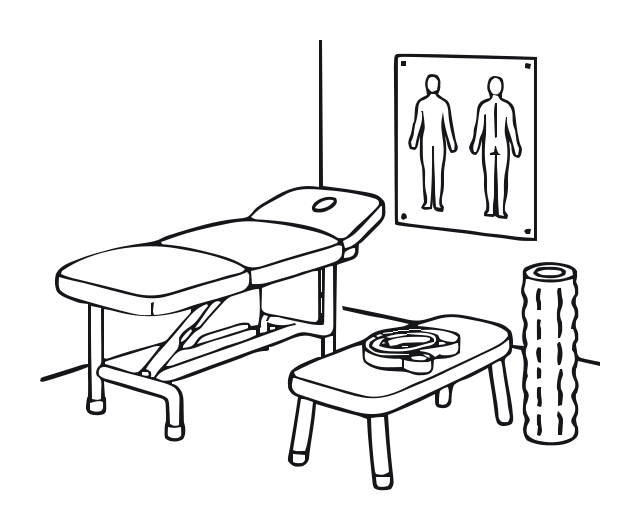
Physiotherapist / rehabilitation therapist
Gets movement back: assesses what is actually limiting someone, treats with hands and exercise, and keeps them doing it for the twelve weeks it takes.
This is not a probability of losing your job. It combines how much of the role's task load is exposed to automation with how far adoption has actually gone — useful for comparing occupations on one consistent basis, and for nothing else.
Covers musculoskeletal and general rehabilitation in clinics, hospitals and community settings. Specialised neurological and paediatric rehabilitation differ substantially. Whether you are paid per session by an insurer or salaried by a hospital changes the pressure on this job more than any technology, because it decides how many minutes each patient gets.
The evidence base holds verified records for other occupations, but not one for this one yet. Until it does, the analysis below is reasoning about task structure and known technical capability — for this job in particular it is not backed by traceable sources, and we would rather say so than cite things we have not verified. An empty section here is a gap in our coverage, not a finding about the work.
What is actually changing#
The unit of analysis is the task, not the job title. A role is not replaced — its task mix shifts.
Is this your job? Say so and this page narrows to your share of it.
A job title is a bundle of tasks bought together, and no two people hold the same bundle. Nothing is sent anywhere — it stays in this browser.
Working out what is actually limiting them
Still human-led≈ Platform inferenceWatching someone move, testing what hurts and what does not, and finding the cause that is often somewhere other than the pain.
The input is a physical examination performed by hand plus watching a person move, and the diagnostic move is a hypothesis tested by touch — press here, resist this, now walk. Motion capture measures movement well and is genuinely useful; what it does not do is decide which movement to ask for, which is the assessment.
Hard to automate and easy to shorten: in session-limited systems the assessment is the part squeezed first, because it produces no treatment the payer recognises. A task can be eroded by a fee schedule without any technology touching it, and in this occupation that has already happened.
Treating with your hands
Still human-led≈ Platform inferenceMobilisation, manipulation, soft tissue work — and adjusting what you are doing based on what you feel while doing it.
This is closed-loop physical work on a person, where the control signal is tissue resistance felt through the hands and the patient's response moment to moment. Robotic rehabilitation devices exist and are used, but they deliver prescribed movement rather than responsive treatment — they are the exercise, not the assessment of it.
Durable and under pressure from a different direction: several systems are moving away from paying for hands-on treatment toward paying for exercise prescription, on evidence grounds rather than cost grounds. A task can be defended against automation and defunded by a guideline in the same decade.
Designing the programme
Being augmented≈ Platform inferenceChoosing the exercises, the load and the progression for this person's job, sport and patience.
Programme design from a diagnosis and a set of constraints is squarely what software does well, and app-delivered exercise programmes are widely deployed. The selection improves with a library; what does not transfer is knowing that this particular patient will not do three sessions a week and choosing the programme they will actually do.
A better programme that is not performed is worth nothing, and adherence is the binding constraint in this field rather than programme quality. Automating the design without addressing adherence optimises the half that was not the problem — which is the most common mistake made by products entering this market.
Keeping them doing it
Still human-led≈ Platform inferenceThe twelve weeks after the pain stops: noticing they have quietly stopped, finding out why, and changing something so they start again.
Adherence is the whole of outcome in rehabilitation and it is a relationship rather than an instruction. Apps send reminders and reminders are what people ignore; what changes behaviour here is a specific person expecting to see you and noticing, which is the same mechanism that makes a coach work.
This is the task with the strongest claim to being the profession's core value and the weakest claim on a payer's schedule: a check-in call is not a billable session in most systems. Where it is unfunded it happens in the therapist's own time, and where it stops happening the outcome falls for reasons no dataset attributes correctly.
Which technologies matter here#
Four separate signals. They are deliberately not added together — a job exposed to two technologies is not twice as exposed.
How it got here#
The index is not a static number. This is where it would have sat at each capability checkpoint since ChatGPT — reconstructed, and labelled as such.
One of the flattest curves on the site, and the small rise it has belongs entirely to programme design — choosing exercises, loads and progressions from a diagnosis and a set of constraints is what software does well, and app-delivered exercise is widely deployed. It stops there because assessment and hands-on treatment are closed-loop physical work in which the control signal is tissue resistance felt through the hands, and because adherence, which decides outcome, is a relationship rather than an instruction. The important caution is that this curve measures the wrong threat: the pressure on this occupation comes from the fee schedule, and it pushes in the same direction software does — toward the parts deliverable without the therapist.
A flat line is not a forecast of safety. It says which tasks automation has reached so far — the occupations that moved least here are the ones where the constraint is physical or regulatory, and both of those can change.
Recent changes#
No verified events recorded yet.
This section will fill from the monitoring pipeline as events are collected, de-duplicated, graded and linked to the tasks above. An empty list here means we have not verified anything — it does not mean nothing is happening.
"We found no news" is not the same as "you are safe."
What this means for you#
Entry is protected by licensing and the shortage is real in most markets, so the risk to you is not employment. It is what your sessions are allowed to contain: if the payer funds exercise prescription and not assessment or follow-up, you will be trained into the half that an app can deliver. Choose a first job by how long its appointments are.
The pressure on this occupation comes from the fee schedule rather than from software, and it moves in the same direction software does — toward the parts that can be delivered without you. The argument that works is outcome data on adherence, because that is the one thing an app cannot claim and a payer cannot ignore.
Your options#
Four directions, each with its real constraints and one thing you can test this week. Continuing as you are is a legitimate choice — it just has to be a chosen one.

Go where assessment is the product
Complex and post-surgical cases are funded for assessment because getting it wrong is expensive, and that is the task no motion-capture system performs.
It usually means hospital rather than private practice, which changes both the pay and the autonomy.
Time your last ten assessments. If the average is under fifteen minutes, the fee schedule has already reshaped your job.
Own adherence as a measured outcome
Adherence is the binding constraint on outcome and nobody measures it, which means the first person to bring numbers has an argument nobody can answer.
Collecting it takes effort that is not funded, so it has to start as your own record before it becomes anyone's policy.
Pick ten discharged patients and find out how many are still doing the programme. That number is the argument.
Common questions#
Programme design is the part software does well and app-delivered exercise is widely deployed, so that half is genuinely augmented. Assessment and hands-on treatment are not: both are closed-loop physical work where the control signal is what you feel through your hands. The more useful warning is that the pressure on this job comes from the fee schedule rather than from software — and it pushes in the same direction, toward the parts that can be delivered without you.
No date, and the signal here is a stopwatch rather than a technology. Time your last ten assessments: if the average is under fifteen minutes, the fee schedule has already reshaped your job toward the half an app can deliver, and that happened without any software being installed. Watch what your payer funds, because that decides what your sessions are allowed to contain long before anything automates.
They deliver a programme well and that is a real contribution. The problem they mostly do not solve is the one that decides outcome: adherence. A better programme that is not performed is worth nothing, and reminders are exactly what people ignore. What changes behaviour is a specific person expecting to see you and noticing when you stop — the same mechanism that makes a coach work. Products entering this market usually optimise the half that was not the constraint.
In several systems the funding is shifting away from it toward exercise prescription, and the stated reason is evidence rather than cost — which is worth taking seriously rather than dismissing. What this site notes is the shape of it: a task can hold against automation completely and still lose its funding to a guideline in the same decade. That is a different kind of risk from the one this question usually has in mind, and it is the one currently moving.
Method and sources#
- Assessment date
- 2026-09-14
- Basis of the task judgements
- 0 evidence-backed · 4 platform inference · 0 not enough evidence
- Verified events
- 0