 LO
LO
Get told when a verified record lands on this occupation →
Security guard
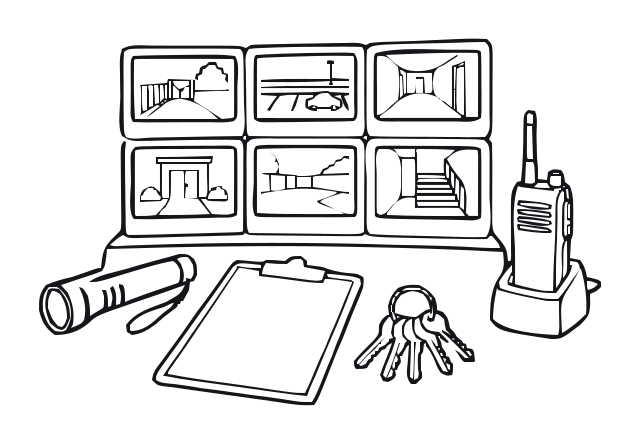
Is present so that things do not happen: watches, patrols, controls who comes in, and is the person who walks toward the situation when there is one.
This is not a probability of losing your job. It combines how much of the role's task load is exposed to automation with how far adoption has actually gone — useful for comparing occupations on one consistent basis, and for nothing else.
Covers uniformed guarding — building entrances, patrols, monitoring, event and retail security. It does not cover police, investigators or specialised protection, which have different powers and a different legal footing. Whether guards in your market have any power beyond observing and reporting changes this job more than any camera does.
The evidence base holds verified records for other occupations, but not one for this one yet. Until it does, the analysis below is reasoning about task structure and known technical capability — for this job in particular it is not backed by traceable sources, and we would rather say so than cite things we have not verified. An empty section here is a gap in our coverage, not a finding about the work.
What is actually changing#
The unit of analysis is the task, not the job title. A role is not replaced — its task mix shifts.
Is this your job? Say so and this page narrows to your share of it.
A job title is a bundle of tasks bought together, and no two people hold the same bundle. Nothing is sent anywhere — it stays in this browser.
Watching the screens
Automating≈ Platform inferenceSitting in front of a wall of camera feeds looking for the thing that is out of place.
This is the clearest automation in the occupation and it is not new: humans are famously bad at sustained visual vigilance, attention collapses within about twenty minutes, and detection software does not get bored. Video analytics is deployed widely precisely because the human baseline on this specific task is poor.
Detection is not response, and every deployment we know of converts a watching post into an alert queue rather than removing the post. The important second-order effect is the false-alarm rate: a system that flags too much moves the guard from watching to dismissing, which is a worse job and, after a few hundred dismissals, a less attentive one.
Walking toward the situation
Still human-led≈ Platform inferenceBeing the person who physically approaches the argument, the intruder, the person who is unwell — and de-escalates it or calls it in.
The value of a guard at an incident is that a person with a uniform is standing there, which changes the behaviour of everyone present. That is a social fact rather than a technical one, and no sensor substitutes for it — the robot patrol units deployed in retail and transit are explicitly specified as observe-and-report and route their alerts to a human.
The task holding does not mean the headcount holds, because the usual design is fewer guards covering more ground with faster alerts. A site can halve its guards and keep response times by adding cameras — the task survives intact and the roster does not, which is the most common shape of change in this occupation.
Controlling the door
Automating≈ Platform inferenceDeciding who comes in: badges, visitors, deliveries, the contractor who is not on the list but is expected.
Access control is a solved engineering problem and has been for years: badges, turnstiles, visitor kiosks and remote verification handle the rule-following portion completely. What remains at the door is the exception, and the exception is exactly what the system escalates to a person.
Automating the rule does not settle who takes responsibility for the exception, and in practice the exception is where every real incident starts. Sites that removed the staffed door and kept only the turnstile have generally re-added a person for reception rather than security reasons — worth knowing, because it means the post can come back under a different name and a lower grade.
The log and the report
Automating≈ Platform inferenceRecording patrols, incidents and handovers in a form that will stand up if it is ever read in an investigation.
Patrol logging has been automated by scan points for a decade and incident reports are the same structured-text problem being solved everywhere else on this site: a person describes what happened, a system formats it, the person signs.
Automating the log changes what the log is for. Scan points prove presence, not attention, and a route that is verified by scans rewards walking it fast — which is the opposite of what the job needs. That trade-off shows up nowhere in the business case for the system.
Which technologies matter here#
Four separate signals. They are deliberately not added together — a job exposed to two technologies is not twice as exposed.



How it got here#
The index is not a static number. This is where it would have sat at each capability checkpoint since ChatGPT — reconstructed, and labelled as such.
The climb is one task and it is the one humans are genuinely bad at: sustained visual vigilance collapses within about twenty minutes, and detection software does not get bored, so video analytics deployed widely on a poor human baseline. It flattens because detection is not response — the patrol robots in retail and transit are specified as observe-and-report and route alerts to a person, and the value of a guard at an incident is that somebody in uniform is standing there, which is a social fact rather than a technical one. The height is about watching. The change to the roster is not in this curve: sites keep response times while halving guards, because the cameras find things faster.
A flat line is not a forecast of safety. It says which tasks automation has reached so far — the occupations that moved least here are the ones where the constraint is physical or regulatory, and both of those can change.
Recent changes#
No verified events recorded yet.
This section will fill from the monitoring pipeline as events are collected, de-duplicated, graded and linked to the tasks above. An empty list here means we have not verified anything — it does not mean nothing is happening.
"We found no news" is not the same as "you are safe."
What this means for you#
This remains one of the most accessible jobs in any city. Where it leads depends entirely on which post you take: a screen-watching post is the one with a mechanism pointed at it, and a post where you control a door and handle people is the one that builds something transferable. Take the second even if it is harder.
The number that decides your working life is guards per site, and it moves after cameras are installed rather than when a guard is replaced by one. If your site is adding analytics, the question to raise early is what happens to response time when the roster shrinks, because that is the argument that has evidence behind it.
Your options#
Four directions, each with its real constraints and one thing you can test this week. Continuing as you are is a legitimate choice — it just has to be a chosen one.

Move from watching to responding
Every analytics deployment creates alerts and none of them creates responders. The post that survives a camera rollout is the one that goes to the alert.
Response posts carry more risk and, in most markets, barely more pay — the premium is in seniority rather than in the task.
Count how much of your shift is spent in front of a screen versus on your feet. That ratio is your exposure, and you can change it by asking for a different post.
Own the false-alarm problem
Every site that installs detection acquires an alert queue nobody tuned, and the person who can say which alerts are worth acting on is the person who has walked the site for two years.
It is systems work inside a job that is not paid to do systems work, so it has to be proposed rather than absorbed.
Log every alert for one week with whether it was real. If the true rate is under one in ten, you have a finding worth a meeting.
Common questions#
They replace one task well: sustained watching, which humans are genuinely bad at — attention on a wall of feeds collapses within about twenty minutes and software does not get bored. What they do not replace is the response, and the patrol robots deployed in retail and transit are specified as observe-and-report for exactly that reason. The realistic change is not a guard being replaced by a camera; it is fewer guards covering more ground because the cameras find things faster.
No date. Watch two things you can actually see: what share of your shift is spent in front of a screen rather than on your feet, and whether the guards-per-site number on your rota has moved since any cameras were installed. The second is where this occupation's change shows up — it happens a few months after installation and it is never announced as a consequence of the system.
Yes, in retail, transit and some campuses, and they are worth understanding precisely: they are specified as observe-and-report, they route alerts to a person, and their deterrent value comes from being conspicuous rather than from being capable. What they change is coverage — how much ground gets looked at — not who deals with anything found. That is why they appear alongside roster reductions rather than instead of a specific guard.
Access control has handled the rule-following part completely for years — badges, turnstiles, visitor kiosks. What stays at the door is the exception, and the exception is where every real incident starts. Worth knowing: sites that removed the staffed door and kept the turnstile have generally re-added a person, usually for reception rather than security reasons. The post can come back under a different name and a lower grade, which is a change worth naming before it happens.
Method and sources#
- Assessment date
- 2026-09-14
- Basis of the task judgements
- 0 evidence-backed · 4 platform inference · 0 not enough evidence
- Verified events
- 0