 LO
LO
Get told when a verified record lands on this occupation →
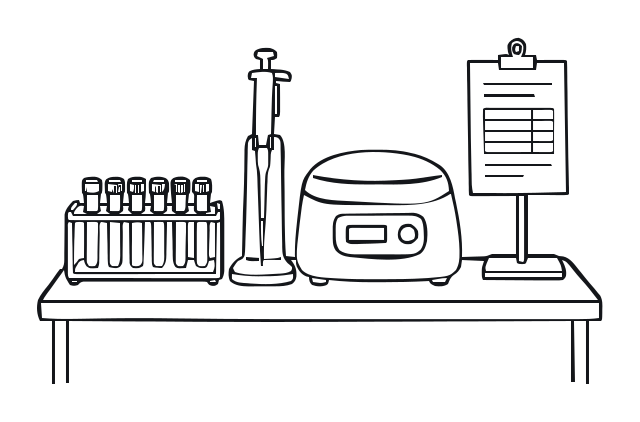
Medical laboratory technician
Runs the tests a diagnosis rests on: prepares the specimen, operates and trusts the analyser, and is the person who decides a result is wrong before it reaches a doctor.
This is not a probability of losing your job. It combines how much of the role's task load is exposed to automation with how far adoption has actually gone — useful for comparing occupations on one consistent basis, and for nothing else.
Covers clinical laboratory work — haematology, chemistry, microbiology, transfusion. Research laboratory work is a different job with different pressures, and pathologists who report and sign findings are a separate role with separate licensing. The degree of automation in your specific lab depends far more on its volume than on its date, because analysers are bought by throughput.
The evidence base holds verified records for other occupations, but not one for this one yet. Until it does, the analysis below is reasoning about task structure and known technical capability — for this job in particular it is not backed by traceable sources, and we would rather say so than cite things we have not verified. An empty section here is a gap in our coverage, not a finding about the work.
What is actually changing#
The unit of analysis is the task, not the job title. A role is not replaced — its task mix shifts.
Is this your job? Say so and this page narrows to your share of it.
A job title is a bundle of tasks bought together, and no two people hold the same bundle. Nothing is sent anywhere — it stays in this browser.
Running the analyser
Automating≈ Platform inferenceLoading, calibrating, and moving hundreds of samples through machines that do the measurement themselves.
This occupation is the most completely automated one on the site and has been since the 1970s: automated analysers replaced manual titration, and track systems later replaced the walking between them. The measurement itself has not been done by hand in most laboratories for a generation, and the current wave adds scheduling and image reading rather than starting anything.
Sixty years of this and the occupation is still here, which makes it the site's clearest counter-example to the idea that automating the core task removes the job. What it removed was the manual method, the entry ladder that taught it and a large share of the headcount per test — the job that remained is supervision of machines, which is a different job at the same title.
Knowing a result is wrong
Still human-led≈ Platform inferenceSpotting the value that is impossible for this patient, the drift that says the instrument needs attention, the specimen that was mislabelled upstream.
Delta checks and rule engines catch the values that violate a stated rule, and they have for decades. What they cannot catch is the plausible wrong answer — a result that is internally consistent and belongs to somebody else — and that is caught by someone who knows what this ward, this analyser and this time of day usually produce.
This task being human does not mean it is staffed: laboratories are sized on throughput, and the person who catches the plausible wrong answer produces no measurable output when they succeed. Where lab staffing has been cut, this is the capacity that went, and the consequence appears as a misdiagnosis nobody traces back.
Handling the specimen
New task≈ Platform inferenceReceiving, spinning, aliquoting, and dealing with the sample that arrived clotted, short, unlabelled or at the wrong temperature.
Track automation handles the compliant specimen completely in high-volume laboratories and is spreading down to smaller ones as the price falls. The non-compliant specimen is the exception the track kicks out, and that exception is a physical judgement about whether the sample can still be used or must be recollected.
Deciding a specimen must be recollected is a decision with a cost that lands on somebody else — a patient stuck again, a delayed result — which is why it stays with a person. But the volume of exceptions falls as the pre-analytical process tightens, so this task shrinks for reasons upstream of the laboratory.
Making the critical call
Still human-led≈ Platform inferenceDeciding a result cannot wait, finding the clinician responsible for this patient right now, and making sure they heard it.
Automated alerting exists and is standard; what is not automated is the closing of the loop, because the requirement is that a person confirms receipt and understanding. Where this has been left to a system, the failure mode is a notification landing in a queue nobody was watching, which is the one outcome the protocol exists to prevent.
This is protected by protocol rather than by difficulty, and protocols are rewritten. A laboratory under staffing pressure will move to automated notification with acknowledgement tracking, which satisfies the audit and moves the risk to whoever is meant to be reading the queue.
Which technologies matter here#
Four separate signals. They are deliberately not added together — a job exposed to two technologies is not twice as exposed.


How it got here#
The index is not a static number. This is where it would have sat at each capability checkpoint since ChatGPT — reconstructed, and labelled as such.
The start is high for a reason that predates this chart entirely: automated analysers replaced manual measurement in the 1970s and track systems later replaced the walking between them, so this occupation entered the period already more automated than any other on the site. The climb from 2023 is scheduling, middleware and image reading in microbiology — an extension rather than a beginning. It flattens because what is left is catching the plausible wrong answer, which needs someone who knows what this ward and this analyser usually produce. Read this curve as the site's clearest precedent rather than as a prediction: sixty years of automating the core task removed the manual method, the entry ladder and much of the headcount per test, and did not remove the occupation.
A flat line is not a forecast of safety. It says which tasks automation has reached so far — the occupations that moved least here are the ones where the constraint is physical or regulatory, and both of those can change.
Recent changes#
No verified events recorded yet.
This section will fill from the monitoring pipeline as events are collected, de-duplicated, graded and linked to the tasks above. An empty list here means we have not verified anything — it does not mean nothing is happening.
"We found no news" is not the same as "you are safe."
What this means for you#
This field automated its core task before you were born and still hires, which is the most encouraging fact on this page and also the most instructive: what it did was remove the manual method that used to teach the judgement. Learn why the analyser does what it does rather than how to load it, because the second is the part the track already took.
The capacity to catch a plausible wrong answer is the thing your laboratory cannot measure and therefore cannot defend in a staffing review. If you want it protected, it has to be turned into a number before the review — how many results you intercepted last quarter and what each would have caused.
Your options#
Four directions, each with its real constraints and one thing you can test this week. Continuing as you are is a legitimate choice — it just has to be a chosen one.

Go where the specimen is difficult
Microbiology, transfusion and anything requiring interpretation rather than measurement is where the track stops and the judgement starts.
These sections are slower, less funded and often the first target for outsourcing to a central laboratory.
Count what share of your day is spent on samples the track could not process. That share is the part of your job that is not throughput.
Own the quality system
Someone has to prove the instruments are producing correct results, and in an accredited laboratory that role is required rather than optional.
It is documentation-heavy work that moves you away from the bench, and the pay premium is modest.
Find your laboratory's last accreditation finding and read what it said. Whoever closes those is doing the job.
Common questions#
This occupation already answered that question, which is why it is worth reading before reasoning about any other. Automated analysers replaced manual measurement in the 1970s and track systems replaced the walking between them; the measurement has not been done by hand in most laboratories for a generation, and the job is still here. What sixty years of automation did was remove the manual method, the entry ladder that taught the judgement, and much of the headcount per test. The job that remained is supervision of machines — the same title, a different job.
No date, and this occupation is better placed than most to see the real signal: count what share of your day goes to samples the track could not process. That share is the part of your job that is not throughput, and it is the part a staffing review cannot cut without someone noticing. The other thing to watch is not technology at all — whether your laboratory's work is being consolidated into a central site, because that moves the job rather than automating it.
It catches the values that violate a stated rule, and delta checks have done that for decades. What it does not catch is the plausible wrong answer — a result that is internally consistent and belongs to a different patient. That is caught by someone who knows what this ward, this analyser and this time of day usually produce, and the uncomfortable part is that succeeding at it produces no measurable output, which is why it is the capacity that goes first in a staffing cut.
It hires, there is a shortage in most markets, and the qualification is a real gate — all of which are genuinely positive. The honest caution is about what you will learn: the manual methods that used to build a technician's judgement are largely gone, and nobody has designed a replacement for how that judgement gets built. If you go in, push early to understand why the analyser does what it does rather than how to load it, because that is the half the track did not take.
Method and sources#
- Assessment date
- 2026-09-14
- Basis of the task judgements
- 0 evidence-backed · 4 platform inference · 0 not enough evidence
- Verified events
- 0