 LO
LO
Get told when a verified record lands on this occupation →
Airline pilot
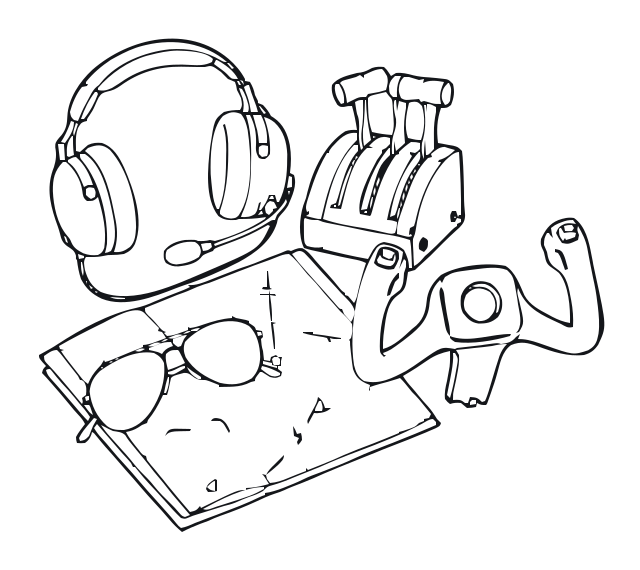
Operates a transport aircraft under a licence issued in their own name — and under a rule that says they may not do it at all unless they have personally landed one, by hand, three times in the last ninety days.
Find your authority's current rulemaking programme and search it for the words crew composition. If something is in consultation, the consultation document will say who it applies to and from when, in plainer language than any news story about it.
This is not a probability of losing your job. It combines how much of the role's task load is exposed to automation with how far adoption has actually gone — useful for comparing occupations on one consistent basis, and for nothing else.
Written for people who fly transport aircraft for a commercial operator: line flying, the decisions the commander is responsible for, and the recurrent training that keeps the licence alive. It does not cover general aviation instructors, remote operators of uncrewed aircraft, cabin crew or maintenance engineers — separate jobs with separate task mixes, and the first two are separate licences. The regulatory evidence here is European, because that is the regime whose text is published as a consolidated act anyone can read; the requirements elsewhere are similar in shape and not identical in number, and nothing on this page is measured outside that regime.
What is actually changing#
The unit of analysis is the task, not the job title. A role is not replaced — its task mix shifts.
Is this your job? Say so and this page narrows to your share of it.
A job title is a bundle of tasks bought together, and no two people hold the same bundle. Nothing is sent anywhere — it stays in this browser.
Read all 6 tasks in full — direction, reasoning and limits →
Recent changes#
Commission Regulation (EU) No 1178/2011 laying down technical requirements and administrative procedures related to civil aviation aircrew, read in its consolidated version in force from 30 April 2026. The provision is FCL.060, Recent experience: a pilot shall not operate an aircraft in commercial air transport or for carrying passengers as pilot-in-command or co-pilot unless he or she has carried out, in the preceding 90 days, at least three take-offs, approaches and landings as pilot flying in an aircraft of the same type or class, or in a full flight simulator representing that type or class. Two things follow and they point in opposite directions, which is why this record links two tasks rather than one. The requirement is written around a named person having personally done the thing, which is a rarer shape than a rule about who may operate a machine. And the same sentence accepts a simulator in place of the aircraft, which is a machine standing in for the very activity the rule exists to preserve. What this establishes is the shape of the obligation, not a measurement: it says nothing about how much of a given flight is flown by hand, how many pilots are employed, or whether crew composition will change - that last would arrive as a separate rulemaking, proposed in public with a comment period. The regulation speaks only for the European regime; other authorities impose requirements of similar shape and different numbers.
Failure, rollback, regulation or cost is suppressing adoption. Can lower an assessment or widen its uncertainty.
What this means for you#
The thing to understand before spending the money is that the gate is a licence, the licence has a running cost, and both are set by rule rather than by an employer. A rating lapses on a date; a medical lapses on a date; and the currency rule means that not flying for ninety days costs you the right to fly at all until you have done three take-offs and landings again. That structure protects the people inside it and it is exactly what makes the entry expensive. What it does not do is tell you how many seats there will be, and this page does not either.
Your leverage is that the rules which decide this job's future are written in public and consulted on in public, and almost nobody in the industry reads them until they are in force. The proposals worth your attention are the ones about crew composition, not the ones about new autopilot modes: an autopilot mode changes what you do on a sector, a crew-composition rule changes how many of you are on it. Being the line pilot who can say what a proposed rule will actually feel like at 3 a.m. is a scarce and requested thing, and it does not require leaving the line.
Your options#
Four directions, each with its real constraints and one thing you can test this week. Continuing as you are is a legitimate choice — it just has to be a chosen one.
Stay, and read the rulemaking instead of the press releases
This occupation's future is decided in a document class that is published, dated, consulted on and slow: licensing and operations rules. A manufacturer's announcement about reduced-crew capability changes nothing on its own, because the aircraft cannot be operated that way until the operating rule says so. Watching the rule rather than the product is the difference between knowing two years early and finding out on the day.
It is slow reading and there is a lot of it, and the part that matters to you is usually three paragraphs inside a hundred pages. It is also a bet that the rule holds, and a rule can change — the point is not that it will not, but that you will see it coming.
Find your authority's current rulemaking programme and search it for the words crew composition. If something is in consultation, the consultation document will say who it applies to and from when, in plainer language than any news story about it.

Move toward training and checking
Everything in this occupation that automation touches has to be trained and then checked, and both are done by other pilots. The licensing rule itself writes simulators into the currency requirement, so simulator capacity is where the money goes when an operator has to convert a fleet or a procedure. An examiner or instructor is holding the part of the system that grows whenever the aircraft changes.
It is a second qualification on top of the one you have, it is assessed, and it changes what your roster looks like — often more days, on the ground, at the training centre rather than at home. It also rewards being able to explain something you long ago stopped having to think about.
Ask your training department how many instructor and examiner slots they are short of this year, and for which fleets. A shortfall concentrated on one fleet is usually a conversion programme nobody has announced yet.
Go where flight operations meets the regulator
Operations engineering, flight safety, and the post-holder roles that sign an operator's procedures are the places where a proposed automation actually gets accepted or refused, and the acceptance test is whether it works on the line — a question only someone who has flown the line can answer. These roles exist because the systems exist, and they multiply every time a new one arrives.
Most of them are based at one place and a roster is not, so this is usually a move of city as well as of job. Keeping your licence current alongside a ground role is possible and is extra work, and letting it lapse removes the exact thing that made you useful in the room.
Find out who in your company signs off a change to a standard operating procedure, and whether any of them are currently line-qualified. If the answer is nobody current, that gap is visible from where you already sit.
Common questions#
Not under the rules as they are written, and the rules are the thing to read. European licensing law does not merely allow a person in the seat, it requires that person to have personally carried out three take-offs, approaches and landings in the preceding ninety days before they may operate at all. A rule written that way is not a statement about what a machine can do — it is a statement about what a named human must have done recently. The honest version of the question is therefore not whether the technology arrives but whether crew-composition rules change, and because those are rules they are proposed in public, consulted on, and dated long before they bite.
We do not answer that with a number of years, and for this occupation the alternative is unusually precise. The thing that would end this job is a change to how many licensed people a commercial flight requires, and that change cannot happen quietly: it is a rule, so it appears first as a proposal with a comment period and a stated applicability date. Watch your authority's rulemaking programme for the words crew composition, and watch whether any proposal has moved from consultation to opinion to applicable regulation. Those three steps are public and take years. That is a clock you can read yourself, and it is more informative than anyone's estimate.
More of it than most occupations on this site, and for much longer. Autopilots, flight management systems and automatic landing have been standard equipment for decades, so a large share of a typical flight is already flown by the aircraft rather than by hand. What has not moved with it is responsibility: the licensed person remains the one the rules hold accountable for what the automation does, which turns flying into supervising rather than removing the seat. One detail is worth noticing because it cuts the other way — the currency rule accepts a full flight simulator in place of the aircraft, so even the requirement designed to keep the manual skill alive is partly satisfied by a machine.
This page cannot tell you that, and anyone who answers it with a number is selling something. What it can give you is the right shape for the question. The cost is large, up front, and paid by you; the protection is a licence that is expensive to obtain and cheap for no one to bypass, because it is written into operating rules rather than into a hiring policy; and the risk is not a machine arriving but a rule changing, which is public and slow. Two things are worth checking before committing, and both are free: whether any crew-composition proposal is currently in consultation at your authority, and what your intended employer's own published hiring numbers did over the last three years.
What these judgements rest on#
2 of 6 task judgements on this page are backed by a verified event and 4 are platform inference, each labelled where it appears. Behind them sit 4 technology dimensions, a reconstructed trajectory since language models reached the public, and 1 verified events.
Other roles in the same function#
A company divides its work into functions before it divides it into jobs. These sit in Operations & fulfilment alongside this one — a fact about org charts, not a judgement that they are similar or that they are changing in the same direction.
Procurement / supply chain specialist · Operations coordinator · Metro train driver · Air traffic controller · Container port worker · Warehouse worker · Truck driver · Delivery rider / courier · Ride-hail / taxi driver · Assembly line worker · Cleaner / janitor · Security guard · E-commerce operations specialist