 LO
LO
DeploymentPhysical automation2022-06-01
Singapore's Civil Defence Force moved to three-person fire sections and put small firefighting robots on its new fire engines
Firefighteroccupation page →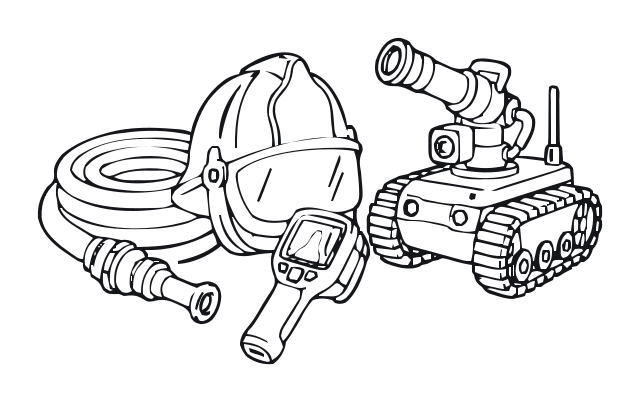
Event date / reported
2022-06-01
Evidence stage
DeploymentAn employer has put it into production. Can move the baseline — weighted by scale and how similar the setting is.
Tasks this bears on
Attacking the fire at close range
Advancing hose lines into the heat and smoke to put water or foam on the seat of the fire.
Being augmented✓ Evidence-backed
Holding a large fire over hours
Keeping sustained water and foam on a warehouse or industrial fire that burns for hours, where heat and collapse risk make standing close dangerous.
Being augmented✓ Evidence-backed
Where this applies
The service's own annual report for FY 2022–2023, read in the full PDF. It states that SCDF transitioned to a three-crew section concept of operations from 1 June 2022 and launched the sixth-generation Light Fire Attack Vehicle and the Red Rhino Robot at that point; that the robot and vehicle were designed to complement the three-crew concept, in a project described as using human-factors technologies to alleviate manpower constraints; that Tier 1 ground robots — the Red Rhino Robot and the Pumper Firefighting Machine — are readily available in all new fire engines for immediate deployment at any fire scene; and, in its incident list, that an Unmanned Firefighting Machine was deployed at warehouse and industrial fires on 18 June 2022, 17 September 2022 and 13 March 2023, alongside about 50 and about 70 firefighters at the two fires where a number is given. It establishes a deployment and a change in crew size at one national service, reported together; it does not say the robots caused the smaller sections, how many firefighters the service employs, or how often the robots are used.
What this means
One national fire service put small firefighting robots on its new fire engines, used a remotely operated machine at named large fires, and moved to three-person sections at the same time.
What it does not yet show
It reports the robots and the smaller sections together; it does not show that one caused the other, how many firefighters the service employs, or how often the robots are actually used.
What you can check
Check your own service's latest annual report for the crew size per appliance and whether any robots are listed as standard equipment.
Does it change the assessment?
No. The impact index is never moved by a single event. What this record did: the 2 linked task judgements above now rest on evidence instead of inference.
Source
Singapore Civil Defence Force — Annual Report FY 2022–2023 · verified 2026-09-23 · Claude (VOLO agent) — source text fetched and cross-checked · interpreted 2026-09-23 · Claude (VOLO agent)
Primary source — published by the party that did this, or the authority of record. No co-signature needed.