 LO
LO
Get told when a verified record lands on this occupation →
Cabin crew
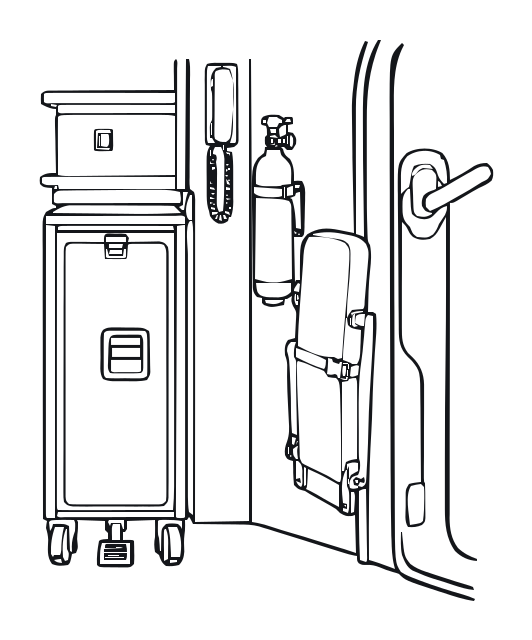
Serves the cabin, and is there to get everyone out of it — and is the occupation where the law sets the minimum number of people by counting seats and exits, for a reason written into the rule: evacuation.
Find your airline's requirements to become crew-in-charge or purser, and count how far you are from the minimum experience it asks for.
This is not a probability of losing your job. It combines how much of the role's task load is exposed to automation with how far adoption has actually gone — useful for comparing occupations on one consistent basis, and for nothing else.
Written for cabin crew on commercial passenger aircraft — flight attendants and the crew-in-charge. It does not cover pilots, who have their own page, or ground staff. The two sources are the rules that set how many cabin crew must be on board in Singapore and in the United States; they establish a legal minimum and the safety reason for it. They do not say how many crew airlines actually roster above that minimum, and nothing on this page measures how much of the onboard service is automated anywhere.
What is actually changing#
The unit of analysis is the task, not the job title. A role is not replaced — its task mix shifts.
Is this your job? Say so and this page narrows to your share of it.
A job title is a bundle of tasks bought together, and no two people hold the same bundle. Nothing is sent anywhere — it stays in this browser.
Read all 6 tasks in full — direction, reasoning and limits →
Recent changes#
The regulations as published on Singapore Statutes Online, in operation since 1 October 2018 and read in the current version. Regulation 138: an operator may not carry passengers on an aeroplane with more than 19 passenger seats unless the cabin crew on board is not less than the greatest of one per 50, or fraction of 50, passenger seats on the same deck; one per pair of directly opposing floor-level exits on a single-aisle aeroplane, or one per floor-level exit with more than one aisle; and the number the manufacturer determined at certification. It allows one crew member fewer only if a crew member is incapacitated, no qualified replacement is reasonably available, seating capacity is reduced, and for one sector unless the regulator approves a second. Regulation 139: every flight needing at least two cabin crew must have a designated crew-in-charge, responsible to the pilot-in-command for the operational and safety functions of each cabin crew member, with at least one year's experience with the operator and appropriate training. It establishes a legal minimum and who is accountable in Singapore; it does not say how many crew airlines roster above that minimum, and it says nothing about onboard service.
Failure, rollback, regulation or cost is suppressing adoption. Can lower an assessment or widen its uncertainty.
The current text of 14 CFR 121.391 on the government's own eCFR, originally published at 30 FR 3206 on 9 March 1965 and amended since. It requires one flight attendant on aeroplanes with more than 9 or 19 (by payload) but fewer than 51 seats, two for 51 to 100 seats, and two plus one for each unit or part of a unit of 50 seats above 100. If an operator's emergency evacuation demonstration used more attendants than that, it may not later fly the aeroplane with fewer. During take-off and landing, the required flight attendants must sit as near as practicable to the required floor-level exits and be uniformly distributed through the aeroplane, to provide the most effective egress of passengers in an emergency evacuation. It establishes a legal minimum and its stated safety purpose in the United States; it does not say how many attendants airlines roster above it, and it says nothing about onboard service.
Failure, rollback, regulation or cost is suppressing adoption. Can lower an assessment or widen its uncertainty.
What this means for you#
If you are joining as cabin crew, understand what you are really hired for: the law counts you by seats and exits because of evacuation, not service. That is why service automation is unlikely to take the job below the legal minimum. What it can do is thin the numbers above that minimum and change the service part of the day, so the parts of your training that matter longest are the safety and emergency ones.
Your leverage is the safety role and the crew-in-charge position, both written into the rules with experience requirements attached. As the administrative and sales work thins, the parts of the job that remain are the ones the law assigns to a trained, named person — and leading a crew through them is the senior version.
Your options#
Four directions, each with its real constraints and one thing you can test this week. Continuing as you are is a legitimate choice — it just has to be a chosen one.
Build toward crew-in-charge
The rules name the crew-in-charge, require experience and training for the role, and make them answerable to the captain. It is the part of the cabin team the regulation itself protects.
Promotion depends on seniority and the airline's own grading, and positions are limited by the number of flights.
Find your airline's requirements to become crew-in-charge or purser, and count how far you are from the minimum experience it asks for.

Move toward safety and emergency training
Every crew member needs recurrent safety and emergency training and competency checks, and those are delivered and examined by experienced crew. It is the part of the organisation that grows with the fleet, not with the service model.
Instructor and examiner roles need approval from the airline and often the regulator, and there are few of them.
Ask your training department what it takes to become a safety and emergency procedures instructor, and what the approval process is.
Move into service design or ground roles that use cabin experience
As ordering and sales move onto screens and phones, airlines need people who know what actually happens in the aisle to design those services. Customer experience, crew scheduling and safety management are other ground roles that value cabin experience.
These roles are fewer than flying roles and often pay differently, and some need qualifications in design, data or operations.
Look at your airline's internal vacancies for customer experience, product or safety roles, and note which ones list cabin experience as an advantage.
Common questions#
Not below the number the law requires, and that number exists for evacuation, not service. Singapore's rules set the minimum by one crew member per 50 seats, by the exits, or by the manufacturer's certified figure, whichever is greatest; the US rule adds one flight attendant per 50 seats above 100 and seats them near the exits for take-off and landing. Ordering, sales and paperwork are moving onto screens and phones, which can thin the crew an airline carries above that minimum. The legal floor itself changes only if the rule does.
We do not answer that with a number of years, and for this occupation there is a signal you can check yourself: the minimum cabin crew rule of the regulator where your airline is certified. As long as it counts crew by seats and exits, the job has a legal floor that service automation does not touch. Watch two things: any proposal to change that ratio, and how many crew your airline rosters above the minimum on each aircraft type.
Because of evacuation. The US rule requires flight attendants to sit as near as practicable to the floor-level exits during take-off and landing and to be spread evenly through the cabin, to provide the most effective egress of passengers in an emergency evacuation, and it bars an airline from flying with fewer attendants than it used in its evacuation demonstration. Singapore's rule also counts the exits: on a single-aisle aircraft, at least one crew member for each pair of opposing floor-level exits.
Down to the legal minimum, yes; below it, no. Airlines often roster more crew than the rules require, for service, on long flights and in premium cabins, and those extra positions are the ones service automation could affect. The minimum itself is set by seats, exits and the manufacturer's certification, and in Singapore a flight may run one crew member short only in a narrow case — an incapacitated crew member, no qualified replacement reasonably available, seating capacity reduced, and limited to one sector unless the regulator approves otherwise.
What these judgements rest on#
2 of 6 task judgements on this page are backed by a verified event and 4 are platform inference, each labelled where it appears. Behind them sit 3 technology dimensions, a reconstructed trajectory since language models reached the public, and 2 verified events.
Other roles in the same function#
A company divides its work into functions before it divides it into jobs. These sit in Operations & fulfilment alongside this one — a fact about org charts, not a judgement that they are similar or that they are changing in the same direction.
Procurement / supply chain specialist · Operations coordinator · Metro train driver · Air traffic controller · Airline pilot · Container port worker · Warehouse worker · Truck driver · Delivery rider / courier · Ride-hail / taxi driver · Bus driver · Assembly line worker · Cleaner / janitor · Security guard · E-commerce operations specialist