 LO
LO
ConstraintPhysical automation2024-10-01
The master contract covering US east and gulf coast ports bars fully automated terminals and remotely operated ship-to-shore cranes for its six-year term, and sets one operator per machine
Container port workeroccupation page →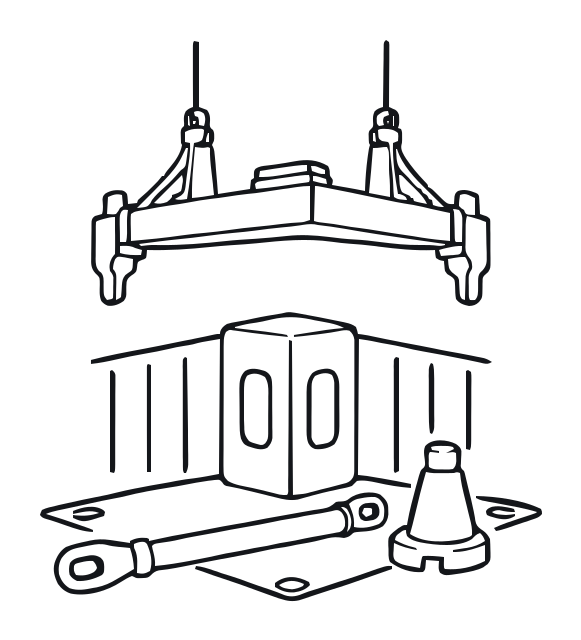
Event date / reported
2024-10-01
Evidence stage
ConstraintFailure, rollback, regulation or cost is suppressing adoption. Can lower an assessment or widen its uncertainty.
Tasks this bears on
Working the crane
Landing a forty-tonne box on a twenty-centimetre target, from a cab seven storeys up or from a screen in a control room.
Being augmented✓ Evidence-backed
What the contract says a machine may do
The clause that decides, before any technology question is asked, whether a terminal may run a crane remotely and who must be holding the controls.
Still human-led✓ Evidence-backed
Where this applies
United States east and gulf coast ports only, and only for the term of this agreement, which runs from 1 October 2024 to 30 September 2030. It is an executed collective agreement published by a signatory, so both parties have an interest and they point in opposite directions, which is what makes the text stronger than either side's account of it. Article XI says there shall be no fully-automated terminals developed and no fully-automated container handling equipment used during the term, defining fully-automated as devoid of human interaction, and separately that no remotely operated ship-to-shore cranes shall be used at any port during the term. Rail-mounted and rubber-tyred gantry cranes may be operated remotely, but the clause requires that the equipment provide the represented operator with control of the vertical and horizontal movement of cargoes for vessel loading and unloading and truck receiving and delivery, with a minimum manning of one operator per machine while gate and vessel operations run simultaneously. The workforce-protection procedure requires the parties to identify the new work created by the technology by craft before implementation, which is unusually close to the unit this site uses. Enforcement is real rather than hortatory: a terminal found in violation pays ten thousand dollars per day to the local container royalty fund, and where it refuses to acknowledge a violation the union may withhold labour. What it does not establish: nothing about whether the technology works, and nothing about any other country. It is a bargained outcome, and reading it as evidence that automation failed inverts it — it is evidence that where dockworkers had the leverage to bargain, the manning was written down rather than engineered away. It also expires.
What this means
In one market the answer to what a machine may do is a contract clause rather than a technical limit, and it is specific: no fully automated terminal, no remote ship-to-shore crane, and one operator per machine when the gate and the vessel run together. The workers also bargained the thing this site tries to document — that the new work created by any technology must be identified by craft before it is switched on.
What it does not yet show
It says nothing about whether the technology works, and nothing about ports outside its coasts. It is a bargained outcome with an expiry date, so it measures leverage rather than feasibility — in ports where dockworkers do not have that leverage, the same equipment runs differently, and this record is no evidence about them.
What you can check
If your port has a collective agreement, find the clause about remote operation and manning and read what it actually says rather than what people tell you it says. Then find its expiry date. Those two facts together tell you how much of your seat is held by technology and how much by a piece of paper that runs out.
Does it change the assessment?
No. The impact index is never moved by a single event. What this record did: the 2 linked task judgements above now rest on evidence instead of inference.
Source
USMX–ILA Master Contract, effective 1 October 2024 for a six-year term — Article XI, New Technology Implementation and Workforce Protection · verified 2026-09-20 · Claude Opus 5 (agent) · interpreted 2026-09-20 · Claude Opus 5 (agent)
Primary source — published by the party that did this, or the authority of record. No co-signature needed.