VOLOVLOAutomation risk & transition, task by task
AskOccupationsMajorsBusinessFoundersChangesNotesMethod
Search occupations, majors…
EN
  • English
  • 简体中文
  • 日本語
  • Español
  • Português
  • Français
VLO
VOLO

Understanding how automation changes work — task by task, with the evidence shown and the uncertainty admitted.

AskOccupationsMajorsBusinessFoundersChangesNotesMethodAboutRole diagnosisPrivacyTerms
© 2026 VOLO
Guides
Ask VOLOFor businessFor foundersRecent changesNotesRole diagnosisFirst AI experimentMethod & evidenceAboutFollow an occupationSearch
Occupations
All occupations
AI / software
Translator / InterpreterBank tellerCopywriterContent moderatorCustomer service representativeAdministrative assistantSoftware tester / QA engineerGraphic designerParalegalVideo editorAccountant / BookkeeperMarketing specialistFrontend developerData analystInsurance claims handlerTechnical writer / documentation engineerJunior software developerHR / recruiterLoan officer / credit officerFinancial analystProcurement / supply chain specialistJournalistSales / account managerReal estate agentIT support specialist / helpdeskAuditorManagement consultantBackend developerAI researcherProduct / UX designerBusiness systems ownerE-commerce operations specialistActuaryRadiologistData engineerLawyerMedical assistant / clinic assistantMachine learning engineerExperienced software engineerDevOps / platform / SRE engineerProduct managerPharmacistPartnerships / channel managerSecurity analyst (SOC)Compliance officerArchitectFirst-line manager / team supervisorCounsellor / therapistRetail salesperson / shop assistantCivil / structural engineerSecurity guardBus driverSchool teacherGeneral practitioner / primary care doctorAirline pilotWaiter / restaurant serverAuto mechanic / vehicle technicianPolice officerAir traffic controllerPhysiotherapist / rehabilitation therapistConstruction workerRegistered nurseCare worker / nursing assistantAI implementation lead
RPA / self-service
Government service clerkOperations coordinatorMetro train driverReceptionist / front desk
Robotics
Retail cashier / shop assistantContainer port workerWarehouse workerAssembly line workerMedical laboratory technicianChef / cookCleaner / janitorFarmerFirefighterCabin crewElectrician
Autonomous driving
Ride-hail / taxi driverTruck driverDelivery rider / courier
Majors
All majorsEnglish / Foreign languagesComputer scienceAccountingPsychologyJournalism / CommunicationFinanceLawVisual communication designMarketingNursingBusiness administrationEducation and teacher trainingArchitecturePublic administrationMedicineHospitality and tourism managementEconomicsInformation systems
Enter as:I have a jobI am studyingI run a companyI am building something
Recent changes›Farmer›2025-03-31
DeploymentPhysical automation2025-03-31

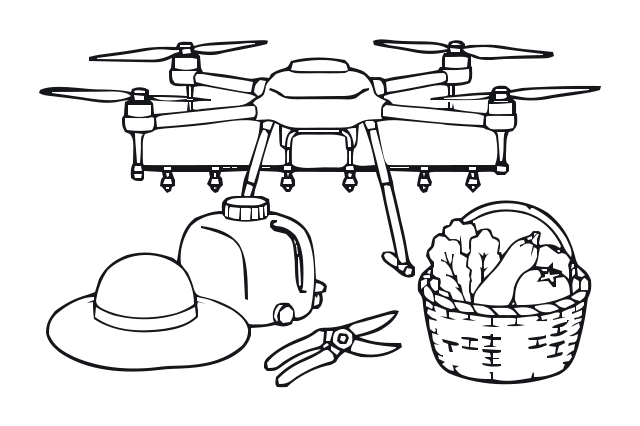
Japan's agriculture ministry estimated drones sprayed about 1.2 million hectares of cumulative farmland area in fiscal 2024

Farmeroccupation page →
Event date / reported
2025-03-31
Evidence stage
DeploymentAn employer has put it into production. Can move the baseline — weighted by scale and how similar the setting is.
Tasks this bears on
Spraying crops
Applying pesticide, fungicide and fertiliser across the fields at the right time, traditionally with a backpack or tractor-mounted sprayer.
Automating✓ Evidence-backed
Where this applies
The ministry's own report on drone use in agriculture, dated March 2026, read in full. It states that the cumulative area sprayed with pesticide, fertiliser and similar materials by drone passed one million hectares in fiscal 2023 and continued to expand, at about 1,196 thousand hectares in fiscal 2024 (an estimate); that sales of spraying drones have run at roughly 3,000 to 4,000 a year, rising slightly to 3,359 in fiscal 2024; and that 1,461 pesticides suitable for drone spraying were registered by the end of fiscal 2024. Its own method note says the area was compiled from operators' reports in 2016–2018, estimated from prefectural data in 2019 and from flight-time reports in 2020, not compiled in 2021, and estimated from registered aircraft and average area per aircraft from 2022 onward; the series therefore mixes methods and is not a reliable growth rate. Cumulative area counts a field once per spraying. It establishes the scale of drone spraying in one country; it does not count farmers, or say how many use drones themselves versus hiring a service.
What this means
Japan's agriculture ministry estimates that drones now spray pesticide and fertiliser over more than a million hectares of cumulative farmland area a year, with thousands of spraying drones sold annually.
What it does not yet show
The figures are estimates made by methods that changed between years, so they show scale rather than a reliable growth rate, and they do not say how many farmers use drones or how many hire a service.
What you can check
Find out whether drone spraying is available as a service near you, and whether the pesticides you use are approved for it.
Does it change the assessment?
No. The impact index is never moved by a single event. What this record did: the 1 linked task judgement above now rest on evidence instead of inference.
Source
Ministry of Agriculture, Forestry and Fisheries of Japan — 令和7年度 農業分野におけるドローンの活用状況 (Crop Production Bureau, March 2026) · verified 2026-09-23 · Claude (VOLO agent) — source text fetched and cross-checked · interpreted 2026-09-23 · Claude (VOLO agent)
Primary source — published by the party that did this, or the authority of record. No co-signature needed.
All changes for Farmer →All recent changes →How events become evidence →
Japan's agriculture ministry estimated… — impact on farmers | VOLO