 LO
LO
Get told when a verified record lands on this occupation →
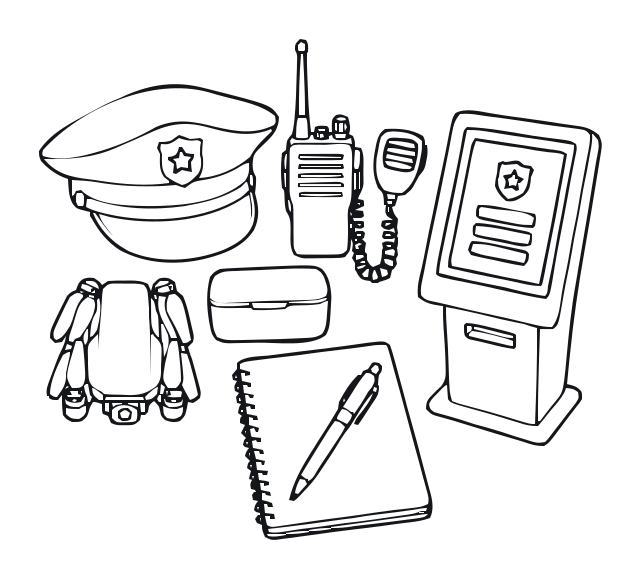
Police officer
Keeps the peace, answers calls and investigates crime — and is the occupation where a government has said plainly that it cannot hire its way out of a shortage, and has started putting drones and software into the patrol and the report desk.
Find out which unmanned systems or AI tools your force already uses, and who is trained to operate or oversee them.
This is not a probability of losing your job. It combines how much of the role's task load is exposed to automation with how far adoption has actually gone — useful for comparing occupations on one consistent basis, and for nothing else.
Written for uniformed police officers and investigation officers in a public police force — patrol, response, report-taking, investigation and traffic enforcement. It does not cover private security guards or specialist forensic scientists, whose tasks differ. Both sources come from Singapore on the same day, from the police force and from the minister responsible, which lets a reader check the force's account against the minister's; Singapore is a small, highly surveilled city with a single national force, so its pace is not a guide to other countries. Nothing on this page counts police officers.
What is actually changing#
The unit of analysis is the task, not the job title. A role is not replaced — its task mix shifts.
Is this your job? Say so and this page narrows to your share of it.
A job title is a bundle of tasks bought together, and no two people hold the same bundle. Nothing is sent anywhere — it stays in this browser.
Read all 6 tasks in full — direction, reasoning and limits →
Recent changes#
The force's own account of its Workplan Seminar, published 22 May 2026. It states that its unmanned systems optimise manpower deployment by automating routine patrols and enabling remote operations, with mature systems overseen by a single operator managing several at once and a human in the loop for newer ones; that from May 2026 the Home Team SkyGuardian drones began aerial patrols from eight drone pods, with operators at the Police Operations Command Centre providing remote oversight; that the Report Lodging Co-Pilot, an AI-assisted chatbot at self-help kiosks, was first rolled out at all seven Police Land Division headquarters in October 2025 and had expanded to 21 more Neighbourhood Police Centres by April 2026; that patrol robots will expand to more Changi Airport terminals and transport nodes from 2027; and that the Police Coast Guard is trialling an unmanned surface vessel which since March 2026 has replaced one manned patrol twice a week. It establishes deployments at one national force; it does not say how many officers the force employs, how many reports go through the chatbot, or that any of these systems has reduced headcount. The vessel is a trial, not a deployment.
An employer has put it into production. Can move the baseline — weighted by scale and how similar the setting is.
The minister's own speech as published by the Ministry of Home Affairs, 22 May 2026. He said the force cannot grow indefinitely and that, given Singapore's demographics, it is not possible to throw more officers at a problem, so technology is a necessary force enabler and multiplier; that the Report Lodging Co-Pilot has been progressively deployed since October 2025; that the Case Summariser module of the Investigator Co-Pilot is in pilot implementation, with further modules next year and a Case Recommender in development, framed as sharpening officers' judgement rather than replacing it; that the force is progressively rolling out TRACER, video analytics that processes footage submitted by the public, automatically identifies traffic violations and pinpoints their timestamps; and that two of every three scam websites blocked today are flagged by the force's AI tools. The force's own account of the same day describes TRACER as a capability it is exploring, so the two sources differ on how far along it is. It establishes a minister's statement of the manpower constraint and of what is being deployed; it does not measure any system's effect on staffing or casework.
An employer has put it into production. Can move the baseline — weighted by scale and how similar the setting is.
What this means for you#
If you are joining a police force, expect to work alongside drones, patrol robots and AI tools from the start, especially in the routine parts of patrol and paperwork. The part of the job these do not touch is the one the law gives only to officers: responding, using force lawfully and making arrests, and deciding what the evidence in a case supports. At least one government has said openly that it cannot solve a shortage by hiring more, which is why these tools arrive — to stretch the officers it has.
Your value is in judgement that the tools feed rather than replace: reading a scene, weighing a case, deciding what action is justified. Officers who can oversee several unmanned systems, and investigators who can check a machine-drafted summary against the evidence, are where these changes land.
Your options#
Four directions, each with its real constraints and one thing you can test this week. Continuing as you are is a legitimate choice — it just has to be a chosen one.
Stay operational, and learn to run the systems
Response, arrest and the use of force stay with officers by law, and where drones and robots patrol, the officers who oversee them and act on what they see are the ones the force relies on.
How much technology a force uses varies enormously, and in many forces there is little yet to learn.
Find out which unmanned systems or AI tools your force already uses, and who is trained to operate or oversee them.
Move toward investigation
Software drafts the summaries, but deciding what the evidence supports and presenting a case stays with an investigator who answers for it. As the drafting gets faster, the judgement becomes a larger share of the job.
Investigation roles usually require selection, training and time in service.
Take a recent report or case file and write down which parts a tool could draft and which parts needed your judgement; that list is what an investigation role is made of.
Move into cyber and scam work
Scams and cybercrime are growing and are fought increasingly with AI tools — in Singapore two of every three scam websites blocked are flagged by them — which creates work for officers who understand both the crime and the tools.
These units need technical skills that may have to be added, and places are limited.
Look up whether your force has a cyber or anti-scam unit, and what training or background it asks for.
Common questions#
Not in the powers that define the job. Drones and robots are taking on routine patrol, software is guiding people through reporting and finding traffic violations in video, and investigators are piloting tools that draft case summaries. But responding to incidents, using force lawfully, making arrests and deciding what evidence supports are given to officers by law. In Singapore, the minister responsible said the force cannot grow indefinitely and called technology a force multiplier — a statement about stretching the officers it has, not about removing them.
We do not answer that with a number of years, and for this occupation there is a signal you can check yourself: which tasks your force hands to machines, and whether it says the goal is headcount or deployment. The force described here says its unmanned systems optimise manpower deployment and keep a human in the loop for newer technology. Watch for a change in that wording, and for any power the law gives only to officers being assigned to a system.
According to the force and the minister on 22 May 2026: a chatbot that guides people lodging reports at kiosks, live at all seven division headquarters from October 2025 and 21 more neighbourhood police centres by April 2026; video analytics that finds traffic violations in footage sent by the public; a suite of investigator tools, with the case-summary module in a pilot; and AI that flags two of every three scam websites blocked. Drones began patrolling from eight pods in May 2026, and an unmanned vessel is being trialled at sea.
In Singapore, the minister gave the reason directly: the force cannot grow as much as it wants, and given the country's demographics it is not possible to throw more officers at a problem, so technology is a necessary force enabler and multiplier. The force adds that the systems reduce operational risk and let officers cover places with little police presence. It is a response to a shortage of people, which is a different claim from the machines doing the job better.
What these judgements rest on#
2 of 6 task judgements on this page are backed by a verified event and 4 are platform inference, each labelled where it appears. Behind them sit 4 technology dimensions, a reconstructed trajectory since language models reached the public, and 2 verified events.
Other roles in the same function#
A company divides its work into functions before it divides it into jobs. These sit in Core delivery (industry-specific) alongside this one — a fact about org charts, not a judgement that they are similar or that they are changing in the same direction.
Content moderator · Registered nurse · Radiologist · General practitioner / primary care doctor · Care worker / nursing assistant · Counsellor / therapist · Pharmacist · School teacher · Chef / cook · Electrician · Architect · Civil / structural engineer · Journalist · Translator / Interpreter · Retail cashier / shop assistant · Bank teller · Medical assistant / clinic assistant · Waiter / restaurant server · Construction worker · Auto mechanic / vehicle technician · Medical laboratory technician · Physiotherapist / rehabilitation therapist · Firefighter · Farmer