 LO
LO
Get told when a verified record lands on this occupation →
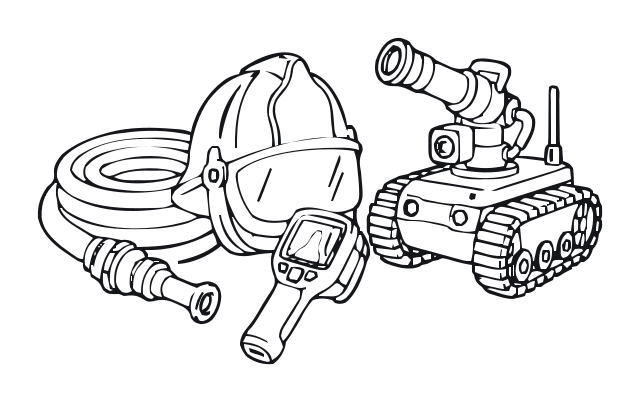
Firefighter
Goes into the burning building so no one else has to — and is the occupation where a fire service has written down, in its own reports, how many of its people robots are meant to keep out of the most dangerous zone.
Find out whether your service has any firefighting robots or drones in use, which appliances carry them, and who on a crew is trained to operate them.
This is not a probability of losing your job. It combines how much of the role's task load is exposed to automation with how far adoption has actually gone — useful for comparing occupations on one consistent basis, and for nothing else.
Written for operational firefighters in a public fire and rescue service — the crews who respond, attack the fire, search buildings and rescue people. It does not cover fire-safety engineers or inspectors, whose work is regulatory, or paramedics, who have different tasks. Both sources are from the Singapore Civil Defence Force, a single national service that publishes its own plans and its own incident records, which is why they can be read side by side; other services buy and deploy robots at very different rates. Nothing here counts firefighters, and the one number on this page — a forecast of nearly 50% fewer people committed into high-risk areas — is about who goes into the most dangerous zone, not about how many firefighters a service employs.
What is actually changing#
The unit of analysis is the task, not the job title. A role is not replaced — its task mix shifts.
Is this your job? Say so and this page narrows to your share of it.
A job title is a bundle of tasks bought together, and no two people hold the same bundle. Nothing is sent anywhere — it stays in this browser.
Read all 6 tasks in full — direction, reasoning and limits →
Recent changes#
The service's own annual report for FY 2022–2023, read in the full PDF. It states that SCDF transitioned to a three-crew section concept of operations from 1 June 2022 and launched the sixth-generation Light Fire Attack Vehicle and the Red Rhino Robot at that point; that the robot and vehicle were designed to complement the three-crew concept, in a project described as using human-factors technologies to alleviate manpower constraints; that Tier 1 ground robots — the Red Rhino Robot and the Pumper Firefighting Machine — are readily available in all new fire engines for immediate deployment at any fire scene; and, in its incident list, that an Unmanned Firefighting Machine was deployed at warehouse and industrial fires on 18 June 2022, 17 September 2022 and 13 March 2023, alongside about 50 and about 70 firefighters at the two fires where a number is given. It establishes a deployment and a change in crew size at one national service, reported together; it does not say the robots caused the smaller sections, how many firefighters the service employs, or how often the robots are used.
An employer has put it into production. Can move the baseline — weighted by scale and how similar the setting is.
An interview published by SCDF itself on 15 November 2021 in its in-house magazine. The officer describes a two-tier approach — small robots at every fire station for small and medium fires, heavier machines placed at certain stations for large fires — and says: with this tiered approach, we forecast a nearly 50% reduction in the number of firefighters needed to be committed into the high-risk areas during offensive firefighting operations, with the approach to be fully operationalised by 2023. He also states that the heavy Unmanned Firefighting Machine is remotely controlled by one person, that robots are deployed manually from vehicles on arrival, and that autonomous deployment and swarm coordination are later stages of a ten-year roadmap. The number is about how many people go into the most dangerous zone during an attack, not about how many firefighters the service employs. A forecast is not evidence about work; this record moves nothing on this page and sits beside the service's own later report of what was deployed.
A named person with standing publicly predicted something, on a date, in an attributable statement. It is recorded so that who said what, and when, stays checkable — and it never moves a task's assessment, because a prediction is not an observation. Its value arrives later: the record sits on the same page as the evidence about that occupation, so anyone reading the forecast reads the record of what happened next beside it. That is the reckoning; this site publishes no verdict on whether a forecast came true.
What this means for you#
If you are joining a fire service, expect robots to be part of the kit rather than a threat to the job: the tasks they take are the ones that were most likely to injure you, and they add a new one — deploying and operating them. What the robots in service do not do is search buildings, rescue people or decide what to do next, and those remain the core of the job. The thing to watch is how your service counts its crews: one national service moved to three-person sections at the same time as it put a robot on each engine.
Your judgement on the fireground is the part robots make more valuable, not less: every machine on the ground is one more thing a commander has to place and one more feed to read. Officers who can run a scene with robots in it — knowing what they can and cannot do in a given building — are where these changes land.
Your options#
Four directions, each with its real constraints and one thing you can test this week. Continuing as you are is a legitimate choice — it just has to be a chosen one.
Stay on the front line, and learn the machines
Search, rescue and the decisions on scene stay with people, and where robots are standard kit the crews who can deploy and operate them well are the ones the service relies on.
Robot adoption varies enormously between services, and in many there is nothing to learn yet.
Find out whether your service has any firefighting robots or drones in use, which appliances carry them, and who on a crew is trained to operate them.

Move toward incident command
More sensors and more machines on the ground mean more to direct, and the decisions about risk stay with a person who answers for them. Command is the part of the job that grows as the equipment does.
Promotion depends on rank structures and years of service, and command posts are few.
Read your service's incident command procedures and note where they mention robots, drones or remote sensors — and where they should but do not.
Move into fire safety or technology roles
Services that adopt robots need people who understand both the fireground and the equipment — to test it, write the procedures and train crews. Fire-safety inspection is another route that uses operational experience.
These roles are few and often need technical or engineering qualifications you may have to add.
Look up whether your service or its technology agency has a unit that develops or tests equipment, and what background its staff have.
Common questions#
Not in the parts of the job that define it. Robots are already taking the most dangerous part of fire attack — carrying water into heat, holding a large fire for hours — and in Singapore a small one rides on every new fire engine. But the robots in service carry water, not people: searching a building, rescuing someone and deciding what to do next remain firefighters' work. The service that deployed them forecast nearly half as many people committed into high-risk areas, which is a statement about who goes into danger, not about how many firefighters it employs.
We do not answer that with a number of years, and for this occupation there is a signal you can check yourself: what your own service's robots are built to carry. As long as they carry water and sensors and not people, the core of the job — search, rescue and command — is not what is being automated. Watch for two things in your service's own reports: a robot that carries casualties entering routine use, and any change in how many people make up a crew.
Singapore's Civil Defence Force moved to a three-person section concept of operations from 1 June 2022 and launched a new light fire attack vehicle and a small firefighting robot at the same time, describing the robot as designed to complement the three-person crew and the project as using technology to alleviate manpower constraints. That is the service's own account of the two changes arriving together. It does not say the robot caused the smaller section, and it does not say how many firefighters the service employs.
In the service described here, small robots carried on fire engines go in at the start to find heat sources and put water on the fire, and a heavier remotely operated machine keeps a sustained stream on large warehouse and industrial fires; its annual report names three such fires in one year. One person controls the heavy machine from a distance. The robots are put in place by hand on arrival, and at the two of those fires where the report gives a number, about 50 and about 70 firefighters were deployed.
What these judgements rest on#
2 of 6 task judgements on this page are backed by a verified event and 4 are platform inference, each labelled where it appears. Behind them sit 2 technology dimensions, a reconstructed trajectory since language models reached the public, and 2 verified events.
Other roles in the same function#
A company divides its work into functions before it divides it into jobs. These sit in Core delivery (industry-specific) alongside this one — a fact about org charts, not a judgement that they are similar or that they are changing in the same direction.
Content moderator · Registered nurse · Radiologist · General practitioner / primary care doctor · Care worker / nursing assistant · Counsellor / therapist · Pharmacist · School teacher · Chef / cook · Electrician · Architect · Civil / structural engineer · Journalist · Translator / Interpreter · Retail cashier / shop assistant · Bank teller · Medical assistant / clinic assistant · Waiter / restaurant server · Construction worker · Auto mechanic / vehicle technician · Medical laboratory technician · Physiotherapist / rehabilitation therapist · Police officer · Farmer