 LO
LO
Get told when a verified record lands on this occupation → · Mark which of these tasks are yours (VOLO Pro, free during the launch) →
Network engineer
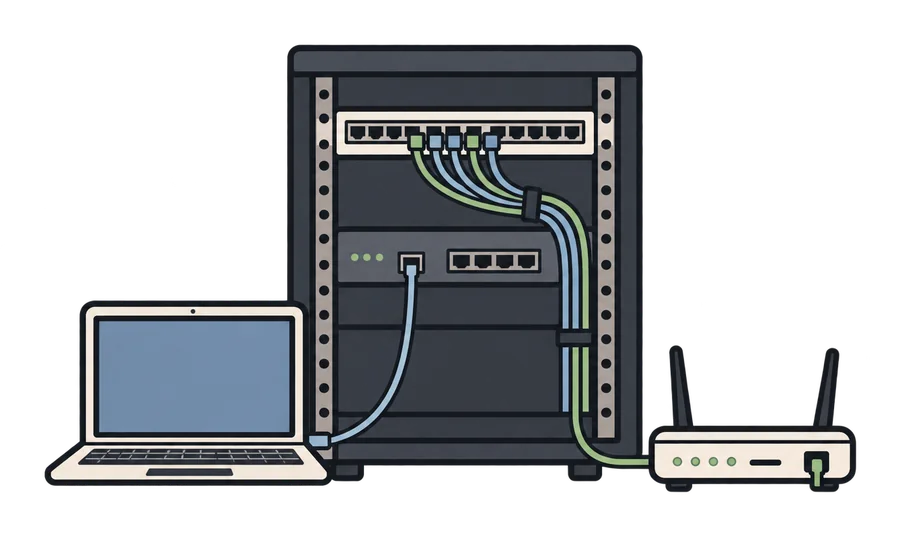
Designs, configures and keeps networks running — enterprise networks and the carrier networks behind mobile and broadband: plans capacity, makes configuration changes, troubleshoots outages and answers for them. Large carriers now let automation make routine configuration changes by the tens of millions and use AI agents to diagnose faults and propose fixes; benchmarks show language models still fix only a minority of complex misconfigurations correctly, and US projections expect administrator jobs to shrink while network architect jobs grow.
List the configuration changes you made last month and mark which could have been automated safely and which needed judgement.
This is not a probability of losing your job. It combines how much of the role's task load is exposed to automation with how far adoption has actually gone — useful for comparing occupations on one consistent basis, and for nothing else.
Written for network engineers, administrators and architects in enterprises and at telecom operators. DevOps, IT support and security analysts have their own pages. The evidence is large carriers' own accounts of network automation, two research benchmarks of language models on configuration and troubleshooting, US outage-reporting rules and US labour projections; it establishes what carriers automate and what models can do on test networks, not how engineers' hours have changed across the occupation.
What is actually changing#
The unit of analysis is the task, not the job title. A role is not replaced — its task mix shifts.
Each tile is one task. Its size is how much of the job it is; its colour is where the task is heading. Click a tile to see what the judgement does not establish.
The carrier's figure is its own; the projection counts architect jobs in the US, not how much design work tools now do.
The carrier figures are their own accounts, and Verizon's 'thousands of technicians' is its counterfactual, not a count of jobs; the benchmark is a preprint on synthetic networks.
The carrier's figure is its own; the benchmark tests lab networks with rewritten tickets.
A projection for a wider US occupation that includes systems administrators; it does not separate how much of the decline each reason explains.
A US rule for communications providers; it governs how outages are reported, not how troubleshooting is done.
Is this your job? Say so and this page narrows to your share of it.
A job title is a bundle of tasks bought together, and no two people hold the same bundle. Nothing is sent anywhere — it stays in this browser.
Read all 5 tasks in full — direction, reasoning and limits →
Recent changes#
A benchmark of 200 troubleshooting scenarios across eight network topologies, including false fault reports and wrong root-cause claims, run against three agents. The paper reports that agents are near-saturated on accurate tickets but falsely diagnose up to 24% of healthy networks, and that ticket phrasing alone changes diagnostic accuracy by up to 14.5 percentage points. It tests emulated lab networks with an LLM judge.
A demo, benchmark or paper shows the task can be done. Updates what the technology can do — not what employers will do.
United States. The statistics bureau projects that employment of network and computer systems administrators will decline 4 percent from 2025 to 2035, from 323,600 to 310,400, with about 13,400 openings a year from replacement needs. It says some of their tasks are increasingly done by software developers focused on DevOps, some are outsourced to companies providing networks as a service, and administrators are increasingly automating routine tasks. Only the last is automation; the occupation also includes systems administrators.
A named person with standing publicly predicted something, on a date, in an attributable statement. It is recorded so that who said what, and when, stays checkable — and it never moves a task's assessment, because a prediction is not an observation. Its value arrives later: the record sits on the same page as the evidence about that occupation, so anyone reading the forecast reads the record of what happened next beside it. That is the reckoning; this site publishes no verdict on whether a forecast came true.
United States. The statistics bureau projects that employment of computer network architects will grow 8 percent from 2025 to 2035, much faster than the average, from 181,800 to 195,800, with about 9,600 openings a year, and says companies looking to leverage technological investments such as artificial intelligence will need these workers to upgrade their IT infrastructure. It counts jobs for one country, not tasks.
A named person with standing publicly predicted something, on a date, in an attributable statement. It is recorded so that who said what, and when, stays checkable — and it never moves a task's assessment, because a prediction is not an observation. Its value arrives later: the record sits on the same page as the evidence about that occupation, so anyone reading the forecast reads the record of what happened next beside it. That is the reckoning; this site publishes no verdict on whether a forecast came true.
United States, Verizon's network. The company's CTO writes that in 2025 its closed-loop automation platforms executed over 70 million network configuration changes autonomously, that implemented by hand these changes would have required thousands of technicians working around the clock, and that issues which took engineering teams hours to diagnose and correct are now identified and resolved in less than two minutes. It is the operator describing its own systems; the 'thousands of technicians' is its counterfactual, not a count of jobs changed.
An employer has put it into production. Can move the baseline — weighted by scale and how similar the setting is.
A benchmark of 231 problems for fixing configurations on network topologies of 20 to 754 nodes, checked by formal verification, on which nine language models were evaluated. The paper reports that the best-performing model resolved only 25% of scenarios, that strictly correct resolutions — every fault fixed with no regressions — occurred in at most 25.5% of cases, and that models are best deployed as human-in-the-loop assistants. It is a preprint on synthesised scenarios.
A demo, benchmark or paper shows the task can be done. Updates what the technology can do — not what employers will do.
Germany, Deutsche Telekom's mobile network. The operator says that since its launch in November 2025 its RAN Guardian agent autonomously triggered over 100 remediation actions at Christmas market events in its first month, and that in live operations it reduced the time needed to manage major events from hours to around a minute, a more than 95% improvement. The agent was co-developed with Google Cloud; the broader MINDR system is only planned. It is the operator describing its own system.
An employer has put it into production. Can move the baseline — weighted by scale and how similar the setting is.
Japan, NTT DOCOMO's network, in operation from 4 February 2026. The operator says the system detects anomalies, identifies suspected failure points and presents recommended actions to maintenance engineers, and that it reduces response time for complex network failures that previously required manual analysis by more than 50%. The platform is supplied by AWS; engineers act on its recommendations. It is the operator describing its own system.
An employer has put it into production. Can move the baseline — weighted by scale and how similar the setting is.
One operator, one edge router in Miami. Cloudflare's post-mortem says a change pushed via its policy automation platform at 20:25 UTC produced unexpected advertisements to transit providers and peers, that the route leak lasted 25 minutes, and that at 20:50 UTC the bad configuration change was manually reverted by a network operator and automation was paused for the router; its stated remediations include automatic routing-policy evaluation in its CI/CD pipelines. It shows routing policy written and pushed by automation in production, and a person stepping in when it failed; one incident is not a measure of the industry.
An employer has put it into production. Can move the baseline — weighted by scale and how similar the setting is.
United States, communications providers. The rule says notification and initial and final outage reports shall be submitted by a person authorised by the provider to submit them, who is also authorised to legally bind the provider to the truth of the report, and that each final report shall be attested by that person, who on oath states that the information is true, correct and accurate. It governs how outages are reported, not how troubleshooting is done.
Failure, rollback, regulation or cost is suppressing adoption. Can lower an assessment or widen its uncertainty.
What this means for you#
If you are starting out, expect routine configuration and first-line diagnosis to be automated at large operators, and expect the administrator role at small firms to be squeezed by automation, DevOps and outsourcing. Aim for the work tools do not do well yet — design, complex repair, and judging whether an automated fix is safe.
Expect to supervise automation rather than type commands: setting the guardrails for closed-loop changes, checking agents' diagnoses, and designing networks that AI workloads need. Architecture roles are projected to grow while administrator roles shrink.
Your options#
Four directions, each with its real constraints and one thing you can test this week. Continuing as you are is a legitimate choice — it just has to be a chosen one.

Stay, and own the automation
Carriers run tens of millions of automated changes; someone has to set their limits and step in when a model's fix would break something.
Needs programming and verification skills beyond classic command-line work.
List the configuration changes you made last month and mark which could have been automated safely and which needed judgement.

Move towards network architecture
US projections expect network architect jobs to grow as companies upgrade infrastructure for AI and cloud, while administrator jobs decline.
Architecture roles usually expect several years of experience and broader design knowledge.
Look at five network architect job ads near you and list the skills they ask for that you do not have yet.
Move into network security or DevOps
Some network administration work is moving to DevOps teams, and access control and incident handling stay with people.
Both need new skills — coding and pipelines for DevOps, threat analysis for security.
Ask your DevOps or security team which network tasks they already handle themselves.
Common questions#
Partly, at the routine end. Large carriers now automate tens of millions of configuration changes and use AI agents to diagnose faults, and US projections expect administrator jobs to decline 4 percent. But benchmarks show models still fix only a minority of complex misconfigurations correctly, outage reports must come from an authorised person, and network architect jobs are projected to grow 8 percent.
We do not answer that with a number of years. Watch two signals instead: whether models start fixing complex misconfigurations without introducing new failures, and whether operators let agents act on outages without an engineer approving. Today the benchmarks recorded here show the first is not there, and the carriers describe engineers acting on agents' recommendations.
Routine changes, yes, at scale: Verizon says it executed over 70 million configuration changes autonomously in 2025. Complex repair, not reliably: on a benchmark of 231 configuration problems the best model fully resolved only 25% of scenarios, and troubleshooting agents falsely diagnosed up to 24% of healthy networks.
It depends on which end. US projections expect network architect employment to grow 8 percent from 2025 to 2035 but administrator employment to decline 4 percent, partly because routine tasks are being automated and partly because work is moving to DevOps teams and outsourced providers.
What these judgements rest on#
4 of 5 task judgements on this page are backed by a verified event and 1 are platform inference, each labelled where it appears. Behind them sit 2 technology dimensions, a reconstructed trajectory since language models reached the public, and 9 verified events.
See which technologies, how it got here, and the method →
Where it sits in the official classification: skills, knowledge, related jobs →
Other roles in the same function#
A company divides its work into functions before it divides it into jobs. These sit in Technology & data alongside this one — a fact about org charts, not a judgement that they are similar or that they are changing in the same direction.
Junior software developer · Experienced software engineer · Frontend developer · Backend developer · Data engineer · Machine learning engineer · AI researcher · Software tester / QA engineer · Data analyst · Data scientist · Business analyst · Business systems owner · IT support specialist / helpdesk · Security analyst (SOC) · DevOps / platform / SRE engineer · Technical writer / documentation engineer