 LO
LO
Get told when a verified record lands on this occupation → · Mark which of these tasks are yours (VOLO Pro, free during the launch) →
Aircraft maintenance technician
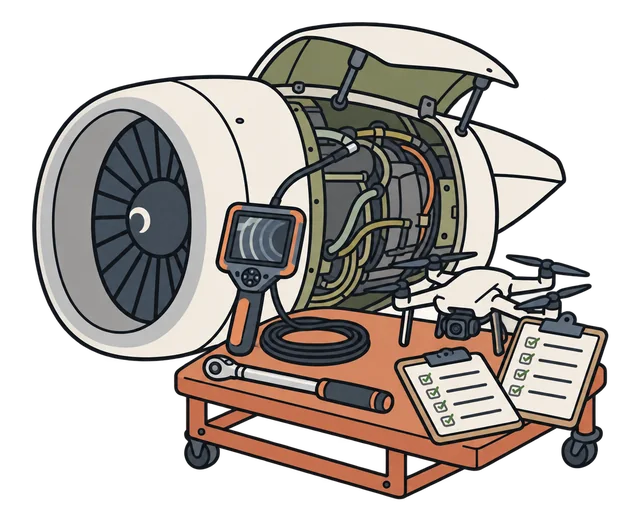
Keeps aircraft airworthy and signs for it: carries out scheduled inspections and checks, troubleshoots faults, replaces and repairs components, inspects engines with borescopes, keeps maintenance records and — when certificated — approves the aircraft for return to service. Drones now photograph airframes for inspection and AI helps review engine blade images, cutting the time to a decision; but trained people still judge airworthiness from those images, and US rules allow only certificated people to approve an aircraft for return to service.
Check which certificate or licence your country requires to sign a release to service, and which of its requirements you already meet.
This is not a probability of losing your job. It combines how much of the role's task load is exposed to automation with how far adoption has actually gone — useful for comparing occupations on one consistent basis, and for nothing else.
Written for aircraft maintenance technicians and licensed aircraft maintenance engineers at airlines and maintenance organisations — airframe, engine and systems work. Pilots have their own page, and so do car mechanics. The evidence is an airline's and a maintenance company's own announcements, an engine maker's account of its own inspection tool, US aviation maintenance rules and a US labour projection; it establishes where inspection is being assisted and what the rules reserve for certificated people, not how technicians' hours have changed.
What is actually changing#
The unit of analysis is the task, not the job title. A role is not replaced — its task mix shifts.
Each tile is one task. Its size is how much of the job it is; its colour is where the task is heading. Click a tile to see what the judgement does not establish.
Both are the companies' own announcements; the 82% figure is Delta's, and neither reports effects on technician staffing.
The figure comes from the tool's maker, which also sells engine maintenance; it is not an independent measurement.
A projection counts jobs, not how much diagnosis software now does; no primary source here measures repair work.
US rules; other regulators have their own licensing, and the rules do not measure how records are produced.
An inference; no primary source recorded here measures how maintenance records are kept or how planning work is done.
Is this your job? Say so and this page narrows to your share of it.
A job title is a bundle of tasks bought together, and no two people hold the same bundle. Nothing is sent anywhere — it stays in this browser.
Read all 5 tasks in full — direction, reasoning and limits →
Recent changes#
United States. The statistics bureau projects that overall employment of aircraft and avionics equipment mechanics and technicians will grow 6 percent from 2025 to 2035, faster than the average, with about 13,100 openings a year; aircraft mechanics and service technicians go from 140,000 to 147,600 and avionics technicians from 19,800 to 21,600. It counts jobs for one country, not tasks.
A named person with standing publicly predicted something, on a date, in an attributable statement. It is recorded so that who said what, and when, stays checkable — and it never moves a task's assessment, because a prediction is not an observation. Its value arrives later: the record sits on the same page as the evidence about that occupation, so anyone reading the forecast reads the record of what happened next beside it. That is the reckoning; this site publishes no verdict on whether a forecast came true.
The engine maker's own release. Its chief MRO engineer is quoted saying that with the AI-enabled blade inspection tool deployed for the GEnx engine, inspection process times were cut in half from 3 to 1.5 hours while improving quality and accuracy, and the company says it is extending the tool to LEAP and GE9X engines. It is the company describing its own product; technicians still take the images, and the figure is not an independent measurement.
A demo, benchmark or paper shows the task can be done. Updates what the technology can do — not what employers will do.
United States, Delta Air Lines' mainline fleet. The airline says the FAA accepted its plan and that drone inspections have been added to the Aircraft Maintenance Manual for its entire mainline fleet, initially for conditional visual inspections after lightning strikes; once images are captured, trained TechOps technicians and inspectors evaluate them to determine airworthiness before returning the aircraft to service, and the airline says this helps them decide on aircraft condition up to 82% faster. It is the airline's own account; no FAA document was found, and staffing effects are not reported.
An employer has put it into production. Can move the baseline — weighted by scale and how similar the setting is.
Singapore, a maintenance organisation's own release. It says this is the first authorisation granted by the Civil Aviation Authority of Singapore for unmanned aerial systems to perform general visual inspection on Singapore-registered aircraft, that inspectors can instead conduct indirect inspection using live video and post-flight images, and that images can be fed through algorithms that detect and classify defects to assist the inspectors. The company developed the drone system itself, and the release gives no time or staffing figures.
An employer has put it into production. Can move the baseline — weighted by scale and how similar the setting is.
United States, certificated repair stations. The rule says that, except for individuals employed by a repair station located outside the United States, only an employee appropriately certificated as a mechanic or repairman under part 65 is authorized to sign off on final inspections and maintenance releases for the repair station. It reserves the final sign-off for certificated people; it says nothing about inspection tools.
Failure, rollback, regulation or cost is suppressing adoption. Can lower an assessment or widen its uncertainty.
United States. The rule says that, except as it provides, no person other than the Administrator may approve an aircraft, airframe, engine, propeller, appliance or component part for return to service after maintenance, preventive maintenance, rebuilding or alteration, and then lists who may — certificated mechanics with the right ratings, repair stations, air carriers and others. It keeps the approval with certificated persons and organisations; it says nothing about software.
Failure, rollback, regulation or cost is suppressing adoption. Can lower an assessment or widen its uncertainty.
United States. The rule says the maintenance record entry must include the signature, certificate number and kind of certificate held by the person approving the work, and that the signature constitutes the approval for return to service only for the work performed. It ties the legal record to a named, certificated person; it says nothing about how the entry is drafted.
Failure, rollback, regulation or cost is suppressing adoption. Can lower an assessment or widen its uncertainty.
What this means for you#
If you are starting out, expect drones and AI to take over much of the photographing and first-pass image review, and expect the judgement of airworthiness, the hands-on repair and the certificate to stay with people. Getting certificated — the licence that lets you sign — is what the rules keep scarce.
Expect to spend less time crawling over an airframe with a flashlight and more time judging images and data that tools bring you. Your signature and your experience of what a real defect looks like are what the rules and the tools both depend on.
Your options#
Four directions, each with its real constraints and one thing you can test this week. Continuing as you are is a legitimate choice — it just has to be a chosen one.
Stay, and get certificated to sign
US rules allow only certificated people to approve return to service and to sign final inspections at repair stations.
Certification takes training, experience and exams, and requirements differ by country.
Check which certificate or licence your country requires to sign a release to service, and which of its requirements you already meet.

Move towards inspection technology — drones, borescope AI and NDT
Airlines and engine makers are putting drones and AI into inspection, and someone trained has to fly, operate and interpret them.
These programmes are still limited to certain operators, aircraft types and inspections.
Ask your maintenance organisation whether it uses drones or AI-assisted borescope inspection, and who operates them.
Move into maintenance planning or quality
Planning and quality roles use hands-on experience to decide what work is done and whether it was done right.
These roles are fewer and usually need years of line or base maintenance first.
Ask a planner or quality inspector at your station what experience their role required.
Common questions#
Not on present evidence. Drones and AI now help inspect airframes and engines and speed up decisions, but trained technicians and inspectors still judge airworthiness from the images, US rules allow only certificated people to approve an aircraft for return to service, and US projections expect the occupation to grow 6 percent from 2025 to 2035.
We do not answer that with a number of years. A signal to watch instead: whether regulators start accepting a drone's or an AI's finding as the airworthiness decision without a certificated person, and whether robots start doing repairs on the aircraft. Today neither is the case.
Yes, for some inspections. Delta has added drone inspections after lightning strikes to the maintenance manual for its mainline fleet, and Singapore's aviation authority authorised drones for general visual inspection in 2020. In both, the drone takes the images and trained people make the airworthiness call.
US projections expect 6 percent growth from 2025 to 2035, faster than average, with about 13,100 openings a year. The certificate that lets you sign for an aircraft is something only people can hold under the rules recorded here.
What these judgements rest on#
3 of 5 task judgements on this page are backed by a verified event and 2 are platform inference, each labelled where it appears. Behind them sit 3 technology dimensions, a reconstructed trajectory since language models reached the public, and 7 verified events.
See which technologies, how it got here, and the method →
Where it sits in the official classification: skills, knowledge, related jobs →
Other roles in the same function#
A company divides its work into functions before it divides it into jobs. These sit in Operations & fulfilment alongside this one — a fact about org charts, not a judgement that they are similar or that they are changing in the same direction.
Procurement / supply chain specialist · Operations coordinator · Supply chain planner · Metro train driver · Air traffic controller · Airline pilot · Cabin crew · Container port worker · Warehouse worker · Truck driver · Delivery rider / courier · Ride-hail / taxi driver · Bus driver · Assembly line worker · Cleaner / janitor · Security guard · E-commerce operations specialist