 LO
LO
Get told when a verified record lands on this occupation → · Mark which of these tasks are yours (VOLO Pro, free during the launch) →
Editor and proofreader
Edits and corrects other people's writing — proofreading, copyediting for accuracy and style, structural editing, and deciding what gets published. A major academic publisher says its own teams use AI for proof preparation and copy editing, and studies find language models catch many errors. But they over-correct, miss errors that span sentences, and make changes of which a large share are not improvements; editors still prefer edits by other experts; and publishers and newsrooms keep final editorial decisions with named editors. US projections expect editor employment to fall 1 percent to 2035, blaming print's decline rather than AI.
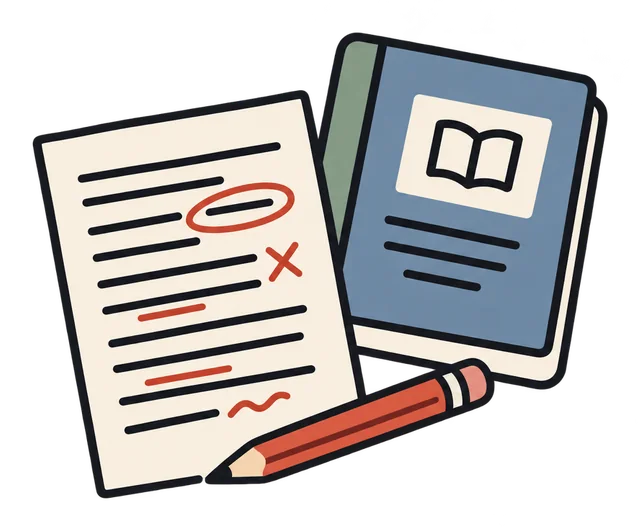
Run a page you have edited through an AI tool and count how many of its changes you would reject.
This is not a probability of losing your job. It combines how much of the role's task load is exposed to automation with how far adoption has actually gone — useful for comparing occupations on one consistent basis, and for nothing else.
Written for editors and proofreaders who work on other people's text — copy editors, book and manuscript editors, proofreaders, and editors at publishers and newsrooms. Journalists, copywriters and video editors have their own pages. The evidence is two US labour projections, an academic publisher's policy, a newspaper's AI principles and four studies of AI editing; it establishes how AI edits compare and who keeps the decisions, not how editors' incomes or copy desks have changed.
What is actually changing#
The unit of analysis is the task, not the job title. A role is not replaced — its task mix shifts.
Each tile is one task. Its size is how much of the job it is; its colour is where the task is heading. Click a tile to see what the judgement does not establish.
2023-era benchmark studies and one publisher's description of its own process; neither measures proofreading jobs.
Small studies of academic and literary text; they do not show how publishers staff copyediting.
Inferred from studies of short texts; no record measures developmental editing work.
Two organisations' own policies; others differ, and policies do not measure staffing.
Is this your job? Say so and this page narrows to your share of it.
A job title is a bundle of tasks bought together, and no two people hold the same bundle. Nothing is sent anywhere — it stays in this browser.
Read all 4 tasks in full — direction, reasoning and limits →
Recent changes#
United States. The statistics bureau projects that employment of editors will decline 1 percent from 2025 to 2035, from 105,000 by 1,100 jobs, with about 7,900 openings a year. It says demand for reading for pleasure may support book editors, while editors at traditional print newspapers and magazines are projected to decline as those publications lose ground; the page does not mention artificial intelligence. It counts jobs for one country.
A named person with standing publicly predicted something, on a date, in an attributable statement. It is recorded so that who said what, and when, stays checkable — and it never moves a task's assessment, because a prediction is not an observation. Its value arrives later: the record sits on the same page as the evidence about that occupation, so anyone reading the forecast reads the record of what happened next beside it. That is the reckoning; this site publishes no verdict on whether a forecast came true.
United States. The projections table lists proofreaders and copy markers (43-9081) at 8,500 jobs in both 2025 and 2035, a change of −0.1 thousand or −0.9 percent, with 25.6 percent self-employed and about 1,100 openings a year. The table gives no reason and does not mention AI; it counts jobs in a small occupation.
A named person with standing publicly predicted something, on a date, in an attributable statement. It is recorded so that who said what, and when, stays checkable — and it never moves a task's assessment, because a prediction is not an observation. Its value arrives later: the record sits on the same page as the evidence about that occupation, so anyone reading the forecast reads the record of what happened next beside it. That is the reckoning; this site publishes no verdict on whether a forecast came true.
A major academic publisher's policy. It says its teams use AI tools to support the post-acceptance stage of publication, including proof preparation, copy editing and identifying inconsistencies or inaccuracies in the final paper; that basic checks of grammar, spelling and punctuation need no declaration from authors; and that AI tools cannot replace an editor's critical thinking, independent evaluation or final decision-making, with editors remaining fully responsible. It is the publisher describing its own process; it gives no figures on staff.
An employer has put it into production. Can move the baseline — weighted by scale and how similar the setting is.
A comparison of copyediting on two global-health papers by a university-hosted GPT, Grammarly and a human editor. The authors report the GPT made about three times as many corrections as the human editor and about ten times more than Grammarly, but was the least discriminating, with only 61% (51/83) of its corrections judged improvements; the human took 3.75 and 4 hours to edit the two papers. It covers two papers only.
A demo, benchmark or paper shows the task can be done. Updates what the technology can do — not what employers will do.
A comparison of human and language-model proofreading of second-language writing. The authors report that both improve some lexical features, but that language models favour more generative rewrites, extensively reworking vocabulary and sentence structures, which may improve fluency but risk altering nuance or inflating perceived proficiency. It concerns learner writing, a workshop paper.
A demo, benchmark or paper shows the task can be done. Updates what the technology can do — not what employers will do.
A study in which professional writers edited 1,057 paragraphs written by language models according to a taxonomy of problems such as clichés and unnecessary exposition. The authors report that a large-scale preference annotation confirms experts largely prefer text edited by other experts, while automatic editing methods show promise. It concerns literary and creative text.
A demo, benchmark or paper shows the task can be done. Updates what the technology can do — not what employers will do.
A national newspaper's published principles. It says that if it wishes to include significant elements generated by AI in a piece of work, it will only do so with clear evidence of a specific benefit, human oversight and the explicit permission of a senior editor, and names assisting colleagues through corrections or suggestions among the situations where AI can improve its work. It is one organisation's policy; it does not describe staffing.
Failure, rollback, regulation or cost is suppressing adoption. Can lower an assessment or widen its uncertainty.
An evaluation of grammatical error correction. The authors report that ChatGPT has excellent error detection and makes corrected sentences very fluent, possibly because it over-corrects and does not follow minimal edits, but that at document level it cannot effectively correct agreement, coreference and tense errors across sentences or cross-sentence boundary errors. It used a 2023 model.
A demo, benchmark or paper shows the task can be done. Updates what the technology can do — not what employers will do.
A benchmark evaluation of grammatical error correction. The authors report that ChatGPT performs worse than dedicated baselines such as Grammarly on automatic metrics, particularly on long sentences, and that human evaluation suggests it produces fewer under-correction or mis-correction issues but more over-corrections. It used a 2023 model.
A demo, benchmark or paper shows the task can be done. Updates what the technology can do — not what employers will do.
What this means for you#
If you are starting out, expect basic proofreading to arrive pre-corrected by software, and build the judgement machines lack: when not to change a sentence, errors across a whole document, and a publisher's standards.
Expect to review more machine edits and to be the person who rejects the over-corrections. Structural editing and the final call on what is published stay with you.
Your options#
Four directions, each with its real constraints and one thing you can test this week. Continuing as you are is a legitimate choice — it just has to be a chosen one.

Move from correcting to reviewing machine edits
Studies show language models over-correct and that a large share of their edits are not improvements.
How review work is valued varies by client and is not settled.
Run a page you have edited through an AI tool and count how many of its changes you would reject.

Stay in structural editing and standards
Publishers keep final editorial decisions with named editors, and experts prefer human edits.
These roles are fewer and usually senior.
Read your publisher's or client's AI policy and note what it reserves for editors.
Move into specialist editing with standards attached
Academic publishers set rules for AI in manuscripts, and specialist text needs editors who know the field.
Specialist editing needs subject knowledge that takes time to build.
Pick one specialist field and read its main publisher's policy on AI in manuscripts.
Common questions#
It is changing proofreading more than editing. Language models catch many errors, and a major publisher uses AI in its copy-editing process, but studies find they over-correct and that many of their changes are not improvements, while publishers keep final decisions with editors. US projections expect editor employment to fall 1 percent from 2025 to 2035, blaming print's decline, and proofreader employment to hold roughly steady.
We do not answer that with a number of years. Watch whether the texts you receive arrive already machine-corrected, and what your clients' AI policies reserve for editors. Those tell you more than any date.
Not overall. It finds many errors and makes text fluent, but it over-corrects, misses errors that span sentences, and in one comparison only 61% of its changes were improvements.
The US projection does not say so. It expects editor employment to fall 1 percent from 2025 to 2035 because traditional print newspapers and magazines are losing ground, and its page does not mention AI.
What these judgements rest on#
3 of 4 task judgements on this page are backed by a verified event and 1 are platform inference, each labelled where it appears. Behind them sit 2 technology dimensions, a reconstructed trajectory since language models reached the public, and 9 verified events.
See which technologies, how it got here, and the method →
Where it sits in the official classification: skills, knowledge, related jobs →
Other roles in the same function#
A company divides its work into functions before it divides it into jobs. These sit in Core delivery (industry-specific) alongside this one — a fact about org charts, not a judgement that they are similar or that they are changing in the same direction.
Content moderator · Registered nurse · Radiologist · Radiographer / radiologic technologist · General practitioner / primary care doctor · Surgeon · Care worker / nursing assistant · Counsellor / therapist · Pharmacist · Pharmacy technician · School teacher · University lecturer · Chef / cook · Electrician · Plumber · Architect · Interior designer · Civil / structural engineer · Electrical engineer · Mechanical engineer · Industrial engineer · Quantity surveyor · Journalist · Translator / Interpreter · Interpreter · Retail cashier / shop assistant · Bank teller · Medical assistant / clinic assistant · Waiter / restaurant server · Construction worker · Auto mechanic / vehicle technician · Medical laboratory technician · Physiotherapist / rehabilitation therapist · Firefighter · Police officer · Farmer · Social worker · Dentist · Veterinarian · Librarian · Welder · Sonographer