 LO
LO
ConstraintCognitive automation2011-11-03
EU law bars a pilot from operating a commercial flight unless they personally carried out three take-offs, approaches and landings in the preceding 90 days
Airline pilotoccupation page →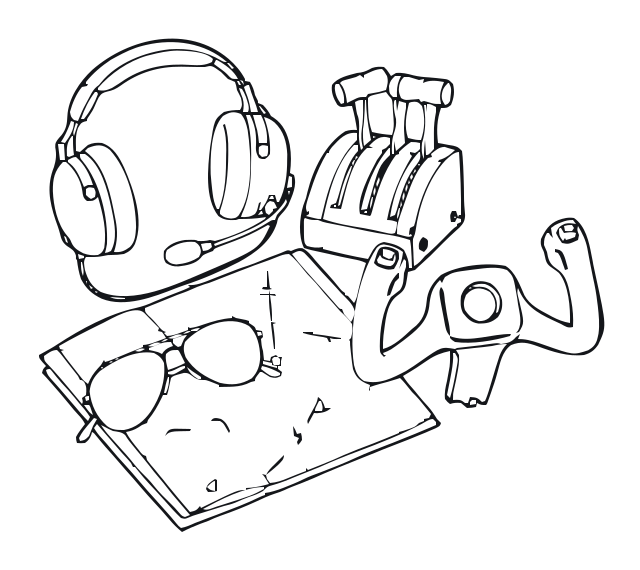
Event date / reported
2011-11-03 · reported 2011-11-25
Evidence stage
ConstraintFailure, rollback, regulation or cost is suppressing adoption. Can lower an assessment or widen its uncertainty.
Tasks this bears on
Flying it by hand
Take-off, the approach, the landing, and any moment the automation is switched off — the part of the job where the aircraft goes where your hands put it.
Still human-led✓ Evidence-backed
Keeping the licence alive
Recurrent simulator checks, line checks, the medical, and the ratings that lapse on a date whether or not you have been flying.
Being augmented✓ Evidence-backed
Where this applies
Commission Regulation (EU) No 1178/2011 laying down technical requirements and administrative procedures related to civil aviation aircrew, read in its consolidated version in force from 30 April 2026. The provision is FCL.060, Recent experience: a pilot shall not operate an aircraft in commercial air transport or for carrying passengers as pilot-in-command or co-pilot unless he or she has carried out, in the preceding 90 days, at least three take-offs, approaches and landings as pilot flying in an aircraft of the same type or class, or in a full flight simulator representing that type or class. Two things follow and they point in opposite directions, which is why this record links two tasks rather than one. The requirement is written around a named person having personally done the thing, which is a rarer shape than a rule about who may operate a machine. And the same sentence accepts a simulator in place of the aircraft, which is a machine standing in for the very activity the rule exists to preserve. What this establishes is the shape of the obligation, not a measurement: it says nothing about how much of a given flight is flown by hand, how many pilots are employed, or whether crew composition will change - that last would arrive as a separate rulemaking, proposed in public with a comment period. The regulation speaks only for the European regime; other authorities impose requirements of similar shape and different numbers.
What this means
Most rules in this base say who may operate a machine. This one says how recently a named person must have operated it themselves, by hand, or they may not fly at all. The second half of the same sentence points the other way and is worth reading with it: a simulator is accepted in place of the aircraft, so even the requirement written to preserve the manual skill is partly satisfied by a machine.
What it does not yet show
A currency minimum is a floor, not a description of a working month: three landings in ninety days says nothing about how much of the rest was flown by the autopilot, and on long-haul it is usually most of it. The rule also says nothing about how many pilots are employed, and nothing about whether crew composition will change - that would be a separate rulemaking.
What you can check
Look up your own authority's recent-experience rule and check one thing: whether a simulator may substitute for the aircraft, and under what conditions. The narrower that substitution, the more of this job the rule is holding in a person's hands rather than in a machine's.
Does it change the assessment?
No. The impact index is never moved by a single event. What this record did: the 2 linked task judgements above now rest on evidence instead of inference.
Source
EUR-Lex, consolidated text of Commission Regulation (EU) No 1178/2011 (Part-FCL) · verified 2026-09-22 · Claude (VOLO CTO/COO agent) · interpreted 2026-09-22 · Claude (VOLO CTO/COO agent)
Primary source — published by the party that did this, or the authority of record. No co-signature needed.