 LO
LO
Get told when a verified record lands on this occupation → · Mark which of these tasks are yours (VOLO Pro, free during the launch) →
Court reporter
Makes the verbatim record of court hearings and depositions, produces and certifies transcripts, and provides live captions. Many courts replaced stenography with audio recording decades ago, the UK is testing whether its own AI can transcribe court hearings to the required accuracy, and US projections say AI transcription is expected to dampen demand for captioners. But generic speech recognition still makes many errors on courtroom audio, US federal law and Queensland's law attach the record's certificate or evidential weight to a person, and California allows electronic recording only in limited civil, misdemeanor and infraction cases after two bills to widen it died.
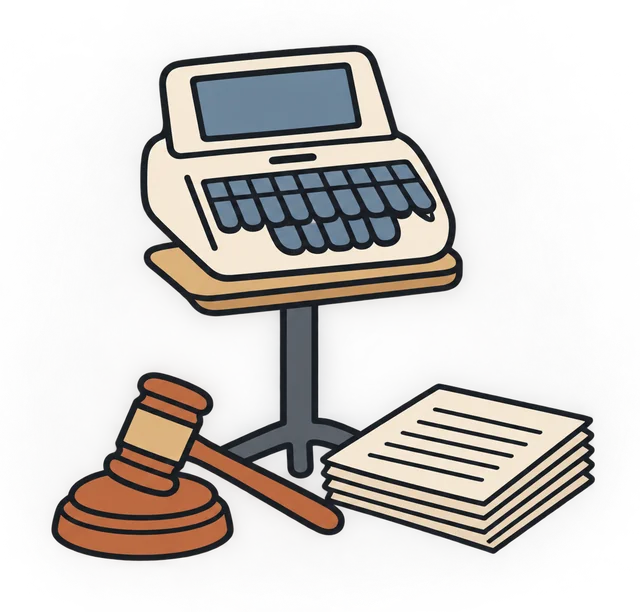
Look up your state's rule on when proceedings may be electronically recorded and list the case types it covers.
This is not a probability of losing your job. It combines how much of the role's task load is exposed to automation with how far adoption has actually gone — useful for comparing occupations on one consistent basis, and for nothing else.
Written for court reporters and stenographers who record court proceedings and depositions, and for captioners who provide live text. Lawyers and paralegals have their own pages. The evidence is a US labour projection, US federal law and judicial policy, a California statute and two failed bills, a Queensland statute, a court's announcement, a UK government study, a courtroom speech-recognition paper and a transcription vendor's annual report; it establishes how the record may be made and who must certify it, not how many reporters work in each country.
What is actually changing#
The unit of analysis is the task, not the job title. A role is not replaced — its task mix shifts.
Each tile is one task. Its size is how much of the job it is; its colour is where the task is heading. Click a tile to see what the judgement does not establish.
Rules and one court's order; recording is not speech recognition, and none of this counts how many proceedings are recorded each way.
A government study that has not reported, a research paper with a commercial partner and a projection; none measures how many transcript hours moved to machines.
The law of three jurisdictions, one of them only as a bill that failed; other countries and states set their own rules.
One state's law, read through a failed bill's digest; other states and countries allow other methods.
A projection and a vendor's description of its own service; no record here measures captioning quality or jobs.
Is this your job? Say so and this page narrows to your share of it.
A job title is a bundle of tasks bought together, and no two people hold the same bundle. Nothing is sent anywhere — it stays in this browser.
Read all 5 tasks in full — direction, reasoning and limits →
Recent changes#
United States. The statistics bureau projects that employment of court reporters and simultaneous captioners will show little or no change from 2025 to 2035, at 19,900 jobs, with about 1,800 openings a year. It says technology may make transcription more efficient but court reporters will continue to be needed to review and edit digitally produced documentation, and that transcription generated by artificial intelligence tools is expected to dampen employment demand for captioners. It counts jobs for one country, not tasks.
A named person with standing publicly predicted something, on a date, in an attributable statement. It is recorded so that who said what, and when, stays checkable — and it never moves a task's assessment, because a prediction is not an observation. Its value arrives later: the record sits on the same page as the evidence about that occupation, so anyone reading the forecast reads the record of what happened next beside it. That is the reckoning; this site publishes no verdict on whether a forecast came true.
England and Wales. The government says transcripts of Crown Court proceedings are currently produced by contracted providers, and that new research led by the courts service will explore how its in-house AI, Justice Transcribe, could meet required accuracy standards while reducing transcription time and costs. It is a study, not a deployment; it does not report accuracy results.
Small-scale trial in a real setting. Tells us the deployment conditions are being tested, not that they hold — so one pilot is never enough on its own; two independent ones are.
California. The bill's digest says it would provide for the certification of digital reporters and authorise a certified digital reporter to swear in witnesses and capture the record, and that where existing law requires depositions to be recorded stenographically by a certified shorthand reporter, except as specified, it would instead allow a certified shorthand reporter or a certified digital recorder. Its history shows it died on January 31, 2026. It did not become law.
A rule that would have constrained or required automation was formally proposed and did not come into force — vetoed, voted down, struck down, or allowed to lapse. It establishes something real and checkable about the legal environment: a guardrail many people assume exists does not. It never moves a task's assessment, because it says nothing about what employers can do or are doing.
Queensland, Australia. The Act says all relevant matter in a legal proceeding is to be recorded, giving shorthand and recording equipment as examples; lets the chief executive arrange with a provider to record and transcribe; and says a document purporting to be a transcription produced by a recorder is to be received as evidence, a recorder being a person who carries out a recording service. The reprint shows the law in force at that date; it does not establish when each provision was made.
Failure, rollback, regulation or cost is suppressing adoption. Can lower an assessment or widen its uncertainty.
California, the largest US trial court. The court says it has recorded a net loss of 117 court reporters since 2018, that over 70 percent of its 315 reporter employees are eligible to retire, and that its presiding judge issued a general order enabling electronic recording in specified proceedings when a court-employed reporter is unavailable, while state law allows recording only in misdemeanor, limited civil and infraction cases. The cause it gives is a shortage of reporters, not better technology; it is the court's own account.
An employer has put it into production. Can move the baseline — weighted by scale and how similar the setting is.
California. The bill's digest says it would instead permit a court to electronically record any civil case if approved equipment is available; its history shows it was held in committee on January 18, 2024 and returned to the Secretary of the Senate pursuant to Joint Rule 56 on February 1, 2024, and its status is inactive, died. It did not become law.
A rule that would have constrained or required automation was formally proposed and did not come into force — vetoed, voted down, struck down, or allowed to lapse. It establishes something real and checkable about the legal environment: a guardrail many people assume exists does not. It never moves a task's assessment, because it says nothing about what employers can do or are doing.
United States federal courts. The policy guide records that in 1983 the Judicial Conference authorised electronic sound recording of court proceedings, effective January 1984, and says that bankruptcy courts ordinarily use electronic sound recording and there are no official court reporters in bankruptcy courts; district judges choose the recording method. This is recording, not speech recognition, and the guide does not count proceedings by method.
An employer has put it into production. Can move the baseline — weighted by scale and how similar the setting is.
A court recording and transcription vendor's annual report. It says it combines artificial intelligence-driven voice and video capture technology and services for governments, courts, insurance and law enforcement, that 61% of its revenue comes from legal courts, and that its recurring revenue was affected by capacity constraints in quality assurance as it expanded and retrained. It is the company describing its own products.
A demo, benchmark or paper shows the task can be done. Updates what the technology can do — not what employers will do.
United Kingdom. Researchers building a transcription tool for the justice sector with an industrial partner say legal transcription is largely met by human transcribers, that the word error rate of a generic cloud speech recogniser remains relatively high on British court rooms because of long hearings, multiple speakers and unusual vocabulary, and that their domain-adapted model outperforms AWS and Whisper with a 9% and 8% word-error improvement; their gold-standard transcripts were made by legal professionals post-editing machine output. It is a workshop preprint with a commercial partner.
A demo, benchmark or paper shows the task can be done. Updates what the technology can do — not what employers will do.
California. The statute says that if an official reporter is unavailable, a court may order that a limited civil, misdemeanor or infraction case be electronically recorded, and that a court shall not expend funds for or use electronic recording to make an unofficial record or to make the official record in circumstances not authorised by the section. It keeps the stenographic record in other case types; it is one state's law.
Failure, rollback, regulation or cost is suppressing adoption. Can lower an assessment or widen its uncertainty.
United States federal district courts. The statute says each session of the court shall be recorded verbatim by shorthand, mechanical means, electronic sound recording or any other method, subject to Judicial Conference regulations and the judge's approval, and that the reporter or other individual designated to produce the record shall attach an official certificate to the original records. It governs federal courts only; states set their own rules.
Failure, rollback, regulation or cost is suppressing adoption. Can lower an assessment or widen its uncertainty.
What this means for you#
If you are considering this work, know that many courts already record by audio, and that the protected work is where the law keeps recording with a certified person — in California, depositions and every case type outside limited civil, misdemeanor and infraction cases. Check your jurisdiction's rules before you train.
Expect more of your work to become reviewing, editing and certifying machine-made drafts, and your value to rest on accuracy the machines do not yet reach on hard audio. Follow the bills in your state: that is where the task moves.
Your options#
Four directions, each with its real constraints and one thing you can test this week. Continuing as you are is a legitimate choice — it just has to be a chosen one.

Stay where the law requires a certified reporter
California allows electronic recording only in limited civil, misdemeanor and infraction cases, requires depositions to be recorded by a certified reporter, and bills to widen recording have failed.
Rules can change with the next bill, and other jurisdictions already record by audio.
Look up your state's rule on when proceedings may be electronically recorded and list the case types it covers.

Become the editor and certifier of machine drafts
Where speech recognition produces the first draft, someone still has to correct it and stand behind its accuracy.
Standards for checking machine drafts differ between courts and providers.
Ask a court or agency you work with whether it has trialled speech recognition, and who checks its output.
Move into realtime captioning for access needs
People with hearing loss need accurate live text, and the stenographic skill carries over.
US projections expect AI transcription to dampen demand for captioners.
Compare an automatic caption and a human caption of the same recorded event and note where they differ.
Common questions#
Recording already replaced stenography in many courts, decades before AI. What AI now targets is the transcript: the UK is testing whether its AI can meet court accuracy standards, but research finds generic speech recognition still error-prone on courtroom audio. US federal law and Queensland's law tie the record's certificate or evidential weight to a person, and US projections expect court reporter and captioner employment to show little or no change from 2025 to 2035.
We do not answer that with a number of years. Watch the rules in your jurisdiction — when courts may record by audio, and who may certify a transcript. Those change by statute and court order, and they decide this job more than any tool.
It depends on the rules. US federal law allows any recording method but requires a designated individual to certify the record; in Queensland a transcript is evidence when produced by a recorder, a person. The UK is still studying whether its AI meets the required accuracy.
In some courts, yes. The Los Angeles Superior Court reported a net loss of 117 reporters since 2018 and ordered electronic recording where none is available. A shortage pushes courts towards recording because people are missing, not because machines are better.
What these judgements rest on#
2 of 5 task judgements on this page are backed by a verified event and 3 are platform inference, each labelled where it appears. Behind them sit 3 technology dimensions, a reconstructed trajectory since language models reached the public, and 11 verified events.
See which technologies, how it got here, and the method →
Where it sits in the official classification: skills, knowledge, related jobs →
Other roles in the same function#
A company divides its work into functions before it divides it into jobs. These sit in Legal & compliance alongside this one — a fact about org charts, not a judgement that they are similar or that they are changing in the same direction.