 LO
LO
Get told when a verified record lands on this occupation → · Mark which of these tasks are yours (VOLO Pro, free during the launch) →
Supply chain planner
Decides how much of what should be where, and when: forecasts demand, sets inventory and replenishment, balances supply against sales in planning meetings, and re-plans when a storm, a port or a supplier breaks the plan. Machine-learning forecasts now run at the scale of millions of items and some retailers let algorithms make replenishment decisions outright; the companies describing these systems still say people make the final calls on trade-offs, and US projections expect logisticians' employment to grow much faster than average.
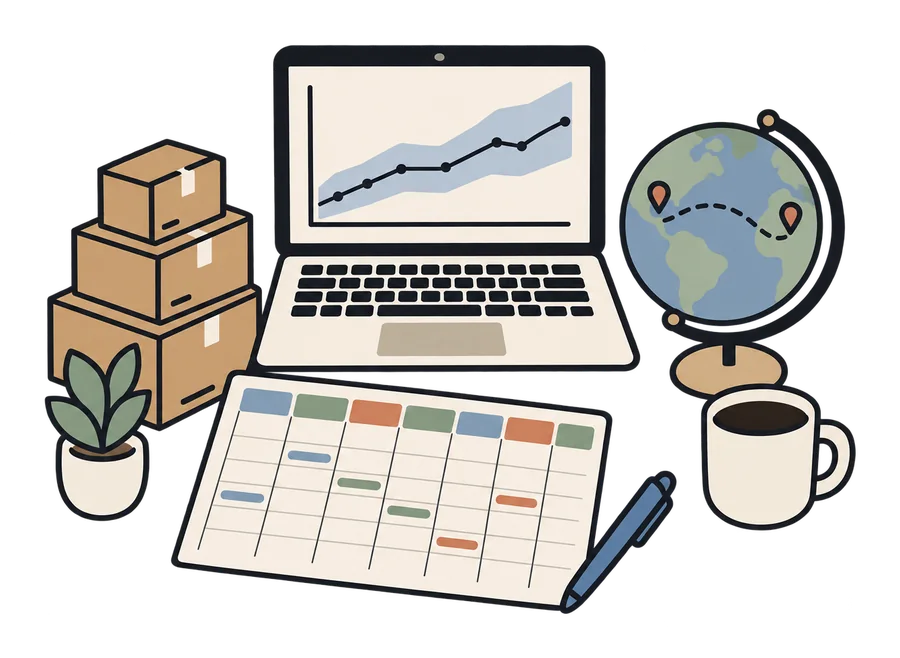
Find out what share of your company's replenishment orders go out without a planner changing them.
This is not a probability of losing your job. It combines how much of the role's task load is exposed to automation with how far adoption has actually gone — useful for comparing occupations on one consistent basis, and for nothing else.
Written for demand, supply and inventory planners and logistics analysts at retailers, manufacturers and distributors. Buying from suppliers is the procurement page; moving the goods is the operations coordinator's. The evidence is large companies' own accounts of their planning systems, a field deployment and a study co-written by retailers, US federal agencies' inventory entries and a US labour projection; it establishes what planning decisions machines make in named companies, not how planners' jobs have changed across the occupation.
What is actually changing#
The unit of analysis is the task, not the job title. A role is not replaced — its task mix shifts.
Each tile is one task. Its size is how much of the job it is; its colour is where the task is heading. Click a tile to see what the judgement does not establish.
These are the companies' and agency's own accounts of their systems; none reports how many planners adjust the forecasts or what happened to planning jobs.
Company accounts and company-co-authored studies from the largest retailers; none measures planner headcount, and across the EU only 6.08% of enterprises using AI applied it to logistics in 2025.
Statements by companies about their own processes, and a projection for a wider US occupation; nothing here measures how planning meetings have changed.
Company accounts; Microsoft's tool reports preliminary accuracy only, and neither measures planner time or staffing.
Is this your job? Say so and this page narrows to your share of it.
A job title is a bundle of tasks bought together, and no two people hold the same bundle. Nothing is sent anywhere — it stays in this browser.
Read all 4 tasks in full — direction, reasoning and limits →
Recent changes#
United States. The statistics bureau projects that employment of logisticians will grow 18 percent from 2025 to 2035, much faster than the average, from 255,100 jobs with a change of 44,900, and about 26,600 openings a year. O*NET files demand planner and supply chain planner among the job titles of logisticians and logistics analysts. It counts jobs for one country, not tasks.
A named person with standing publicly predicted something, on a date, in an attributable statement. It is recorded so that who said what, and when, stays checkable — and it never moves a task's assessment, because a prediction is not an observation. Its value arrives later: the record sits on the same page as the evidence about that occupation, so anyone reading the forecast reads the record of what happened next beside it. That is the reckoning; this site publishes no verdict on whether a forecast came true.
Unilever's own account of its supply chain. It says its Forecast Engine Utility combines machine learning and data science to generate a 104-week forecast every week across more than 5 million product–customer combinations in 40 operating markets, and that while AI helps make better decisions at scale, human expertise remains key: its people provide the judgement, context and experience needed to make the final decisions. It is the company describing its own processes; no staffing figures are given.
An employer has put it into production. Can move the baseline — weighted by scale and how similar the setting is.
Walmart's technology blog. It says that instead of reacting after a disruption occurs, planners use simulations to gain immediate visibility into how weather could affect inventory availability, transportation routes and customer deliveries, and that those insights help planners identify opportunities to reposition inventory, adjust transit times or reroute shipments before weather impacts operations. The tool informs planners, who act; no figures are given.
An employer has put it into production. Can move the baseline — weighted by scale and how similar the setting is.
EU27, enterprises with 10 or more employees, reference year 2025. 19.95% of enterprises used at least one AI technology, and 6.08% of those applied it to logistics — about 1.21% of all enterprises — the lowest of the seven purposes the dataset publishes; among enterprises with 250 or more employees the logistics share is 14.95%. It measures adoption by enterprises across the economy, not planners' work, and 'logistics' is the survey's broad category.
An employer has put it into production. Can move the baseline — weighted by scale and how similar the setting is.
China, JD.com. A replenishment model validated through a field deployment with a difference-in-differences analysis, reporting a 5.27-day reduction in turnover, a 2.29% increase in in-stock rates and a 29.95% decrease in holding costs against incumbent practice. The paper defines the automation rate as the percentage of replenishment decisions that are output by models and adopted for execution, and says treatment items were chosen by JD's managers for high automation rates. Several authors work for JD.com, which has a stake in the result.
An employer has put it into production. Can move the baseline — weighted by scale and how similar the setting is.
Walmart's own newsroom article. It says that when overstocks appear, a system automatically reroutes supply to the stores that need it most before the excess becomes waste, and that this one system alone has already saved Walmart more than $55 million. It is the company describing its own system; it does not say what planners do differently or report staffing.
An employer has put it into production. Can move the baseline — weighted by scale and how similar the setting is.
Amazon's own announcement about its operations. It says that while previous systems used sales history to guide inventory planning decisions, a foundation model adds time-bound data such as weather patterns and holiday schedules, and that these forecasts have contributed to a 10% improvement in long-term national forecasts for deal events and a 20% improvement in regional forecasts for millions of popular items. It is the company describing its own systems; it does not report effects on planning staff.
An employer has put it into production. Can move the baseline — weighted by scale and how similar the setting is.
China, Alibaba. The abstract says that traditionally human buyers make replenishment decisions and can ignore the algorithms' recommendations, that the company has been exploring a new replenishment system in which algorithmic recommendations are final, and that the authors present evidence that their algorithms outperform human buyers in reducing out-of-stock rates and inventory levels. Three of the four authors work at Alibaba; the abstract gives no figures, and 'exploring' is weaker than full deployment.
Small-scale trial in a real setting. Tells us the deployment conditions are being tested, not that they hold — so one pilot is never enough on its own; two independent ones are.
United States, Bureau of Engraving and Printing. The inventory entry, marked deployed with an operational date of 15 September 2023, says the model helps reduce supply chain disruptions by forecasting vendor performance and item stockouts, enabling proactive sourcing decisions and improving inventory planning. It is the agency describing its own model; it does not report effects on staff.
An employer has put it into production. Can move the baseline — weighted by scale and how similar the setting is.
United States, Microsoft Azure's server supply chain. The paper says the authors deployed the OptiGuide tool for the server deployment optimisation used in Azure's supply chain; that the main consumers of the optimisation are planners, who confirm that its outcome meets business needs or override it; that before OptiGuide, answering one what-if question needed more than three operators and one on-call engineer; and that preliminary evaluation shows more than 90% accuracy in distribution. Microsoft both built and uses the tool, and sells the underlying models.
An employer has put it into production. Can move the baseline — weighted by scale and how similar the setting is.
United States, FDA's Center for Devices and Radiological Health. The inventory entry, marked deployed with an operational date of April 2023, describes estimating potential future demand of medical devices and forecasting demand for critical devices during a variety of scenarios, such as a natural disaster or a public health emergency. The entry has no id in the file and gives no figures; it is the agency describing its own model.
An employer has put it into production. Can move the baseline — weighted by scale and how similar the setting is.
What this means for you#
If you are starting out, expect the forecast and much of routine replenishment to be produced by systems, and expect the work to be in the exceptions: the item the model gets wrong, the promotion it cannot see, the disruption that needs a new plan. Learn how the models work well enough to know when to override them.
Expect fewer hours building forecasts and more deciding trade-offs and handling what the system flags. The companies furthest along still keep the final call on trade-offs with people — that is where your experience counts.
Your options#
Four directions, each with its real constraints and one thing you can test this week. Continuing as you are is a legitimate choice — it just has to be a chosen one.
Stay, and become the person who manages the exceptions
Machine forecasts and replenishment handle the routine; companies still rely on planners to judge trade-offs and override when the model is wrong.
Where algorithms decide outright, fewer planners may be needed for routine items.
Find out what share of your company's replenishment orders go out without a planner changing them.

Move towards planning trade-offs and S&OP
Balancing supply, sales and cost across functions is where the companies recorded here keep people in charge.
These roles are fewer and need cross-functional credibility.
Sit in on your next sales and operations planning meeting and note which decisions were made by people rather than by the numbers.

Move into planning analytics and model ownership
Someone has to know when a forecasting or replenishment model has drifted, and to decide what share of decisions it may take on its own.
Needs data and modelling skills beyond classic planning.
Ask who in your company is responsible when the forecast model is wrong, and what they check.
Common questions#
It is taking over much of the forecasting and routine replenishment at large companies — some retailers let algorithms make replenishment decisions outright. But those same companies say people make the final calls on trade-offs, and US projections expect logisticians' employment to grow 18 percent from 2025 to 2035.
We do not answer that with a number of years. Watch the share of decisions that go out without a planner touching them — companies such as JD.com already measure it — and whether trade-offs between cost, service and capacity start being set by systems rather than people. Today the companies recorded here keep the second with people.
At scale, the companies recorded here say so. Amazon reports 10% better long-term forecasts for deal events and 20% better regional forecasts after adding a foundation model, and a study co-written by Alibaba staff found its algorithms beat human buyers on out-of-stock rates and inventory levels. Planners still adjust for what the model cannot see.
US projections expect logisticians' employment to grow 18 percent from 2025 to 2035, much faster than average, with about 26,600 openings a year. The work is moving from producing forecasts towards handling exceptions, trade-offs and disruptions.
What these judgements rest on#
4 of 4 task judgements on this page are backed by a verified event and 0 are platform inference, each labelled where it appears. Behind them sit 2 technology dimensions, a reconstructed trajectory since language models reached the public, and 11 verified events.
See which technologies, how it got here, and the method →
Where it sits in the official classification: skills, knowledge, related jobs →
Other roles in the same function#
A company divides its work into functions before it divides it into jobs. These sit in Operations & fulfilment alongside this one — a fact about org charts, not a judgement that they are similar or that they are changing in the same direction.
Procurement / supply chain specialist · Operations coordinator · Metro train driver · Air traffic controller · Airline pilot · Aircraft maintenance technician · Cabin crew · Container port worker · Warehouse worker · Truck driver · Delivery rider / courier · Ride-hail / taxi driver · Bus driver · Assembly line worker · Cleaner / janitor · Security guard · E-commerce operations specialist