 LO
LO
Get told when a verified record lands on this occupation → · Mark which of these tasks are yours (VOLO Pro, free during the launch) →
HVAC technician
Installs heating, ventilation, air-conditioning and refrigeration systems, diagnoses and repairs faults, handles refrigerants, checks for leaks, and deals with customers. Smart diagnostic tools help technicians find more faults and cut callbacks, and in large refrigeration systems US rules now require automatic leak detection that removes routine leak inspections. But the work itself is physical, and the law keeps it with certified people: in the US anyone who could open a refrigerant circuit must pass a certification exam and leak repairs must be done by a certified technician, and in the EU the people who install and service these systems must be certified. The US projects employment to grow 11 percent to 2035, without mentioning AI.
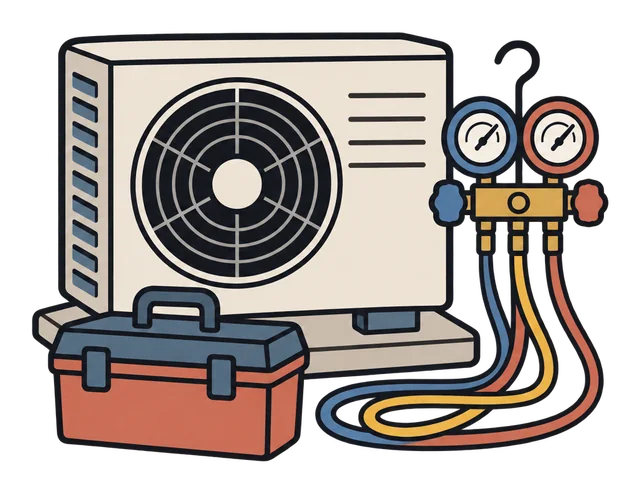
Try a digital gauge or diagnostic app on your next service call and note whether it flags anything you would have missed.
This is not a probability of losing your job. It combines how much of the role's task load is exposed to automation with how far adoption has actually gone — useful for comparing occupations on one consistent basis, and for nothing else.
Written for HVAC and refrigeration technicians who install, service and repair heating, cooling and refrigeration systems in homes and commercial buildings. Electricians, plumbers and mechanical engineers who design these systems have their own pages. The evidence is a US labour projection, US and EU refrigerant rules, a survey of users of a smart diagnostic tool, a national laboratory report on fault detection, and a field-service software company's annual report; it establishes what tools and rules change in the work, not how technicians' jobs have changed.
What is actually changing#
The unit of analysis is the task, not the job title. A role is not replaced — its task mix shifts.
Each tile is one task. Its size is how much of the job it is; its colour is where the task is heading. Click a tile to see what the judgement does not establish.
A projection and a certification rule; no record on this page tests machines or robots installing HVAC systems.
A self-reported survey of one app's users, co-written by the app's maker, and interviews with unnamed manufacturers.
Certification rules in two jurisdictions; they bind people and say nothing about tools that assist them.
It applies to large commercial and industrial refrigeration in the US and to equipment above thresholds in the EU, not to most home systems; repairs still need a certified technician.
A vendor describing its own product across all trades, and a survey of one app's users.
Is this your job? Say so and this page narrows to your share of it.
A job title is a bundle of tasks bought together, and no two people hold the same bundle. Nothing is sent anywhere — it stays in this browser.
Read all 5 tasks in full — direction, reasoning and limits →
Recent changes#
United States. The statistics bureau projects employment of heating, air conditioning and refrigeration mechanics and installers to grow 11 percent from 2025 to 2035, from 440,900 to 489,100, with about 40,600 openings a year. It notes that modern HVACR systems contain computerized components and networking features that technicians must be able to install or repair. The page does not mention artificial intelligence. It counts jobs for one country.
A named person with standing publicly predicted something, on a date, in an attributable statement. It is recorded so that who said what, and when, stays checkable — and it never moves a task's assessment, because a prediction is not an observation. Its value arrives later: the record sits on the same page as the evidence about that occupation, so anyone reading the forecast reads the record of what happened next beside it. That is the reckoning; this site publishes no verdict on whether a forecast came true.
A software company serving HVAC, plumbing, electrical and other trades businesses. Its annual report says its virtual agents, paired with its platform, use AI to automatically handle overflow and after-hours calls to book, reschedule and confirm appointments. It is the company describing its own product across trades, not a measure of HVAC offices' staffing.
A demo, benchmark or paper shows the task can be done. Updates what the technology can do — not what employers will do.
United States, commercial and industrial refrigeration. The rule requires owners of systems with a full charge of 1,500 pounds or more to install and use an automatic leak detection system, on installation for systems installed from January 1, 2026 and by January 1, 2027 for those installed from 2017; quarterly or annual leak inspections are not required on appliances continuously monitored by such a system; and repairs must be conducted by a certified technician. It does not cover most home systems.
Regulation, subsidy or public procurement is requiring or funding adoption — the mirror of a constraint. It shows adoption is being required, not that it has happened, so one mandate is never enough on its own; two independent ones are.
United States. A national laboratory report analysing field data and interviews with smart thermostat manufacturers. It says faults that occur during installation, such as refrigerant overcharge or undercharge, are typically addressed by technicians and are difficult for occupants to detect, and records a manufacturer's comment that the long payback period is a significant barrier to automatic fault detection in residential buildings. The manufacturers are not named.
Failure, rollback, regulation or cost is suppressing adoption. Can lower an assessment or widen its uncertainty.
United States, residential HVAC contractors who use one smart diagnostic app (measureQuick). Most respondents said more time is spent on site, especially on service visits, because the app helps technicians find more faults to repair; 83 percent of contractors reported fewer callbacks; and the app's graded report helps explain system performance to customers in nontechnical terms. Self-reported by the app's own users; the app's developer is described as working on the project.
Measured, large-scale use of a tool for real work, where the decision to use it was the worker's rather than an employer's. It is more than a capability record — the work is real, not a demo — and less than a deployment record, because no employer put it into production, required it, or built a process around it. Weighted `cautious`: `automating` means the machine can do the task AND there are adoption signs, and this is an adoption sign — but usage can be experimental, and much of the measurement comes from a party with a stake, so one record is never enough and two independent ones are. Note who is counting. Vendor telemetry sees this directly and sells the tool, so such a record names that stake in its scope; a statistics agency asking firms whether their workers use AI in tasks sees the same channel with no stake at all, and that is the better source where it exists.
European Union. Article 10 requires natural persons to be certified to carry out installation, maintenance or servicing, repair or decommissioning of listed equipment, and leak checks; Article 5 sets leak-check intervals that lengthen where a leakage detection system is installed, for example from at least every 12 months to at least every 24 months for smaller equipment. It binds people and equipment operators, not software.
Failure, rollback, regulation or cost is suppressing adoption. Can lower an assessment or widen its uncertainty.
United States. The regulation says any person who could be reasonably expected to violate the integrity of the refrigerant circuit during the maintenance, service, repair or disposal of appliances containing regulated refrigerants must pass a certification exam. It binds people, predates current AI tools and says nothing about software.
Failure, rollback, regulation or cost is suppressing adoption. Can lower an assessment or widen its uncertainty.
What this means for you#
If you are starting out, get the certifications the law requires for refrigerants, and expect diagnostic apps and connected systems to be part of the job. The hands-on installation and repair is where the demand is.
Expect more sensor data and remote alerts on larger systems, and fewer routine inspection visits there. Diagnosis on site, repairs and refrigerant work stay with certified people.
Your options#
Four directions, each with its real constraints and one thing you can test this week. Continuing as you are is a legitimate choice — it just has to be a chosen one.
Use diagnostic tools to find more faults
Users of smart diagnostic tools report finding more faults to repair and fewer callbacks.
Tools and their data vary by manufacturer, and the evidence comes from one app's users.
Try a digital gauge or diagnostic app on your next service call and note whether it flags anything you would have missed.
Stay in certified refrigerant and installation work
US and EU rules keep refrigerant work and leak repairs with certified people, and US demand is projected to grow.
The work is physical and often in hot, cramped spaces.
Check which refrigerant certification your jurisdiction requires and whether yours covers the equipment you work on.
Move into controls and building automation
Modern systems carry computerized components and networking features, and large systems now come with automatic leak detection.
It needs training in controls and networks on top of mechanical skills.
Find out which building-automation or fault-detection systems the commercial buildings you serve already use.
Common questions#
The evidence does not show that. Diagnostic tools help technicians find faults and sensors take over routine leak inspections on large systems, but installation and repair are physical and the law requires certified people to handle refrigerants. The US projects employment to grow 11 percent from 2025 to 2035, without mentioning AI.
We do not answer that with a number of years. Watch whether the systems you service come with remote monitoring, and whether certification rules change. Those tell you more than any date.
Tools can flag faults such as wrong refrigerant charge, and technicians using them report finding more problems. But a national laboratory report found such faults are typically fixed by technicians, and cost is a barrier to automatic fault detection in homes.
Yes, where the rules require it. In the US anyone who could open a refrigerant circuit must pass a certification exam, and in the EU people who install or service equipment with fluorinated gases must be certified.
What these judgements rest on#
4 of 5 task judgements on this page are backed by a verified event and 1 are platform inference, each labelled where it appears. Behind them sit 3 technology dimensions, a reconstructed trajectory since language models reached the public, and 7 verified events.
See which technologies, how it got here, and the method →
Where it sits in the official classification: skills, knowledge, related jobs →
Other roles in the same function#
A company divides its work into functions before it divides it into jobs. These sit in Core delivery (industry-specific) alongside this one — a fact about org charts, not a judgement that they are similar or that they are changing in the same direction.
Content moderator · Registered nurse · Radiologist · Pathologist · Radiographer / radiologic technologist · General practitioner / primary care doctor · Surgeon · Care worker / nursing assistant · Counsellor / therapist · Psychologist · Dietitian / nutritionist · Pharmacist · Pharmacy technician · School teacher · University lecturer · Chef / cook · Electrician · Plumber · Architect · Interior designer · Civil / structural engineer · Electrical engineer · Mechanical engineer · Industrial engineer · Quantity surveyor · Journalist · Editor and proofreader · Translator / Interpreter · Interpreter · Retail cashier / shop assistant · Bank teller · Medical assistant / clinic assistant · Waiter / restaurant server · Construction worker · Auto mechanic / vehicle technician · Medical laboratory technician · Physiotherapist / rehabilitation therapist · Firefighter · Police officer · Farmer · Social worker · Dentist · Dental hygienist · Veterinarian · Librarian · Welder · Sonographer