 LO
LO
Get told when a verified record lands on this occupation → · Mark which of these tasks are yours (VOLO Pro, free during the launch) →
Pathologist
Examines tissue under the microscope — increasingly on a screen — to diagnose disease: detecting and grading cancer, searching lymph nodes, scoring biomarkers, reporting frozen sections during surgery, and signing out the report. AI for prostate biopsies is cleared by the US regulator, but only as an add-on that must not be used as the primary diagnosis, and in a prospective study across three NHS centres its second read changed the diagnosis or grade for 5.4% of patients while cutting extra stains. Studies show AI helping pathologists find small metastases faster and agree on biomarker scores. Frozen sections were excluded from the first digital-slide clearance, and the UK's professional body says AI will not remove the need for pathologists in diagnosis.
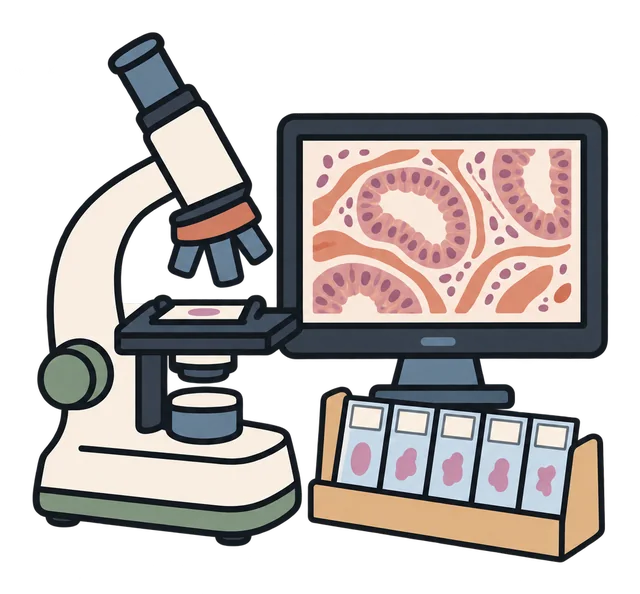
Find out whether your laboratory scans slides for primary diagnosis and which AI tools it has validated.
This is not a probability of losing your job. It combines how much of the role's task load is exposed to automation with how far adoption has actually gone — useful for comparing occupations on one consistent basis, and for nothing else.
Written for anatomic and surgical pathologists (histopathologists) who diagnose from tissue slides. Radiologists, who diagnose from images of the living body, have their own page, and laboratory technicians who prepare the slides are a different job. The evidence is three US regulatory decisions, a UK professional body's position, a prospective NHS study, a laboratory deployment, and studies of AI in grading, lymph-node review, biomarker scoring and frozen donor biopsies; much of it concerns prostate biopsies, and several studies were funded or written by the AI's developers. It establishes what the tools are cleared and shown to do, not how pathologists' jobs or incomes have changed. This page gives no clinical advice.
What is actually changing#
The unit of analysis is the task, not the job title. A role is not replaced — its task mix shifts.
Each tile is one task. Its size is how much of the job it is; its colour is where the task is heading. Click a tile to see what the judgement does not establish.
Almost all of it is prostate biopsy; the clearances are add-on only, and the prospective study and one deployment were written or funded by the developers.
A 70-slide reader study by the algorithm's developers and a professional body's view; neither measures workloads in practice.
One biomarker in one cancer, with a model built by the authors; it does not show routine use.
No record here measures AI on intraoperative tumour frozen sections; the only frozen-section study is retrospective and about donor kidneys.
Regulatory scope and a professional position; they describe the rules now, not what future clearances will allow.
Is this your job? Say so and this page narrows to your share of it.
A job title is a bundle of tasks bought together, and no two people hold the same bundle. Nothing is sent anywhere — it stays in this browser.
Read all 5 tasks in full — direction, reasoning and limits →
Recent changes#
England, three NHS specialist centres. Of 1,613 prostate biopsy cases, 1,049 were reported with assistance from a commercially available AI system. Staged second reads changed the initial diagnosis or grade group for 21 of 386 patients (5.4%), five of them (1.3%) potentially affecting management; cases requiring immunohistochemistry fell at all sites, and at one site concurrent reading cut mean turnaround by 30.1 hours. The developer was the industry partner and at least one author works for it.
Small-scale trial in a real setting. Tells us the deployment conditions are being tested, not that they hold — so one pilot is never enough on its own; two independent ones are.
United States. The FDA clearance says the device is intended to identify prostate core needle biopsy cases initially diagnosed as benign for further review by a pathologist, giving case- and slide-level alerts. In its reader study with 12 pathologists, combined sensitivity rose by 3.5 points and specificity fell by 3.2 points with the device. The study data came from the developer.
Failure, rollback, regulation or cost is suppressing adoption. Can lower an assessment or widen its uncertainty.
A study in which 21 pathologists of different levels from four institutions scored PD-L1 combined positive score in triple-negative breast cancer by eye and with a deep-learning model the authors built. With AI assistance there were no significant differences between pathologists, the intraclass correlation rose from 0.618 to 0.931, and 80% of the AI results were accepted overall, most by junior pathologists. One biomarker in one cancer.
A demo, benchmark or paper shows the task can be done. Updates what the technology can do — not what employers will do.
United States, a retrospective study of procurement biopsies from 2,431 deceased-donor kidneys. It says frozen sections present challenges for histological scoring, leading to inter- and intra-observer variability and inappropriate discard; its model's whole-slide features correlated with pathologists' scores and were more strongly associated with graft outcomes, and it suggests 110 of 398 kidneys discarded for biopsy findings could have had similar survival. Organ allocation, not intraoperative tumour frozen sections.
A demo, benchmark or paper shows the task can be done. Updates what the technology can do — not what employers will do.
United Kingdom, the professional body for pathologists. It says AI in healthcare must be clinically led; that pathologists will still be needed to interpret and analyse information to produce an overall pathological assessment; that AI could free pathologists from routine and repetitive work such as searching lymph nodes for cancer, simple quantitative tasks, or ordering additional tests before review; and that only a handful of UK trusts were using digital pathology. A professional position, not a binding rule.
Failure, rollback, regulation or cost is suppressing adoption. Can lower an assessment or widen its uncertainty.
An international competition with 1,290 developers and 10,616 digitised prostate biopsies. Submitted algorithms reached pathologist-level performance on independent cross-continental cohorts, with agreements of 0.862 and 0.868 (quadratically weighted kappa) with expert uropathologists on US and European validation sets; the authors say this warrants evaluating AI grading in prospective clinical trials. Retrospective validation, not clinical use.
A demo, benchmark or paper shows the task can be done. Updates what the technology can do — not what employers will do.
United States. The FDA's De Novo decision for Paige Prostate says it is an adjunctive computer-assisted methodology whose output should not be used as the primary diagnosis, to be used only with the pathologist's complete standard-of-care evaluation. In its study, expected patient benefit from improved sensitivity was 7.3% of biopsy specimens with cancer, which the FDA says would likely be substantially lower per patient. The study data came from the developer.
Failure, rollback, regulation or cost is suppressing adoption. Can lower an assessment or widen its uncertainty.
One pathology laboratory in Israel. The algorithm was implemented within routine clinical workflow as a second read system to review all prostate core needle biopsies; in routine practice it assessed 11,429 slides from 941 cases, raising 90 high-grade and 560 cancer alerts, of which 51 (9%) led to additional cuts or stains. The study was funded by the developer, some authors report fees from it, and it reports one missed cancer caught by the algorithm.
An employer has put it into production. Can move the baseline — weighted by scale and how similar the setting is.
A multireader, multicase study in which six pathologists reviewed 70 digitised lymph-node slides with and without an algorithm outlining likely tumour. Assisted sensitivity for micrometastases was 91% against 83%, and average review time per image was 61 against 116 seconds for micrometastases and 111 against 137 seconds for negative images. The authors who built and tested the algorithm are employees of Alphabet.
A demo, benchmark or paper shows the task can be done. Updates what the technology can do — not what employers will do.
United States. The FDA's De Novo decision authorised a whole-slide imaging system for pathologists to review and interpret digital images of formalin-fixed paraffin-embedded surgical pathology slides, and says it is not intended for use with frozen section, cytology or non-FFPE hematopathology specimens. In its study of 7,959 paired readings, 96.5% showed no major discordance between modalities or major discordance for both. It moves reading from glass to screen; it is not AI.
Failure, rollback, regulation or cost is suppressing adoption. Can lower an assessment or widen its uncertainty.
What this means for you#
If you are training, expect to report on screens with AI flags from the start, and build what the tools cannot take: frozen sections, the unusual case, and the integrated diagnosis you sign.
Expect AI second reads and pre-ordered stains in prostate and similar high-volume work. The diagnosis, and responsibility for it, stay with you.
Your options#
Four directions, each with its real constraints and one thing you can test this week. Continuing as you are is a legitimate choice — it just has to be a chosen one.

Work with AI as a second reader in high-volume specimens
Cleared tools flag cases for review, and a prospective NHS study found they changed some diagnoses and reduced extra stains.
It needs digital slide scanning, which not every laboratory has.
Find out whether your laboratory scans slides for primary diagnosis and which AI tools it has validated.

Stay in frozen sections and complex diagnosis
Frozen sections were excluded from the first digital clearance, and every cleared tool keeps the diagnosis with the pathologist.
Future clearances may widen what tools are allowed to do.
Read the intended-use statement of one AI tool your laboratory uses or is considering.
Move into validating and governing pathology AI
Each laboratory must validate digital and AI tools before use, and the professional body says AI must be clinically led.
These roles are few and usually part of a senior post.
Read the Royal College of Pathologists' position statement on digital pathology and AI.
Common questions#
The evidence does not show that. Cleared AI tools for prostate biopsies work as second readers whose output must not be the primary diagnosis, and studies show AI helping pathologists search slides and score biomarkers. The UK's professional body says pathologists will still be needed to produce the overall assessment.
We do not answer that with a number of years. Watch whether regulators clear AI for primary diagnosis rather than as an add-on, and whether your laboratory digitises its slides. Those tell you more than any date.
In the US, AI for prostate biopsies is cleared only as an aid: the FDA says Paige Prostate's output should not be used as the primary diagnosis, and a later tool flags benign-diagnosed cases for a pathologist's review.
In some studies. Assisted pathologists took about half the time per lymph-node image in a reader study, and one NHS site saw turnaround fall by 30.1 hours with AI read alongside the pathologist.
What these judgements rest on#
4 of 5 task judgements on this page are backed by a verified event and 1 are platform inference, each labelled where it appears. Behind them sit 1 technology dimensions, a reconstructed trajectory since language models reached the public, and 10 verified events.
See which technologies, how it got here, and the method →
Where it sits in the official classification: skills, knowledge, related jobs →
Other roles in the same function#
A company divides its work into functions before it divides it into jobs. These sit in Core delivery (industry-specific) alongside this one — a fact about org charts, not a judgement that they are similar or that they are changing in the same direction.
Content moderator · Registered nurse · Radiologist · Radiographer / radiologic technologist · General practitioner / primary care doctor · Surgeon · Care worker / nursing assistant · Counsellor / therapist · Psychologist · Dietitian / nutritionist · Pharmacist · Pharmacy technician · School teacher · University lecturer · Chef / cook · Electrician · Plumber · Architect · Interior designer · Civil / structural engineer · Electrical engineer · Mechanical engineer · Industrial engineer · Quantity surveyor · Journalist · Editor and proofreader · Translator / Interpreter · Interpreter · Retail cashier / shop assistant · Bank teller · Medical assistant / clinic assistant · Waiter / restaurant server · Construction worker · Auto mechanic / vehicle technician · Medical laboratory technician · Physiotherapist / rehabilitation therapist · Firefighter · Police officer · Farmer · Social worker · Dentist · Veterinarian · Librarian · Welder · Sonographer