 LO
LO
Get told when a verified record lands on this occupation → · Mark which of these tasks are yours (VOLO Pro, free during the launch) →
Anaesthesiologist / anaesthetist
Keeps patients safe and unaware through surgery: assesses them beforehand, plans and delivers anaesthesia, watches their blood pressure, breathing and depth of anaesthesia minute by minute, manages the airway, and handles recovery and pain. Machines already help with the dosing and the watching — trials of closed-loop systems that adjust the anaesthetic automatically keep patients in the target range more of the time, and an algorithm cleared by the US regulator warns of low blood pressure before it happens. But every approval keeps a person in charge: the regulator cleared the warning algorithm only as an adjunct that may not direct treatment on its own, approved an automated sedation machine only for healthy adults with an anaesthesia professional immediately available, and two 2026 trials found the algorithm no better than a simple blood-pressure alarm.
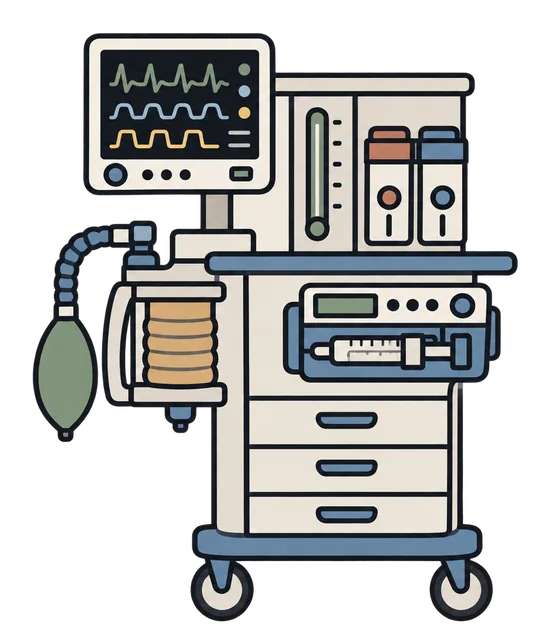
Find out which monitoring or closed-loop devices your hospital uses and read the intended-use statement in one of their regulatory clearances.
This is not a probability of losing your job. It combines how much of the role's task load is exposed to automation with how far adoption has actually gone — useful for comparing occupations on one consistent basis, and for nothing else.
Written for doctors who specialise in anaesthesia, and relevant to nurse anaesthetists and anaesthesia associates who share many of the same tasks. Surgeons and radiologists have their own pages. The evidence is two US regulatory decisions on automated sedation and hypotension-warning devices, three randomised trials of the warning algorithm, a meta-analysis of automated anaesthetic delivery and two studies of language models on anaesthesiology exams; it establishes what machines can do in anaesthesia and what regulators require of a person, not how anaesthetists' numbers or workload have changed.
What is actually changing#
The unit of analysis is the task, not the job title. A role is not replaced — its task mix shifts.
Each tile is one task. Its size is how much of the job it is; its colour is where the task is heading. Click a tile to see what the judgement does not establish.
Exam studies, not patients; an exam answer is not an assessment of a real patient, and neither study measures work in hospitals.
Trials of research systems and one restricted approval; no record shows automated anaesthesia in routine use, or how much of the anaesthetist's attention it frees.
Small trials of one algorithm; they measure blood pressure, not staffing, and do not show whether anaesthetists watch fewer patients.
The absence of a record is not evidence that nothing is being developed; research on predicting difficult airways was found only in reviews and single studies.
This judgement rests on the absence of records and on the other tasks, not on evidence about recovery or pain management itself.
Is this your job? Say so and this page narrows to your share of it.
A job title is a bundle of tasks bought together, and no two people hold the same bundle. Nothing is sent anywhere — it stays in this browser.
Read all 5 tasks in full — direction, reasoning and limits →
Recent changes#
An open-label randomised trial at two centres with 100 adults having major noncardiac surgery. Treatment triggered by the prediction algorithm was compared with treatment triggered at a mean arterial pressure of 73 mmHg or below, under the same protocol. The algorithm was not superior; the authors note the trial was not designed to show equivalence, and that earlier benefits may partly reflect open-label designs and treating at higher thresholds.
A demo, benchmark or paper shows the task can be done. Updates what the technology can do — not what employers will do.
A single-centre, blinded randomised trial in adults having moderate- or high-risk elective noncardiac surgery, with 143 participants analysed. A mean arterial pressure alarm below 72 mmHg was non-inferior to the prediction algorithm's default alarm in preventing hypotension, with no differences in secondary outcomes; the authors call the simple alarm a pragmatic and cost-effective alternative.
A demo, benchmark or paper shows the task can be done. Updates what the technology can do — not what employers will do.
A systematic review and meta-analysis of 17 randomised trials with 1,898 adults having noncardiac surgery, comparing closed-loop systems guided by brain-activity monitoring with clinicians adjusting by hand. The closed-loop systems increased time within the target range by 17.6%, reduced time too deep, and shortened time to removing the breathing tube slightly. The trials compare research and commercial controllers in study settings; they do not show routine unsupervised use.
A demo, benchmark or paper shows the task can be done. Updates what the technology can do — not what employers will do.
A study running GPT-4o 30 times on Chile's 183-question anaesthesiology certification exam. Overall accuracy was 83.69%, highest on understanding and recall and lower on application (76.83%) and analysis (76.54%). Among incorrect answers, unsupported medical claims were the most common error. The authors say its limits in higher-order reasoning and diagnostic judgement call for more safeguards before clinical use.
A demo, benchmark or paper shows the task can be done. Updates what the technology can do — not what employers will do.
An exploratory study comparing four anaesthesiology fellows with ChatGPT on two sample US oral board examinations, which test judgement and adapting to unexpected clinical changes, scored blind by eight examiners using a voice replicator. Fellows scored better on module topics, with no significant difference in overall module scores, and examiners identified the ChatGPT answers in 23 of 24 modules. A small study of sample exams.
A demo, benchmark or paper shows the task can be done. Updates what the technology can do — not what employers will do.
A preliminary, unblinded randomised trial at one tertiary centre in Amsterdam with 68 patients having elective noncardiac surgery. With the early warning system and a treatment protocol, the median time of hypotension per patient was 8.0 minutes against 32.7 minutes with standard care. The authors call it a single-centre preliminary study and say larger studies in diverse settings are needed.
A demo, benchmark or paper shows the task can be done. Updates what the technology can do — not what employers will do.
United States. The regulator created a new device type, the adjunctive predictive cardiovascular indicator, for software that estimates the likelihood of future cardiovascular events such as low blood pressure. It says the device is intended for adjunctive use with other vital signs and patient information and is not intended to independently direct therapy. The algorithm can warn; the decision to treat stays with the clinician.
Failure, rollback, regulation or cost is suppressing adoption. Can lower an assessment or widen its uncertainty.
United States. The regulator approved a computer-assisted system that delivers propofol for minimal to moderate sedation, but only in adults of ASA physical status I and II undergoing colonoscopy and gastroscopy. Its advisory panel voted 10-0 that one person with at least a nurse's training should be responsible only for monitoring the device and managing the airway, and the approval kept a restriction requiring that a professional trained in the administration of anaesthesia is immediately available; post-approval studies were meant to test whether that restriction could later be removed.
Failure, rollback, regulation or cost is suppressing adoption. Can lower an assessment or widen its uncertainty.
What this means for you#
If you are training, expect automated dosing and warning systems in the theatre, and build what they lack: judging which warning matters for this patient, managing the airway, and leading when things go wrong.
Expect more monitoring signals and more automated adjustment, and more of your role to be deciding when to trust them. The trials so far show a simple threshold can do as well as a prediction algorithm, so your judgement about targets still carries the outcome.
Your options#
Four directions, each with its real constraints and one thing you can test this week. Continuing as you are is a legitimate choice — it just has to be a chosen one.
Stay in theatre anaesthesia
Every approval found keeps a trained person in charge of dosing, monitoring and the airway.
Automated sedation for simple procedures could move some low-risk cases away from anaesthetists if regulators relax the conditions.
Find out which monitoring or closed-loop devices your hospital uses and read the intended-use statement in one of their regulatory clearances.
Become the person who evaluates the algorithms
The warning algorithm looked helpful in an early trial and no better than a simple alarm in later ones; departments need someone who can read that evidence.
It takes time for research and governance on top of clinical work.
Read one of the 2026 randomised trials of the hypotension prediction algorithm and compare its alarm threshold with the one your department uses.
Move into intensive care or pain medicine
They draw on the same skills in airway, resuscitation and pain control, where no record shows machines taking over.
It usually requires further specialist training and exams.
Look up the training route to intensive care or pain medicine where you work and note what it requires beyond anaesthesia.
Common questions#
Not on present evidence. Closed-loop systems adjust anaesthetic dosing well in trials and an algorithm warns of low blood pressure, but the US regulator clears the algorithm only as an adjunct, approved automated sedation only for healthy adults with an anaesthesia professional immediately available, and recent trials found the algorithm no better than a simple alarm.
We do not answer that with a number of years. Watch whether regulators start approving automated devices without the condition that a trained person is present, and whether hospitals change how many patients one anaesthetist oversees. Those tell you more than any date.
Not under current approvals. Closed-loop systems kept patients in the target depth more of the time in 17 trials, and one automated sedation machine was approved for healthy adults having endoscopy — but only with an anaesthesia professional immediately available and a dedicated person watching the airway.
The evidence is mixed. An early single-centre trial found less low blood pressure during surgery, but two 2026 randomised trials found it no better than treating at a simple blood-pressure threshold of 72 or 73 mmHg.
What these judgements rest on#
3 of 5 task judgements on this page are backed by a verified event and 2 are platform inference, each labelled where it appears. Behind them sit 2 technology dimensions, a reconstructed trajectory since language models reached the public, and 8 verified events.
See which technologies, how it got here, and the method →
Where it sits in the official classification: skills, knowledge, related jobs →
Other roles in the same function#
A company divides its work into functions before it divides it into jobs. These sit in Core delivery (industry-specific) alongside this one — a fact about org charts, not a judgement that they are similar or that they are changing in the same direction.
Content moderator · Registered nurse · Radiologist · Pathologist · Radiographer / radiologic technologist · General practitioner / primary care doctor · Surgeon · Optometrist · Care worker / nursing assistant · Counsellor / therapist · Psychologist · Dietitian / nutritionist · Pharmacist · Pharmacy technician · School teacher · Driving instructor · University lecturer · Chef / cook · Electrician · Plumber · HVAC technician · Architect · Interior designer · Civil / structural engineer · GIS analyst / cartographer · Electrical engineer · Chip design engineer · Mechanical engineer · Industrial engineer · Quantity surveyor · Journalist · Editor and proofreader · Translator / Interpreter · Interpreter · Retail cashier / shop assistant · Bank teller · Medical assistant / clinic assistant · Waiter / restaurant server · Hairdresser / barber · Construction worker · Auto mechanic / vehicle technician · Medical laboratory technician · Physiotherapist / rehabilitation therapist · Firefighter · Police officer · Farmer · Social worker · Dentist · Dental hygienist · Veterinarian · Librarian · Welder · Sonographer