 LO
LO
Get told when a verified record lands on this occupation → · Mark which of these tasks are yours (VOLO Pro, free during the launch) →
Pharmacy technician
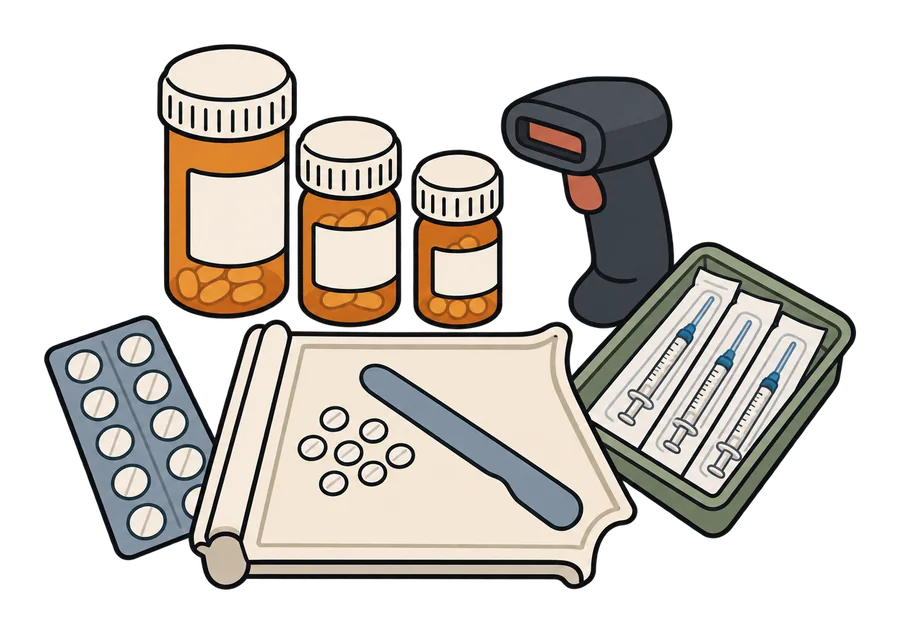
Works under a pharmacist to get the right medicine to the patient: takes in and enters prescriptions, counts, fills and packages them, prepares sterile and chemotherapy doses, keeps stock, stocks automated cabinets in hospitals and serves people at the counter. Counting and filling is moving into robots and central fill centres, and compounding robots cut errors while taking longer per dose; at the same time the law is handing technicians work that used to be the pharmacist's, and US projections expect the occupation to grow.
Find out whether your jurisdiction allows technicians to do final product checks, and what training it requires.
This is not a probability of losing your job. It combines how much of the role's task load is exposed to automation with how far adoption has actually gone — useful for comparing occupations on one consistent basis, and for nothing else.
Written for pharmacy technicians and dispensing assistants in community and hospital pharmacies. Pharmacists — the final check and the advice — have their own page. The evidence is a US pharmacy chain's own filings, hospital studies of dispensing and compounding robots, rules in the UK, Japan and Iowa on which tasks non-pharmacists may do, and a US labour projection; it establishes what machines took over in named settings and what rules allow, not how technicians' hours have changed across the occupation. Countries differ widely: some register technicians, some have no such grade.
What is actually changing#
The unit of analysis is the task, not the job title. A role is not replaced — its task mix shifts.
Each tile is one task. Its size is how much of the job it is; its colour is where the task is heading. Click a tile to see what the judgement does not establish.
No primary source measured how much of intake or insurance work software now does; the projection describes a shift of tasks, not its size.
One chain's own filings and releases, one hospital's study and one ministry notice; none of them counts technician jobs or hours.
Hospital studies of specific robots in cancer care; they do not measure staffing, and most compounding elsewhere is still manual.
These rules allow the shift; they do not measure how many pharmacies use it, and the rules differ widely between places.
One hospital; errors were measured at nurses' administration, not in technicians' work, and staffing was not reported.
The UK rule allows a delegation; it does not measure counter work or automated stock ordering.
Is this your job? Say so and this page narrows to your share of it.
A job title is a bundle of tasks bought together, and no two people hold the same bundle. Nothing is sent anywhere — it stays in this browser.
Read all 6 tasks in full — direction, reasoning and limits →
Recent changes#
United States. The statistics bureau projects that employment of pharmacy technicians will grow 6 percent from 2025 to 2035, faster than the average for all occupations, from 471,200 to 501,300, with about 44,700 openings a year. It says technicians will need to perform tasks such as collecting patient information, handling prescription transfers and verifying the work of other technicians that were previously done by pharmacists. It counts jobs for one country.
A named person with standing publicly predicted something, on a date, in an attributable statement. It is recorded so that who said what, and when, stays checkable — and it never moves a task's assessment, because a prediction is not an observation. Its value arrives later: the record sits on the same page as the evidence about that occupation, so anyone reading the forecast reads the record of what happened next beside it. That is the reckoning; this site publishes no verdict on whether a forecast came true.
Great Britain. The regulator says the new legislation will allow pharmacists to authorise, when absent or treated as absent, the handing out of checked and bagged prescriptions from 7 January 2026; and from 10 December 2026 to authorise a pharmacy technician to undertake or supervise the preparation, assembly, dispensing and sale and supply of medicines, with pharmacy technicians able to take primary responsibility for preparation in hospital aseptic facilities. It enables delegation from pharmacist to technician; it does not concern automation, and use depends on employers.
Failure, rollback, regulation or cost is suppressing adoption. Can lower an assessment or widen its uncertainty.
United States. The company's own release says its network of 12 micro-fulfillment centers now supports over 5,000 stores, fulfilling more than 3.5 million prescriptions weekly, with shipped volumes up 24% year over year, and that the new facility will support nearly 200 stores with dispensing and shipping of prescriptions. It frames the benefit as freeing pharmacists; it does not report effects on technician staffing, and it is the company describing its own operations.
An employer has put it into production. Can move the baseline — weighted by scale and how similar the setting is.
United States. The annual report says the US retail pharmacy segment operated 11 prescription micro-fulfillment centers covering about 858 thousand square feet, and it names the rollout of micro-fulfillment centers among growth initiatives that were reprioritised as capital expenditure fell. It shows central fill in production and its expansion slowing for financial reasons; it does not report staffing effects.
An employer has put it into production. Can move the baseline — weighted by scale and how similar the setting is.
United States, one community cancer centre in Tennessee. Of 8,210 doses, 52.1% were made by the APOTECAchemo robot; of 25 failed doses, 8 (0.2%) were attributed to the robot and 17 (1%) to manual compounding, and the average dose preparation time was longer with the robot than with manual methods. The authors declared no conflicts. It is one site and one product.
An employer has put it into production. Can move the baseline — weighted by scale and how similar the setting is.
United States, Walgreens' retail pharmacy business. The company's own results release says it was operating nine automated micro-fulfillment centers at quarter-end, supporting about 3,600 stores; an October 2021 release named the automation vendor, iA. The centres fill refill prescriptions centrally so store staff do not count and fill them. It is the operator describing its own operations; it does not report staffing effects on technicians.
An employer has put it into production. Can move the baseline — weighted by scale and how similar the setting is.
Japan, one hospital pharmacy. After a robotic dispensing system operated by pharmacy support staff was introduced, the median dispensing time of pharmacists per prescription fell from 60 to 23 seconds, and prevented dispensing errors fell from 0.204% to 0.044%. The authors declared no competing interests; co-authors include a consultancy. It is one hospital, and it measures pharmacists' time rather than the support staff's.
An employer has put it into production. Can move the baseline — weighted by scale and how similar the setting is.
Japan. The ministry notice says that, on a pharmacist's instruction and under the pharmacist's supervision, non-pharmacist staff may gather the required quantity of medicines still in PTP (blister) packaging and count one-dose packs before the pharmacist's check, while non-pharmacists directly weighing or mixing ointments, liquids or powders still violates Article 19 of the Pharmacists Act, even with checks along the way; it adds that this is not meant to discourage active use of dispensing equipment. Japan has no registered technician grade, so this concerns pharmacy support staff.
Failure, rollback, regulation or cost is suppressing adoption. Can lower an assessment or widen its uncertainty.
Iowa, United States. The statute allows pharmacies to run programmes in which certified pharmacy technicians do the final product verification, and requires the plan to demonstrate that onsite practice hours for a pharmacist will not be reduced but will be redistributed directly to patient care activities. It moves a check from pharmacist to technician under conditions; it does not measure use.
Failure, rollback, regulation or cost is suppressing adoption. Can lower an assessment or widen its uncertainty.
France, one general hospital. After a unit-dose robot and automated dispensing cabinets replaced traditional ward stock, the study reports that the implementation of an automated drug dispensing system resulted in a 53% reduction in medication administration errors. Errors were measured when nurses gave medicines, not in pharmacy staff's work; the authors declared no conflicts; staffing was not reported.
An employer has put it into production. Can move the baseline — weighted by scale and how similar the setting is.
United States, one academic cancer centre. Comparing manual preparation with a compounding robot, drugs failed accuracy measurements in 12.5% (23 of 184) of preparations at baseline and 0.9% (1 of 110) with the robot; mean drug preparation time increased by 47%, and labour costs were similar in both periods. It is one site and an older robot; the published text available did not include the authors' disclosures.
An employer has put it into production. Can move the baseline — weighted by scale and how similar the setting is.
What this means for you#
If you are starting out, expect less counting and filling by hand where chains build central fill or robots, and more of the checking, sterile preparation and patient-facing work the law is moving to technicians. Registration and training in sterile compounding and product checking are what open those roles.
Expect your role to move up the chain: supervising robots and cabinets, checking others' work and, in some places, running dispensing under a pharmacist's authorisation. Learn the machines your pharmacy is buying and the rules your jurisdiction is changing.
Your options#
Four directions, each with its real constraints and one thing you can test this week. Continuing as you are is a legitimate choice — it just has to be a chosen one.

Stay, and take on product checking
Rules in Iowa and the UK move the final check and supervised dispensing to technicians, and US projections name checking others' work as a task moving to technicians.
Depends on local rules, registration and your employer's programme.
Find out whether your jurisdiction allows technicians to do final product checks, and what training it requires.

Move into sterile and chemotherapy preparation
Compounding robots cut errors but still need people to load, supervise and handle what they cannot, and the UK is giving technicians primary responsibility in aseptic units.
Sterile work needs specific training and usually a hospital or specialist setting.
Ask your hospital pharmacy or a local one whether it uses a compounding robot and who operates it.
Move into pharmacy automation operations
Central fill centres and hospital robots need people who understand dispensing to run, stock and troubleshoot them.
Such centres are few and concentrated in large chains and hospitals, and rollouts can slow when budgets are cut.
Check whether any chain or hospital near you runs a central fill or automated dispensing operation, and what roles it advertises.
Common questions#
Robots are taking over counting and filling where pharmacies invest in them, and compounding robots make fewer errors. But the same period has seen rules move checking and dispensing work from pharmacists to technicians, and US projections expect pharmacy technician employment to grow 6 percent from 2025 to 2035.
We do not answer that with a number of years. Watch two signals instead: whether central fill and robots spread beyond a few large chains and hospitals, and whether the rules that move checking and dispensing to technicians are used widely. Today central fill at scale is documented at one large US chain, and those rules are just coming into force.
Not in the studies we cite. In a US cancer centre a chemotherapy robot cut doses failing accuracy checks from 12.5% to 0.9% but raised mean preparation time by 47%, with similar labour costs; a community cancer centre also found robot doses took longer. What they buy is accuracy, not speed.
US projections expect 6 percent growth from 2025 to 2035, faster than average, with about 44,700 openings a year. The work is shifting from hand-filling towards checking, sterile preparation and supervising machines.
What these judgements rest on#
5 of 6 task judgements on this page are backed by a verified event and 1 are platform inference, each labelled where it appears. Behind them sit 3 technology dimensions, a reconstructed trajectory since language models reached the public, and 11 verified events.
See which technologies, how it got here, and the method →
Where it sits in the official classification: skills, knowledge, related jobs →
Other roles in the same function#
A company divides its work into functions before it divides it into jobs. These sit in Core delivery (industry-specific) alongside this one — a fact about org charts, not a judgement that they are similar or that they are changing in the same direction.
Content moderator · Registered nurse · Radiologist · Radiographer / radiologic technologist · General practitioner / primary care doctor · Surgeon · Care worker / nursing assistant · Counsellor / therapist · Pharmacist · School teacher · University lecturer · Chef / cook · Electrician · Plumber · Architect · Interior designer · Civil / structural engineer · Electrical engineer · Mechanical engineer · Industrial engineer · Quantity surveyor · Journalist · Editor and proofreader · Translator / Interpreter · Interpreter · Retail cashier / shop assistant · Bank teller · Medical assistant / clinic assistant · Waiter / restaurant server · Construction worker · Auto mechanic / vehicle technician · Medical laboratory technician · Physiotherapist / rehabilitation therapist · Firefighter · Police officer · Farmer · Social worker · Dentist · Veterinarian · Librarian · Welder · Sonographer