 LO
LO
Labour impactProcess & self-service2026-06-04
University of Pennsylvania Health System's year-long donor-care ICU program had respiratory therapists manage ventilators and monitoring remotely, saving an estimated 2.2 FTEs
Respiratory therapistoccupation page →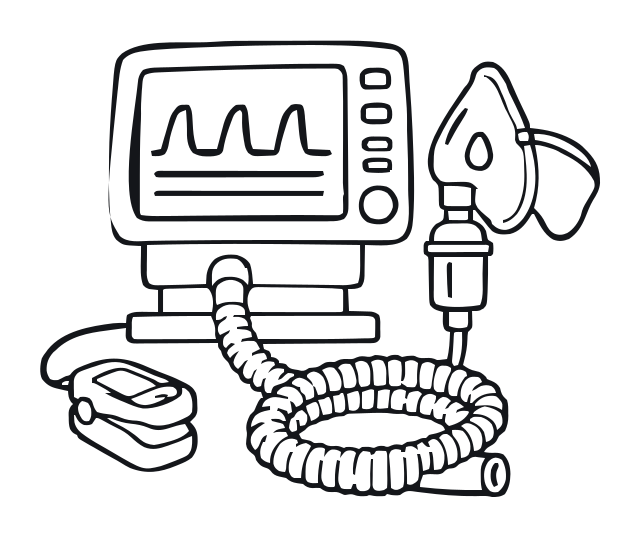
Event date / reported
2026-06-04
Evidence stage
Labour impactVerifiable change in hiring, headcount, hours or job scope. Highest weight — but causal attribution still has to be argued, not assumed.
Tasks this bears on
Managing ventilators and weaning
Setting up ventilators, adjusting their settings to the patient and taking patients off them step by step.
Being augmented✓ Evidence-backed
Assessing and monitoring patients
Measuring blood gases and lung function, watching oxygen levels and alarms, and reporting changes to the care team.
Being augmented✓ Evidence-backed
Where this applies
A prospective observational study (October 2023 to October 2024) by the University of Pennsylvania Health System's Center for Connected Care (PENN E-LERT) and the Gift of Life Donor Program, published in Critical Care Medicine (2026-06-04), of an eight-bed brain-dead donor-care ICU where all respiratory therapy care, including full ventilator management, was delivered remotely via a telecritical-care platform with real-time audiovisual monitoring and a remote ventilator interface, with in-person respiratory therapists called in only when needed. Across 182 organ donors, the program logged 3,872 remote respiratory procedures and 1,782 hours of remote care; in-person respiratory therapists were needed for only 119 hours (6.1%), mostly for transport and advanced airway work, and the health system estimated this avoided 2.2 full-time-equivalent respiratory therapist positions and $306,952 in labor costs. This is one health system's own account of one specialised ICU that manages brain-dead organ donors, not general hospital patients, over one year, with no control group; the FTE-savings estimate is the health system's own calculation, not an independently audited figure. The 6.1% of hours still done in person is evidence that hands-on airway work and transport keep needing a respiratory therapist physically present.
What this means
This health system ran a remote respiratory-therapy service for a full year and measured a real staffing effect: an estimated 2.2 fewer full-time respiratory therapist positions needed at the bedside, with therapists instead managing ventilators and watching monitors from off-site.
What it does not yet show
It does not establish how respiratory therapists' numbers or hours are changing in an ordinary hospital ICU — this is one specialised ICU that manages brain-dead organ donors, at one health system, with no comparison group, and the FTE-savings figure is the health system's own estimate.
What you can check
Ask your respiratory therapy department whether it runs, or is piloting, a tele-critical-care service for any of its ICUs, and what share of ventilator-management hours are handled remotely versus at the bedside.
Does it change the assessment?
No. The impact index is never moved by a single event. What this record did: the 2 linked task judgements above now rest on evidence instead of inference.
Source
University of Pennsylvania Health System / Gift of Life Donor Program — Critical Care Medicine · verified 2026-10-06 · VOLO agent loop · interpreted 2026-10-06 · VOLO agent loop
Primary source — published by the party that did this, or the authority of record. No co-signature needed.