 LO
LO
Get told when a verified record lands on this occupation → · Mark which of these tasks are yours (VOLO Pro, free during the launch) →
Dental assistant / dental nurse
Works beside the dentist: passing instruments and keeping the mouth clear during treatment, cleaning and sterilising instruments, taking X-rays and impressions, and keeping records and the front desk running. The tools are changing more than the job: intraoral scanners are faster than traditional impressions in studies, and Virginia now lets dental assistants and a new, separately trained digital scan technician take scans; instrument cleaning already runs through washer-disinfectors and sterilisers operated by dental nurses. AI voice charting aims at the assistant's recording role but transcribed periodontal charts with only 67.40% accuracy in one study. The US projects 7% growth.
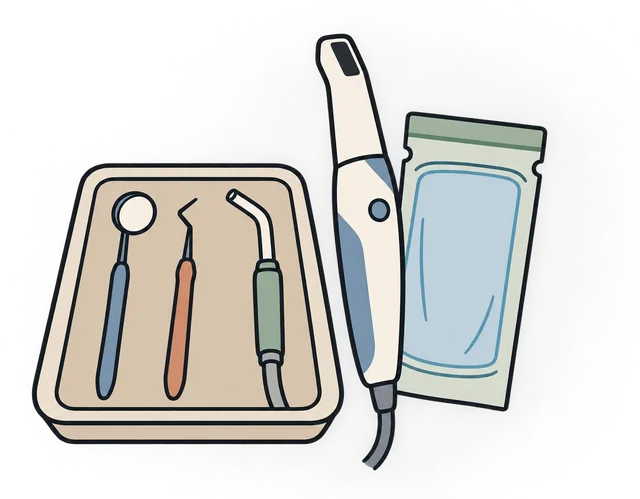
Check your state's or country's rules on who may take digital dental scans.
This is not a probability of losing your job. It combines how much of the role's task load is exposed to automation with how far adoption has actually gone — useful for comparing occupations on one consistent basis, and for nothing else.
Written for dental assistants in the US and dental nurses in the UK and elsewhere; dentists and dental hygienists have their own pages. The evidence is a US labour projection, a systematic review of intraoral scanning, Virginia's rules on who may take dental scans, Scotland's decontamination guidance and a study of AI voice charting; it establishes how tools and rules are changing parts of the work, mostly in single jurisdictions, not how assistants' numbers or hours have changed.
What is actually changing#
The unit of analysis is the task, not the job title. A role is not replaced — its task mix shifts.
Each tile is one task. Its size is how much of the job it is; its colour is where the task is heading. Click a tile to see what the judgement does not establish.
A projection and the absence of a record; they do not measure how chairside work is changing.
Guidance in one country; it describes how the work is done, not a recent change in it.
A review of procedure time and one US state's rules; they do not show who takes scans in most practices.
One study in one clinic setting with one language mix; it does not measure front-desk work.
Is this your job? Say so and this page narrows to your share of it.
A job title is a bundle of tasks bought together, and no two people hold the same bundle. Nothing is sent anywhere — it stays in this browser.
Read all 4 tasks in full — direction, reasoning and limits →
Recent changes#
United States. The statistics bureau projects employment of dental assistants to grow 7 percent from 2025 to 2035, from 388,600, with about 53,000 openings a year. It says research linking oral and general health will increase demand for preventive dental services and that dentists will continue to hire dental assistants to complete routine tasks so they can work more efficiently. It does not mention technology.
A named person with standing publicly predicted something, on a date, in an attributable statement. It is recorded so that who said what, and when, stays checkable — and it never moves a task's assessment, because a prediction is not an observation. Its value arrives later: the record sits on the same page as the evidence about that occupation, so anyone reading the forecast reads the record of what happened next beside it. That is the reckoning; this site publishes no verdict on whether a forecast came true.
Virginia, United States. The statute says no person other than a dentist, dental hygienist, dental assistant I or II, digital scan technician, or other person under a dentist's direction shall obtain dental scans; a digital scan technician is someone who has completed a board-approved training programme to take scans for teledentistry. The final regulation, effective March 25, 2026, requires the delegating dentist to be accessible and available for consultation with the technician at all times. One state; it widens who may scan rather than automating it.
Failure, rollback, regulation or cost is suppressing adoption. Can lower an assessment or widen its uncertainty.
Taiwan, a simulated clinical setting. The authors describe the current two-person workflow, in which a dentist performs the examination and a recorder enters the data, as costly and error-prone, and test an AI voice system that reached 67.40 percent overall accuracy in extracting and formatting data fields; they say a better benchmark would be dentists working with experienced dental assistants. A capability test in one language setting.
A demo, benchmark or paper shows the task can be done. Updates what the technology can do — not what employers will do.
Scotland. The guidance lists washer-disinfectors, benchtop sterilisers and ultrasonic cleaners for processing dental instruments in a local decontamination unit, and defines the Operator, for example a dental nurse or decontamination operator, as the person with authority to operate the equipment, whose duties include noting instrument readings and replenishing consumables. It describes a task already run through machines, with a person operating and logging them.
Failure, rollback, regulation or cost is suppressing adoption. Can lower an assessment or widen its uncertainty.
A systematic review of 17 studies (9 randomised trials and 8 prospective clinical studies) with 430 intraoral scans and 370 conventional impressions in 437 patients. It finds intraoral scanning faster than conventional impressions regardless of the area scanned, with similar prosthodontic outcomes, but generally more retakes. It measures procedure time, not who takes the scan.
A demo, benchmark or paper shows the task can be done. Updates what the technology can do — not what employers will do.
What this means for you#
If you are starting out, expect to scan rather than take impressions, run sterilisation machines rather than scrub by hand, and see voice charting tools tried at the chair. Build what stays with you: four-handed assisting, infection control and caring for nervous patients.
Expect new tools and new roles around scanning and records. Chairside skill and infection control stay with you.
Your options#
Four directions, each with its real constraints and one thing you can test this week. Continuing as you are is a legitimate choice — it just has to be a chosen one.
Get trained on intraoral scanning
Scanning is faster than impressions in studies, and some US states let dental assistants take scans.
Whether assistants may take scans depends on each state's or country's rules.
Check your state's or country's rules on who may take digital dental scans.
Stay at the chair and in infection control
No record shows machines assisting at the chair, and the US projects growth for the job.
Pay is modest and the work is physically demanding.
List which of your tasks last week were at the chair and which were records or scheduling.
Move towards dental hygiene or expanded functions
Many places let trained assistants take on expanded duties, and dental hygienists have a separate licensed scope.
Becoming a hygienist needs further study and a licence.
Find out which expanded functions your jurisdiction allows for assistants and what training they need.
Common questions#
Not on present evidence. Scanners, sterilisers and voice tools change parts of the work, but no record shows machines assisting at the chair, AI voice charting reached only 67.40% accuracy in one study, and the US projects 7% growth for the job.
We do not answer that with a number of years. Watch whether voice charting becomes accurate enough to drop the second person at the chair, and whether scanning moves to other roles in your area. Those tell you more than any date.
Increasingly. A review of 17 studies found intraoral scanning faster than conventional impressions with similar results, though with more retakes. Someone still has to take the scan, and some US states allow dental assistants to do it.
The US labour statistics agency projects 7% growth from 2025 to 2035 as demand for preventive dental care rises, and does not mention technology. Chairside work and infection control are hands-on.
What these judgements rest on#
2 of 4 task judgements on this page are backed by a verified event and 2 are platform inference, each labelled where it appears. Behind them sit 3 technology dimensions, a reconstructed trajectory since language models reached the public, and 5 verified events.
See which technologies, how it got here, and the method →
Where it sits in the official classification: skills, knowledge, related jobs →
Other roles in the same function#
A company divides its work into functions before it divides it into jobs. These sit in Core delivery (industry-specific) alongside this one — a fact about org charts, not a judgement that they are similar or that they are changing in the same direction.
Content moderator · Registered nurse · Midwife · Radiologist · Pathologist · Radiographer / radiologic technologist · General practitioner / primary care doctor · Surgeon · Anaesthesiologist / anaesthetist · Respiratory therapist · Optometrist · Care worker / nursing assistant · Counsellor / psychotherapist · Psychologist · Dietitian / nutritionist · Pharmacist · Pharmacy technician · School teacher · Driving instructor · University lecturer · Chef / cook · Electrician · Plumber · HVAC technician · Architect · Building inspector · Drafter / CAD technician · Interior designer · Civil / structural engineer · Land surveyor · Urban planner · GIS analyst / cartographer · Electrical engineer · Chip design engineer · Mechanical engineer · Industrial engineer · Quantity surveyor · Journalist · Editor and proofreader · Translator / Interpreter · Interpreter · Retail cashier / shop assistant · Bank teller · Medical assistant / clinic assistant · Waiter / restaurant server · Bartender / barista · Hairdresser / barber · Construction worker · Bricklayer / blocklayer · Carpenter / joiner · Auto mechanic / vehicle technician · Medical laboratory technician · Physiotherapist / rehabilitation therapist · Speech-language pathologist / speech and language therapist · Occupational therapist · Phlebotomist · Massage therapist · Firefighter · Paramedic / EMT · Police officer · Emergency dispatcher · Farmer · Gardener / landscaper · Social worker · Dentist · Dental hygienist · Veterinarian · Librarian · Welder · Machinist / CNC machinist · Sonographer