 LO
LO
Get told when a verified record lands on this occupation → · Mark which of these tasks are yours (VOLO Pro, free during the launch) →
Machinist / CNC machinist
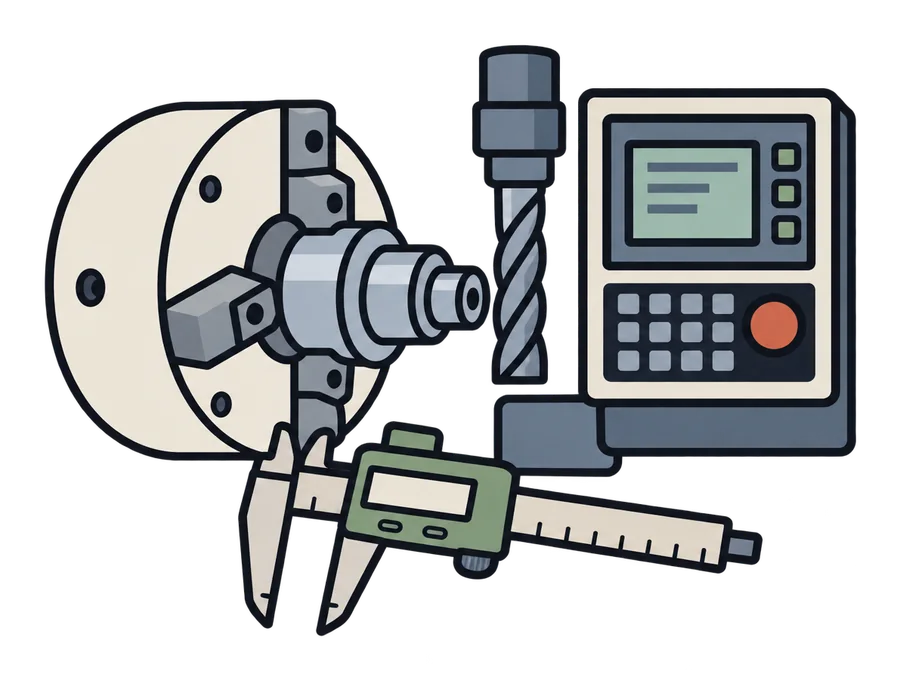
Programs, sets up and runs lathes, milling machines and other machine tools, most of them computer numerically controlled (CNC), and checks that the parts come out to size. The US labour statistics agency expects the work to shift rather than vanish: CNC tool operators are projected to fall 9% to 2035 while CNC programmers grow 6%, because CNC equipment needs programmers instead of people setting up and tending machines. In studies, language models have written working machine code for simple parts but still need an expert to check it, and measurement is moving onto the machine itself. No record yet measures how much unattended machining has spread.
Ask who writes the programs in your shop and whether you could shadow them on one job.
This is not a probability of losing your job. It combines how much of the role's task load is exposed to automation with how far adoption has actually gone — useful for comparing occupations on one consistent basis, and for nothing else.
Written for machinists, CNC machine operators and CNC programmers in metal and plastic parts shops; welders, assembly-line workers and mechanical engineers have their own pages. The evidence is two US labour projections, two studies of language models writing machine code checked in simulation, and one study of measurement on the machine in production; it establishes how official forecasters expect the mix of these jobs to shift and what AI can do in tests, not how many machinists' hours have changed in real shops.
The evidence base holds verified records for other occupations, but not one for this one yet. Until it does, the analysis below is reasoning about task structure and known technical capability — for this job in particular it is not backed by traceable sources, and we would rather say so than cite things we have not verified. An empty section here is a gap in our coverage, not a finding about the work.
What is actually changing#
The unit of analysis is the task, not the job title. A role is not replaced — its task mix shifts.
Each tile is one task. Its size is how much of the job it is; its colour is where the task is heading. Click a tile to see what the judgement does not establish.
Simulation tests on simple parts; they do not show models programming complex parts or being used in real shops.
A projection and the absence of a record; they do not measure how setup work is changing.
A forecast that also names foreign competition; no record measures how far robot loading or unattended machining has spread.
One feature type on one machine family; it is not evidence of how widely in-machine measurement is used.
Is this your job? Say so and this page narrows to your share of it.
A job title is a bundle of tasks bought together, and no two people hold the same bundle. Nothing is sent anywhere — it stays in this browser.
Read all 4 tasks in full — direction, reasoning and limits →
Recent changes#
United States. The statistics bureau projects machinists' employment to grow from 288,300 to 291,200 between 2025 and 2035, 1 percent. It says machinists will be required to set up, monitor and maintain systems such as CNC machine tools, autoloaders and high-speed machining, but their employment growth is expected to be limited as improvements in these technologies increase their efficiency.
A named person with standing publicly predicted something, on a date, in an attributable statement. It is recorded so that who said what, and when, stays checkable — and it never moves a task's assessment, because a prediction is not an observation. Its value arrives later: the record sits on the same page as the evidence about that occupation, so anyone reading the forecast reads the record of what happened next beside it. That is the reckoning; this site publishes no verdict on whether a forecast came true.
United States. The statistics bureau projects CNC tool operators to fall from 170,000 to 154,100 between 2025 and 2035, 9 percent, and CNC tool programmers to grow from 28,600 to 30,300, 6 percent. It says firms keep expanding laborsaving technologies such as CNC tools and robots, that CNC equipment requires CNC tool programmers instead of machine setters, operators and tenders, and it also names foreign competition.
A named person with standing publicly predicted something, on a date, in an attributable statement. It is recorded so that who said what, and when, stays checkable — and it never moves a task's assessment, because a prediction is not an observation. Its value arrives later: the record sits on the same page as the evidence about that occupation, so anyone reading the forecast reads the record of what happened next beside it. That is the reckoning; this site publishes no verdict on whether a forecast came true.
Poland, a production environment. The study evaluates a procedure for measuring pitch diameter with a touch-trigger probe on the CNC machine tool: the error spread was about ±0.015 mm, within the manufacturing tolerance of ±0.07 mm, and the authors call the method reliable for production use, though automatic correction routines may need minor adjustments. One thread type on one machine family.
A demo, benchmark or paper shows the task can be done. Updates what the technology can do — not what employers will do.
Slovenia, a laboratory study. The authors asked ChatGPT-3.5 and GPT-4o to write ISO G-code for a sample part and checked it in simulation: GPT-4o produced fully functional code, while GPT-3.5's code caused a collision. They conclude that GPT-4o cannot yet replace traditional CAM programming, especially for complex operations, and that it still requires expert supervision. One part, simulated, not cut.
A demo, benchmark or paper shows the task can be done. Updates what the technology can do — not what employers will do.
Germany, a software company's study in a peer-reviewed conference's industrial track. Across six G-code tasks for simple shapes, checked against target toolpaths in simulation and averaged over five runs, two models reached about 80 percent success, and structured prompts in which a person had already extracted the parameters reached 100 percent for most tasks. Nothing was cut; the authors build tools of this kind.
A demo, benchmark or paper shows the task can be done. Updates what the technology can do — not what employers will do.
What this means for you#
If you are starting out, expect fewer jobs that only load parts and press start, and more that ask you to program, set up and check the machine. Learn CAM and how to read a model's code critically before trusting it.
Expect tending work to shrink and programming and setup to matter more. Your judgement on fixtures, tools and first parts is what the machines and models still lack.
Your options#
Four directions, each with its real constraints and one thing you can test this week. Continuing as you are is a legitimate choice — it just has to be a chosen one.

Move from running machines to programming them
The US projects CNC programmer jobs to grow while CNC operator jobs fall, because CNC equipment needs programmers.
Programming needs CAM skills and an understanding of tools and materials that takes time to build.
Ask who writes the programs in your shop and whether you could shadow them on one job.

Specialise in setup and first-part work
No record shows setup being automated, and official forecasts still expect machinists to set up and maintain CNC machines.
Setup roles are fewer than operator roles and need broad experience across machines.
List which machines in your shop you can set up alone and which you can only run.
Move into quality and metrology
As measurement moves onto the machine and into software, shops need people who can set up probing and judge measurement results.
Metrology roles often expect training on coordinate measuring machines and quality systems.
Find out whether your shop's machines have probes and who sets up the measuring cycles.
Common questions#
Not on present evidence, but the job is shifting. The US projects CNC operator jobs to fall and CNC programmer jobs to grow, and language models can write simple machine code only under expert supervision.
We do not answer that with a number of years. Watch whether your shop adds robot loading or runs machines unattended overnight, and whether programming moves to fewer people. Those tell you more than any date.
For simple parts, in tests. A peer-reviewed study found GPT-4o produced working G-code for a sample part checked in simulation, but the authors say it cannot yet replace CAM programming for complex operations and still needs an expert to check it.
It depends on which part of the job. US projections to 2035 have CNC programmers growing 6% and CNC operators falling 9%, with machinists overall roughly flat; programming and setup look stronger than tending machines.
What these judgements rest on#
0 of 4 task judgements on this page are backed by a verified event and 4 are platform inference, each labelled where it appears. Behind them sit 3 technology dimensions, a reconstructed trajectory since language models reached the public, and 5 verified events.
See which technologies, how it got here, and the method →
Where it sits in the official classification: skills, knowledge, related jobs →
Other roles in the same function#
A company divides its work into functions before it divides it into jobs. These sit in Core delivery (industry-specific) alongside this one — a fact about org charts, not a judgement that they are similar or that they are changing in the same direction.
Content moderator · Registered nurse · Radiologist · Pathologist · Radiographer / radiologic technologist · General practitioner / primary care doctor · Surgeon · Anaesthesiologist / anaesthetist · Respiratory therapist · Optometrist · Care worker / nursing assistant · Counsellor / psychotherapist · Psychologist · Dietitian / nutritionist · Pharmacist · Pharmacy technician · School teacher · Driving instructor · University lecturer · Chef / cook · Electrician · Plumber · HVAC technician · Architect · Building inspector · Drafter / CAD technician · Interior designer · Civil / structural engineer · Land surveyor · Urban planner · GIS analyst / cartographer · Electrical engineer · Chip design engineer · Mechanical engineer · Industrial engineer · Quantity surveyor · Journalist · Editor and proofreader · Translator / Interpreter · Interpreter · Retail cashier / shop assistant · Bank teller · Medical assistant / clinic assistant · Waiter / restaurant server · Bartender / barista · Hairdresser / barber · Construction worker · Bricklayer / blocklayer · Carpenter / joiner · Auto mechanic / vehicle technician · Medical laboratory technician · Physiotherapist / rehabilitation therapist · Massage therapist · Firefighter · Paramedic / EMT · Police officer · Emergency dispatcher · Farmer · Gardener / landscaper · Social worker · Dentist · Dental hygienist · Veterinarian · Librarian · Welder · Sonographer