 LO
LO
Get told when a verified record lands on this occupation → · Mark which of these tasks are yours (VOLO Pro, free during the launch) →
Phlebotomist
Draws blood from veins and fingertips for tests and donations: checking the patient's identity and the order, drawing the sample, labelling and handling the tubes, and keeping anxious or fainting patients safe. In August 2026 the US FDA authorised the first autonomous blood-drawing robot, for adult outpatients and monitored by a trained phlebotomist who may supervise up to three devices; in its trial it succeeded on the first stick 94.5% of the time when it could find a vein, but no commercial use has yet been recorded. Fingerstick devices now let pharmacy staff collect some samples, and bedside label printing is spreading slowly. The US projects 7% growth.
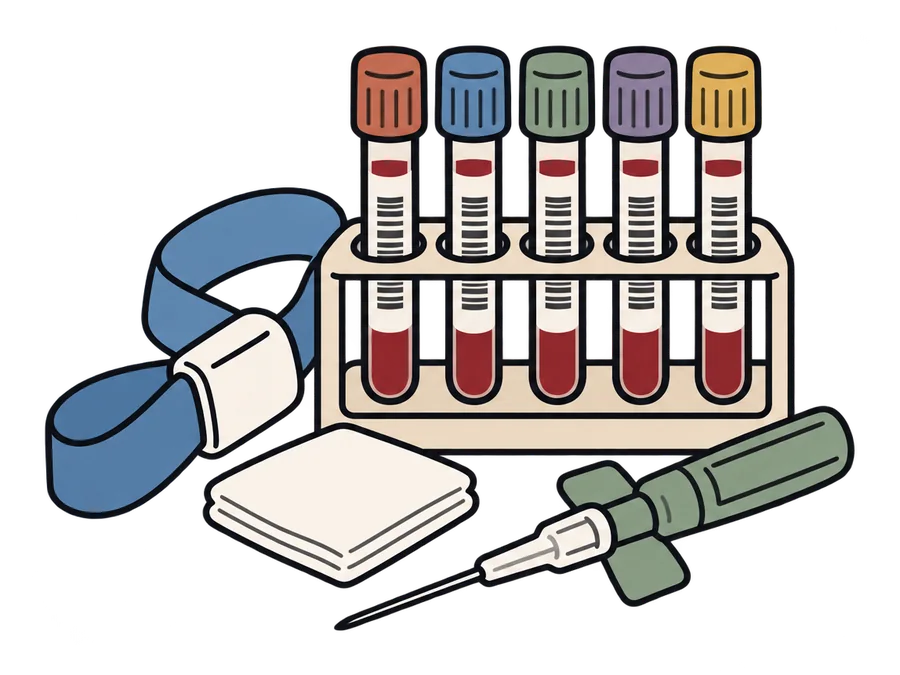
Ask whether your employer is evaluating automated venipuncture and what role phlebotomists would have in it.
This is not a probability of losing your job. It combines how much of the role's task load is exposed to automation with how far adoption has actually gone — useful for comparing occupations on one consistent basis, and for nothing else.
Written for phlebotomists and phlebotomy technicians in hospitals, clinics and laboratories; laboratory technicians and medical assistants, who also draw blood in many places, have their own pages. The evidence is a US regulator's authorisation of an autonomous blood-drawing robot and the manufacturer's trial, a UK national audit of sample labelling, a US clearance of a fingerstick device for non-phlebotomists and a US labour projection; it establishes what a robot is allowed and able to do and how labelling is changing, not how many phlebotomists' jobs or hours have changed.
What is actually changing#
The unit of analysis is the task, not the job title. A role is not replaced — its task mix shifts.
Each tile is one task. Its size is how much of the job it is; its colour is where the task is heading. Click a tile to see what the judgement does not establish.
One national audit in the UK, observational; it does not measure staff time or adoption elsewhere.
An authorisation and a manufacturer-run trial in adult outpatients; no commercial use has been recorded, and children, inpatients and difficult cases are outside it.
Inferred without a record on specimen handling; laboratory automation is covered on the laboratory technician's page.
Read from one authorisation; it does not show how patients or phlebotomists experience robot draws in practice.
Is this your job? Say so and this page narrows to your share of it.
A job title is a bundle of tasks bought together, and no two people hold the same bundle. Nothing is sent anywhere — it stays in this browser.
Read all 4 tasks in full — direction, reasoning and limits →
Recent changes#
United States. The statistics bureau projects phlebotomists to grow from 143,900 to 153,700 between 2025 and 2035, 7 percent, with about 18,000 openings a year. It says the growing and ageing population will keep increasing demand for blood tests, so demand for phlebotomists will remain high. It does not mention robots or automation; the projection was made before any US use of a blood-drawing robot.
A named person with standing publicly predicted something, on a date, in an attributable statement. It is recorded so that who said what, and when, stays checkable — and it never moves a task's assessment, because a prediction is not an observation. Its value arrives later: the record sits on the same page as the evidence about that occupation, so anyone reading the forecast reads the record of what happened next beside it. That is the reckoning; this site publishes no verdict on whether a forecast came true.
United States. The regulator granted De Novo classification for a device intended to perform autonomous, ultrasound-guided venipuncture and blood collection for diagnostic purposes in adult outpatients, monitored by a trained phlebotomist; one phlebotomist may supervise up to three devices at once. Its labelling must state the expected rate of referral to manual phlebotomy, and its testing must include subgroups such as skin tone and difficult venous access. A marketing authorisation, not evidence of use.
A demo, benchmark or paper shows the task can be done. Updates what the technology can do — not what employers will do.
Netherlands, outpatient departments. In 1,633 patients, the device's first-stick success rate was 94.5 percent among patients in whom it could identify a suitable vein, and remained high in patients with difficult venous access, obesity and age 65 or over; adverse events, all mild, occurred in 0.6 percent. The success rate excludes patients the device referred back to manual phlebotomy. The first author works for the manufacturer.
A demo, benchmark or paper shows the task can be done. Updates what the technology can do — not what employers will do.
United Kingdom, NHS hospital sites. The audit found 23 percent of sites could print a sample label at the patient's side, up from 2012; the six sites using only electronic labelling had a 46.9 percent lower sample rejection rate than sites using only hand-labelling but still reported wrong blood in tube incidents. Observational; electronic systems help but need careful implementation and training.
An employer has put it into production. Can move the baseline — weighted by scale and how similar the setting is.
United States. The clearance's summary says the system standardises capillary collection so that users trained on the device, who may not otherwise have been trained in phlebotomy, can collect fingerstick samples, for use by trained healthcare workers in settings such as retail pharmacies and clinics. This moves some collection to other staff rather than automating it; the summary is written by the manufacturer and filed with the regulator.
A demo, benchmark or paper shows the task can be done. Updates what the technology can do — not what employers will do.
What this means for you#
If you are starting out, expect to meet machines that do part of the needle work in some outpatient clinics, and electronic labelling at the bedside. Build what they do not cover: difficult veins, children, inpatients, calming patients and checking every tube.
Expect some draws to move to supervision of devices and some fingerstick work to move to pharmacy staff. Difficult cases and patient safety stay with you.
Your options#
Four directions, each with its real constraints and one thing you can test this week. Continuing as you are is a legitimate choice — it just has to be a chosen one.
Learn to supervise automated blood draws
The first authorised blood-drawing robot must be monitored by a trained phlebotomist, who may supervise up to three devices.
The device is authorised for adult outpatients in the US and is not yet in commercial use.
Ask whether your employer is evaluating automated venipuncture and what role phlebotomists would have in it.
Specialise in difficult draws, children and inpatients
These are outside the robot's authorisation, and the device must refer patients it cannot handle back to manual phlebotomy.
Paediatric and inpatient work may need extra training and is concentrated in hospitals.
Find out whether your hospital has a difficult-access or paediatric phlebotomy team and how to join it.
Move into specimen quality and laboratory support
Labelling errors still occur even with electronic systems, so services need people who own sample quality between the patient and the laboratory.
Laboratory roles often require further qualifications.
Check how your service tracks rejected or mislabelled samples and who follows them up.
Common questions#
Not on present evidence. The first blood-drawing robot was authorised in the US in August 2026 for adult outpatients, and only with a trained phlebotomist monitoring it, up to three devices each; no commercial use has yet been recorded, and the US projects 7% growth for the job.
We do not answer that with a number of years. Watch whether blood-drawing robots move from authorisation into clinics, how often they refer patients back to people, and whether their use extends beyond adult outpatients. Those tell you more than any date.
In the manufacturer's trial of 1,633 patients, it succeeded on the first stick 94.5% of the time when it could find a suitable vein, with mild adverse events in 0.6% of patients. It does not attempt a draw when it cannot find a vein, and those patients go back to a phlebotomist.
The US labour statistics agency projects 7% growth from 2025 to 2035 because an ageing population needs more blood tests, and does not mention robots. Difficult draws, children and patient care are outside what the first robot is allowed to do.
What these judgements rest on#
2 of 4 task judgements on this page are backed by a verified event and 2 are platform inference, each labelled where it appears. Behind them sit 2 technology dimensions, a reconstructed trajectory since language models reached the public, and 5 verified events.
See which technologies, how it got here, and the method →
Where it sits in the official classification: skills, knowledge, related jobs →
Other roles in the same function#
A company divides its work into functions before it divides it into jobs. These sit in Core delivery (industry-specific) alongside this one — a fact about org charts, not a judgement that they are similar or that they are changing in the same direction.
Content moderator · Registered nurse · Midwife · Radiologist · Pathologist · Radiographer / radiologic technologist · General practitioner / primary care doctor · Surgeon · Anaesthesiologist / anaesthetist · Respiratory therapist · Optometrist · Care worker / nursing assistant · Counsellor / psychotherapist · Psychologist · Dietitian / nutritionist · Pharmacist · Pharmacy technician · School teacher · Driving instructor · University lecturer · Chef / cook · Electrician · Plumber · HVAC technician · Architect · Building inspector · Drafter / CAD technician · Interior designer · Civil / structural engineer · Land surveyor · Urban planner · GIS analyst / cartographer · Electrical engineer · Chip design engineer · Mechanical engineer · Industrial engineer · Quantity surveyor · Journalist · Editor and proofreader · Translator / Interpreter · Interpreter · Retail cashier / shop assistant · Bank teller · Medical assistant / clinic assistant · Waiter / restaurant server · Bartender / barista · Hairdresser / barber · Construction worker · Bricklayer / blocklayer · Carpenter / joiner · Auto mechanic / vehicle technician · Medical laboratory technician · Physiotherapist / rehabilitation therapist · Speech-language pathologist / speech and language therapist · Occupational therapist · Massage therapist · Firefighter · Paramedic / EMT · Police officer · Emergency dispatcher · Farmer · Gardener / landscaper · Social worker · Dentist · Dental hygienist · Veterinarian · Librarian · Welder · Machinist / CNC machinist · Sonographer