 LO

Game developer and designer
Designs and builds video games: inventing mechanics, missions and puzzles and balancing them, prototyping in a game engine, writing the documents and text the team and players read, and steering artists, programmers and producers towards one vision. The change is uneven. Code assistants and asset generators make prototypes, design documents and bulk game text much cheaper, and that falls hardest on entry-level work; deciding what is fun, testing it on real players and leading the team stay with people, and many players and publishers still push back against generated content in finished games.
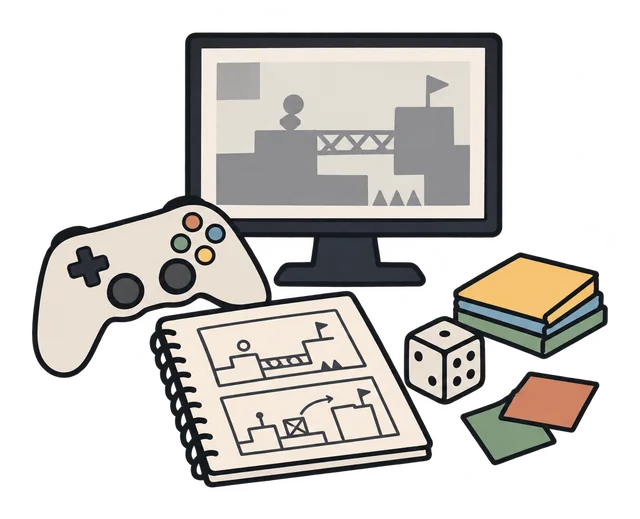
Take one mechanic you designed, build the smallest playable version of it, have three people play it, and write down where each one got stuck or bored.
This is not a probability of losing your job. It combines how much of the role's task load is exposed to automation with how far adoption has actually gone — useful for comparing occupations on one consistent basis, and for nothing else.
Written for people who design and build video games — game, level, systems and narrative designers and gameplay programmers, in studios of any size or working independently, wherever games are made. Illustrators and concept artists, animators, voice actors and software testers have their own pages, and general programming work is covered by the software developer pages. Judgements marked as platform inference reason from what each task is made of and from what current technology does in general; they are not measurements of this occupation.
The evidence base holds verified records for other occupations, but not one for this one yet. Until it does, the analysis below is reasoning about task structure and known technical capability — for this job in particular it is not backed by traceable sources, and we would rather say so than cite things we have not verified. An empty section here is a gap in our coverage, not a finding about the work.
Get told when a verified record lands on this occupation → · Mark which of these tasks are yours (VOLO Pro, free) → · For a team or a graduating class →
What is actually changing#
The unit of analysis is the task, not the job title. A role is not replaced — its task mix shifts.
Each tile is one task. Its size is how much of the job it is; its colour is where the task is heading. Click a tile to see what the judgement does not establish.
This says who decides, not how many designers a studio needs: if tools let each designer explore ideas faster, a team can stay the same size and make more, or shrink. Evidence that would move it: a released commercial game whose core mechanics were chosen by a generative system with designers only reviewing, or studios cutting design roles and naming such tools as the reason.
Faster tuning shortens the work without saying who loses the hours: outside test groups and junior tuning roles are likelier to feel it than the lead designer. The judgement would move if studios shipped balance changes decided by automated agents without a designer's sign-off, or replaced sessions with real players by simulated ones.
Augmenting can still mean fewer people: if one developer can prototype what used to take several, entry-level programming and greyboxing jobs are the first to thin out. Generated assets here are mostly placeholders; this does not say they reach a finished game. A dated case of a studio releasing a game whose code or levels were mostly generated, or cutting prototyping staff because of these tools, would move this towards automating.
This removes hours, not a role: few people are hired only to write design documents, so the effect shows as designers spending less time on paperwork, or as fewer junior designers whose first job was keeping documents current. It would move back if studios found generated documents drifting from what was actually built often enough to stop using them.
There is a split inside this task: bulk text may move to automating while the main story stays with people, and this judgement covers both. It does not say how many writing jobs remain. A dated release in which most of the text was generated at scale and players accepted it, or a change in the rules on owning generated text, would move this.
Human-led says the coordinating role survives, not how many coordinators: if teams shrink because building is faster, fewer people are needed to lead them. It would change if studios began running production with automated planning tools that make scheduling and cut decisions which leads only approve.
A new task is not a new job: in most studios it is part of an existing designer's or lead's week, and it grows only as far as generated content actually ships. It would grow into roles of its own if platform holders or rules began requiring games to disclose generated content and keep provenance records.
Is this your job? Say so and this page narrows to your share of it.
A job title is a bundle of tasks bought together, and no two people hold the same bundle. Nothing is sent anywhere — it stays in this browser.
Read all 7 tasks in full — direction, reasoning and limits →
Recent changes#
No verified events recorded yet.
This section will fill from the monitoring pipeline as events are collected, de-duplicated, graded and linked to the tasks above. An empty list here means we have not verified anything — it does not mean nothing is happening.
"We found no news" is not the same as "you are safe."
What this means for you#
If you are starting out, expect the entry tasks — documentation, greyboxing, placeholder content, simple scripting — to be the ones tools take first, which makes a first job harder to get. Show the judgement tools lack: a small playable game, with notes on what you changed after watching people play it.
Expect your team to make more with the same people, or the same with fewer. Your value sits in deciding what is fun, reading playtests and holding a team to one vision; find out how the tools fail in your engine so you can judge what they produce.
Your options#
Four directions, each with its real constraints and one thing you can test this week. Continuing as you are is a legitimate choice — it just has to be a chosen one.

Stay, and own the decisions about what is fun
Deciding whether a mechanic works, and proving it with real players, is the part of the job current tools do not do.
Senior design roles are few and usually follow years of shipped work; studios hire in cycles and often cut staff after a release.
Take one mechanic you designed, build the smallest playable version of it, have three people play it, and write down where each one got stuck or bored.

Become the technical designer who runs the tools
Studios that bring code assistants and generators into the pipeline need someone who knows both design and the engine to set them up, check their output and set the rules for what ships.
It needs scripting and engine knowledge; the tools change quickly, and studios differ in what they allow in a finished game.
Rebuild one small feature you already made, this time with a code assistant; log the time and every error you had to fix, and compare with your first build.
Take game design to simulation, training and learning products
Training simulations, learning apps and engagement features in ordinary software use the same skills — designing systems, feedback and difficulty — outside the hit-driven games market.
Pay and creative freedom are often lower than in games, and employers expect you to know their field.
Find three job postings for simulation, training or learning-product design and list which of their requirements you meet and which you do not.
Common questions#
Not as a whole job, but it is changing what the job is made of. Tools already make prototypes, design documents and bulk game text cheaper, and that falls hardest on entry-level work. Deciding what is fun, testing it with real players and leading a team stay with people, and many players and publishers push back against generated content in finished games.
We do not answer that with a number of years. Watch two things: whether studios start shipping games whose code, levels or text were mostly generated and players accept them, and whether entry-level design and programming openings keep shrinking while senior ones hold. That tells you more than any date.
Writing design documents and test specifications, scripting common game logic, making placeholder art and rough levels, and drafting bulk text such as item descriptions. Deciding mechanics, reading playtests and leading the team are the least exposed.
Generators can produce simple playable games and many of the parts of a larger one, but a game people pay for needs someone to decide what it is, test whether it is fun and fix what the tools get wrong. What is changing is how few people it takes to make a game, not whether anyone is needed.
The craft is less exposed than the way into it. Studios still need people who can judge fun and lead teams, but the junior tasks that used to train them are the ones tools take first, so a portfolio of finished, playtested games matters more than it did.
What these judgements rest on#
0 of 7 task judgements on this page are backed by a verified event and 7 are platform inference, each labelled where it appears. Behind them sit 2 technology dimensions, a reconstructed trajectory since language models reached the public, and 0 verified events.
See which technologies, how it got here, and the method →
Where it sits in the official classification: skills, knowledge, related jobs →
Other roles in the same function#
A company divides its work into functions before it divides it into jobs. These sit in Product & design alongside this one — a fact about org charts, not a judgement that they are similar or that they are changing in the same direction.